Biology:Paranephrops planifrons
| Paranephrops planifrons | |
|---|---|
.jpg)
| |
Invalid status (NZ TCS)
| |
Scientific classification 
| |
| Kingdom: | Animalia |
| Phylum: | Arthropoda |
| Class: | Malacostraca |
| Order: | Decapoda |
| Suborder: | Pleocyemata |
| Family: | Parastacidae |
| Genus: | Paranephrops |
| Species: | P. planifrons
|
| Binomial name | |
| Paranephrops planifrons White, 1842
| |

| |
| Synonyms | |
| |
Paranephrops planifrons or northern kōura is a species of southern crayfish in the family Parastacidae. It is found in New Zealand.[2][1] P. planifrons is one of two indigenous species of freshwater crayfish found in New Zealand. They are more commonly found in the North Island and the West Coast of the South Island while the P. zealandicus is found in the east and south of the South Island. Both species of Paranephrops are important resources to the indigenous Māori, particularly in the Te Arawa and Lake Taupō regions.[3]
Taxonomy
Paranephrops planifrons was first described in taxonomic literature in 1842 by Scottish zoologist Adam White from specimens collected from Waihou River (then called Thames River) in the North Island.[4] The species has been redescribed numerous times, but was most recently revised in 1970. The holotype specimen is stored in the Natural History Museum of London.[5]
Eytmology
Paranephrops planifrons is commonly known as the northern crayfish or northern kōura in English, though its more specific name is the North Island freshwater crayfish. In the indigenous Māori language, it has several names: karawai (a generic term),[6] kēkēwai,[7] kēwai[8] koeke[9] and kōura (also a generic term).[10]
Description
Paranephrops planifrons is smaller than the southern kōura, Paranephrops zealandicus, and has front claws that are less hairy.[11]
Conservation status
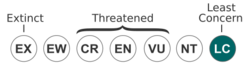
The International Union for Conservation of Nature's conservation status of P. planifrons is "least concern", with no immediate threat to the species' survival.[1] Likewise, the New Zealand Threat Classification System lists the species as "Not Threatened".[12]
References
- ↑ 1.0 1.1 1.2 Parkyn, S. (2010). "Paranephrops planifrons". IUCN Red List of Threatened Species 2010. doi:10.2305/IUCN.UK.2010-3.RLTS.T153750A4540571.en. https://www.iucnredlist.org/species/153750/4540571. Retrieved 11 November 2021.
- ↑ "Paranephrops planifrons". https://www.gbif.org/species/5178536.
- ↑ Kusabs, Ian A.; Hicks, Brendan J.; Quinn, John M.; Hamilton, David P. (2015). "Sustainable management of freshwater crayfish (kōura, Paranephrops planifrons) in Te Arawa (Rotorua) lakes, North Island, New Zealand.". Fisheries Research 168: 35–46. doi:10.1016/j.fishres.2015.03.015. https://www.sciencedirect.com/science/article/pii/S0165783615001058. Retrieved 2020-03-03.
- ↑ White, A (1843). "Description of an orthopterous insect, and two new species of Crustacea, from New Zealand: in the collection of the British Museum". The zoological miscellany: to be continued occasionally. London: Treuttel, Wurtz and Co., G.B. Sowerby, W. Wood. pp. 78–79. doi:10.5962/bhl.title.113722. https://www.biodiversitylibrary.org/page/49831441.
- ↑ Hopkins, C L (1970). "Systematics of the New Zealand freshwater crayfish Paranephrops (Crustacea: Decapoda: Parastacidae)" (in en). New Zealand Journal of Marine and Freshwater Research 4 (3): 278–291. doi:10.1080/00288330.1970.9515347. ISSN 1175-8805. https://onlinelibrary.wiley.com/doi/abs/10.1080/00288330.1970.9515347.
- ↑ Template:Māori Dictionary
- ↑ Template:Māori Dictionary
- ↑ Template:Māori Dictionary
- ↑ Template:Māori Dictionary
- ↑ Template:Māori Dictionary
- ↑ , Wikidata Q114871191
- ↑ "NZTCS". https://nztcs.org.nz/assessments/109277.
Further reading
- Hobbs, Horton H. Jr. (1989). "An Illustrated Checklist of the American Crayfishes (Decapoda: Astacidae, Cambaridae, and Parastacidae)". Smithsonian Contributions to Zoology (480): 1–236. doi:10.5479/si.00810282.480. https://repository.si.edu/bitstream/handle/10088/5542/SCtZ-0480-Lo_res.pdf?sequence=2&isAllowed=y.
- Nizinski, Martha S. (2003). "Annotated checklist of decapod crustaceans of Atlantic coastal and continental shelf waters of the United States". Proceedings of the Biological Society of Washington 116 (1): 96–157. ISSN 0006-324X. https://research.nhm.org/pdfs/12091/12091.pdf.
Wikidata ☰ Q4485277 entry
 |  |


