Biology:Parasitiformes
Parasitiformes are a superorder of Arachnids, constituting one of the two major groups of mites, alongside Acariformes.[1][2][3][4][5] Parasitiformes has, at times, been classified at the rank of order or suborder.[6][7][8][9][10][11]
It is uncertain whether Parasitiformes and Acariformes are closely related, and in many analyses they are recovered more closely related to other arachnids.[3][12] Amongst the best known members of the group are the ticks, though the Mesostigmata is by far the most diverse group with over 8,000 described species, including economically important species such as the varroa mite.
Description
They are distinguished from the Acariformes by the absence of actinochitin and trichobothria. Non-opiloacarid parasitiforms lack visible segmentation and a dorsal transversal groove dividing the body, and possess sclerotized plates covering the anal opening, as well as a ring around the gnathosoma.[13][14] The sperm transfer is considered indirect as it relies on a spermatophore instead of a penis.[13]
Evolutionary history
The oldest known fossils of Parasitiformes, representing three out of the four modern groups, Ixodida, Mesostigmata, and Opilioacarida, are known from Cretaceous aged amber, dating to around 100 million years ago.[15][16][17] They are suspected to have diversified substantially earlier. The genetic divergence between the groups is less than that of Acariform mites, suggesting a younger origin, likely dating to the late Paleozoic.[18]
Taxonomy
- Holothyrida - small group of scavenging mites native to former Gondwana landmasses
- Ixodida – ticks
- Mesostigmata – a large order of predatory and parasitic mites
- Opilioacarida – a small group of large, long-legged segmented mites.
Many species are parasitic (most famous of which are ticks), but not all. For example, about half of the 10,000 known species in the suborder Mesostigmata are predatory and cryptozoan, living in soil-litter, rotting wood, dung, carrion, nests or house dust. A few species have switched to grazing on fungi or ingesting spores or pollen. Phylogenetic relationships of the groups, after Klompen, 2010:[19]
| |||||||||||||||||||||||||||||||
The phytoseiid mites, which account for about 15% of all described Mesostigmata are used with great success for biological control.
The group may also be referred to as Anactinotrichida when the name Parasitiformes is restricted to the non-opilioacarid orders.[20]
Gallery
-
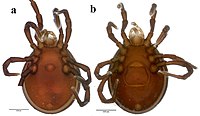 Ventral views of male (left) and female (right) of Diplothyrus lecorrei (Holothyrida, Neothyridae)
 -
 Specimen of Opilioacarus baeticus (Opilioacarida)
 -

-
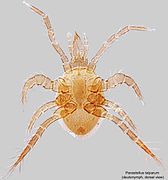 Specimen of Parasitellus (Mesostigmata, Parasitidae)
 -
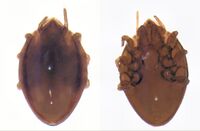
-
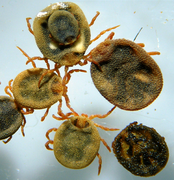 Specimens of Nuttalliella (Ixodida, Nuttalliellidae)

.png)
.jpg)


References
- ↑ Beaulieu, Frédéric (2011). "Superorder Parasitiformes: In: Zhang, Z-Q. (ed.) Animal biodiversity: an outline of higher-level classification and survey of taxonomic richness". Zootaxa 3148. doi:10.11646/zootaxa.3148.1.23. ISBN 978-1-86977-849-1. ISSN 1175-5326. https://www.mapress.com/zootaxa/list/2011/3148.html.
- ↑ "Parasitiformes Report". https://www.itis.gov/servlet/SingleRpt/SingleRpt?search_topic=TSN&search_value=82758.
- ↑ 3.0 3.1 Arribas, Paula; Andújar, Carmelo; Moraza, María Lourdes; Linard, Benjamin et al. (2019). "Mitochondrial Metagenomics Reveals the Ancient Origin and Phylodiversity of Soil Mites and Provides a Phylogeny of the Acari". Molecular Biology and Evolution 37 (3): 683–694. doi:10.1093/molbev/msz255. PMID 31670799. https://academic.oup.com/mbe/article/37/3/683/5610533.
- ↑ Acarorum Catalogus VI, Order Mesostigmata. Pensoft. 2020. doi:10.3897/ab.e54206. ISBN 978-619-248-006-6. https://ab.pensoft.net/book/54206/.
- ↑ Castilho, Raphael de Campos; Moraes, Gilberto; Halliday, R. B. (2012). "Catalogue of the mite family Rhodacaridae Oudemans, with noyes on the classification of the Rhodacaroidea (Acari: Mesostigmata)". Zootaxa 3471. doi:10.11646/zootaxa.3471.1.1. https://www.researchgate.net/publication/260290201.
- ↑ Barker, S.C.; Murrell, A. (2004). "Systematics and evolution of ticks with a list of valid genus and species names". Parasitology 129 (7): S15–S36. doi:10.1017/S0031182004005207. PMID 15938503. https://tede.ufrrj.br/jspui/handle/jspui/2545.
- ↑ Evolution of ticks. Klompen, J.S.; Black, W.C.; Keirans, J.E.; Oliver, J.H. Annual Review of Entomology, 1996, Vol.41, pp.141-61
- ↑ John F Anderson, The natural history of ticks, Medical Clinics of North America, Volume 86, Issue 2, March 2002, Pages 205-218
- ↑ Hans Klompen, Mariam Lekveishvili, William C. Black IV, Phylogeny of parasitiform mites (Acari) based on rRNA, Molecular Phylogenetics and Evolution, Volume 43, Issue 3, June 2007, Pages 936-951
- ↑ Lindquist, E.E.; Walter, D.E.; Krantz, G.W. (2009) A manual of Acarology, 3 Edit. Lubbock: Texas Tech, pp. 97-103
- ↑ Schweizer, J. (1949). Die Landmilben des schweizerischen Nationalparks: Teil 1. Liestal: Lüdin.
- ↑ Giribet, Gonzalo (March 2018). "Current views on chelicerate phylogeny—A tribute to Peter Weygoldt" (in en). Zoologischer Anzeiger 273: 7–13. doi:10.1016/j.jcz.2018.01.004. https://linkinghub.elsevier.com/retrieve/pii/S0044523118300044.
- ↑ 13.0 13.1 Ruppert, Edward E.; Fox, Richard S.; Barnes, Robert D. (2004) (in en). Invertebrate Zoology: A Functional Evolutionary Approach (7th ed.). Brooks/Cole. pp. 590-595. ISBN 0-03-025982-7.
- ↑ Brusca, Richard C.; Giribet, Gonzalo; Moore, Wendy (2023) (in en). Invertebrates (4th ed.). New York City: Oxford University Press. ISBN 9780197554418.
- ↑ Joharchi, Omid; Vorontsov, Dmitry D.; Walter, David Evans (2021-09-30). "Oldest determined record of a mesostigmatic mite (Acari: Mesostigmata: Sejidae) in Cretaceous Burmese amber". Acarologia 61 (3): 641–649. doi:10.24349/goj5-BZms. https://www1.montpellier.inrae.fr/CBGP/acarologia/article.php?id=4463.
- ↑ Jason A. Dunlop; Leopoldo Ferreira de Oliveira Bernardi (2014). "An opilioacarid mite in Cretaceous Burmese amber". Naturwissenschaften 101 (9): 759–763. doi:10.1007/s00114-014-1212-0. PMID 25027588.
- ↑ "Ticks parasitised feathered dinosaurs as revealed by Cretaceous amber assemblages". Nature Communications 8 (1): 1924. December 2017. doi:10.1038/s41467-017-01550-z. PMID 29233973. Bibcode: 2017NatCo...8.1924P.
- ↑ Arribas, Paula; Andújar, Carmelo; Moraza, María Lourdes; Linard, Benjamin; Emerson, Brent C; Vogler, Alfried P (2020-03-01). Teeling, Emma. ed. "Mitochondrial Metagenomics Reveals the Ancient Origin and Phylodiversity of Soil Mites and Provides a Phylogeny of the Acari" (in en). Molecular Biology and Evolution 37 (3): 683–694. doi:10.1093/molbev/msz255. ISSN 0737-4038. PMID 31670799. https://academic.oup.com/mbe/article/37/3/683/5610533.
- ↑ Klompen, H. (2010-06-30). "Holothyrids and ticks: new insights from larval morphology and DNA sequencing, with the description of a new species of Diplothyrus (Parasitiformes: Neothyridae)". Acarologia 50 (2): 269–285. doi:10.1051/acarologia/20101970. ISSN 0044-586X. http://www1.montpellier.inra.fr/CBGP/acarologia/article.php?id=1970.
- ↑ "Acari". http://tolweb.org/tree?group=Acari&contgroup=Arachnida.
| Acariformes |
|  | |||||||
|---|---|---|---|---|---|---|---|---|---|
| Parasitiformes |
| ||||||||
Wikidata ☰ Q132756 entry
 |  |


