Biology:Dark-breasted rosefinch
| Dark-breasted rosefinch | |
|---|---|

| |
| Male at 9,800 ft in East Sikkim of the state of Sikkim, India | |

| |
| Female at 6,500 ft in Khangchendzonga National Park, West Sikkim, India | |
Scientific classification 
| |
| Kingdom: | Animalia |
| Phylum: | Chordata |
| Class: | Aves |
| Order: | Passeriformes |
| Family: | Fringillidae |
| Subfamily: | Carduelinae |
| Genus: | Procarduelis Blyth, 1843 |
| Species: | P. nipalensis
|
| Binomial name | |
| Procarduelis nipalensis (Hodgson, 1836)
| |

The dark-breasted rosefinch (Procarduelis nipalensis) is a species of true finch in the monotypic genus Procarduelis. It is found in Bhutan, China, India, Laos, Myanmar, Nepal, Pakistan, Thailand, and Vietnam. Its natural habitats are boreal forests and subtropical or tropical high-altitude shrubland.
Taxonomy
The dark-breasted rosefinch was formerly placed in the genus Carpodacus but was moved Procarduelis based on the results from the phylogenetic analyses of mitochondrial and nuclear DNA sequences.[2][3]
Subspecies
Subspecific variation is mostly clinal, with the plumage becoming darker from west to east.[4] There are between two-three recognised subspecies:[5]
- P. n. nipalensis – Hodgson, 1836: The nominate, it is found in the Himalayas, from Kumaon to Nepal, Sikkim, Bhutan, and southeastern Tibet. Populations from southwestern China, south Tibet, and northern Vietnam are sometimes separated as a distinct subspecies, P. n. intensicolor.
- P. n. kangrae – Whistler, 1939: in the western Himalayas, from Kashmir to Garhwal.
Description
The Dark-breasted rosefinch is a medium-sized finch characterized by sexual dimorphism. Males exhibit a vibrant dark pink plumage with a contrasting lighter throat and eyebrow stripe, while females, in contrast, are a subdued dark brown with conspicuous light-colored wingbars. While superficially resembling the Vinaceous Rosefinch, Dark-breasted rosefinch can be distinguished by the male's unique head pattern and the female's lack of streaking on the underparts, coupled with prominent wingbars.[6]
Its vocalizations include a characteristic wheezy sparrow-like "wheer".[6]
Ecology
This finch is a rather shy and reclusive bird that breeds in shrublands above the tree line and mixed forest with elements of rhododendron. In winter it is seen in forest clearings and agricultural areas. It forages on the ground in pairs or small groups, searching for seeds and berries.[7]
Status
The species has a large range and a large population with stable development and is not believed to be under any substantial threat. Based on these criteria, the International Union for Conservation of Nature (IUCN) categorizes the species as "Least Concern".[1] The global population has not been estimated but it is described as common or fairly common.[8]
Gallery
-
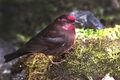 Male at 12,000 ft. from Pangolakha Wildlife Sanctuary, East Sikkim, India
 -
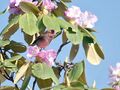 Male at 9,500 ft. in Kullu - Manali District of Himachal Pradesh, India.
 -
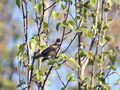 Female at 10,500 ft.in Kullu - Manali District of Himachal Pradesh, India
 -
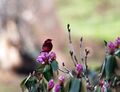 Male at 11,000 ft. in Kullu - Manali District of Himachal Pradesh, India

_I_IMG_3793.jpg)
_I_IMG_3802.jpg)
_I_IMG_7236.jpg)
References
- ↑ 1.0 1.1 BirdLife International (2016). "Procarduelis nipalensis". IUCN Red List of Threatened Species 2016. doi:10.2305/IUCN.UK.2016-3.RLTS.T22720550A94672357.en. https://www.iucnredlist.org/species/22720550/94672357. Retrieved 11 November 2021.
- ↑ Gill, Frank; Donsker, David, eds. "Finches, euphonias". World Bird List Version 5.2. International Ornithologists' Union. http://www.worldbirdnames.org/bow/finches/.
- ↑ Zuccon, Dario; Prŷs-Jones, Robert; Rasmussen, Pamela C.; Ericson, Per G.P. (2012). "The phylogenetic relationships and generic limits of finches (Fringillidae)". Molecular Phylogenetics and Evolution 62 (2): 581–596. doi:10.1016/j.ympev.2011.10.002. PMID 22023825. http://www.nrm.se/download/18.9ff3752132fdaeccb6800010935/Zuccon%20et%20al%202012.pdf. Retrieved 2015-06-08.
- ↑ Clement, Peter (2020-03-04). Del Hoyo, Josep; Elliott, Andrew; Sargatal, Jordi et al.. eds. "Dark-breasted Rosefinch (Procarduelis nipalensis)" (in en). Birds of the World. doi:10.2173/bow.dabros1.01. https://birdsoftheworld.org/bow/species/dabros1/cur/introduction.
- ↑ "Finches, euphonias, longspurs, Thrush-tanager – IOC World Bird List" (in en-US). https://www.worldbirdnames.org/new/bow/finches/.
- ↑ 6.0 6.1 "Dark-breasted Rosefinch" (in en). https://ebird.org/ebird/species/dabros1.
- ↑ Grewal, Bikram, ed (2002). A photographic guide to the birds of India: and the Indian subcontinent, including Pakistan, Nepal, Bhutan, Bangladesh, Sri Lanka & the Maldives. Princeton, NJ: Princeton University Press. ISBN 978-0-691-11496-5.
- ↑ Clement, Peter (1994). Finches & sparrows: an identification guide (Repr ed.). London: Helm. ISBN 978-0-7136-8017-1.
Wikidata ☰ Q27075738 entry
 |  |


