Biology:Psidium guajava
| Common guava | |
|---|---|

| |
| Common guava fruit | |
Scientific classification 
| |
| Kingdom: | Plantae |
| Clade: | Tracheophytes |
| Clade: | Angiosperms |
| Clade: | Eudicots |
| Clade: | Rosids |
| Order: | Myrtales |
| Family: | Myrtaceae |
| Genus: | Psidium |
| Species: | P. guajava
|
| Binomial name | |
| Psidium guajava | |
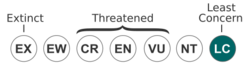
Psidium guajava, the common guava,[2] yellow guava,[2] lemon guava,[2] or apple guava is an evergreen shrub or small tree native to South America. It is pollinated by insects. When cultivated, it is pollinated mainly by the common honey bee, Apis mellifera.
Description
Widely cultivated in tropical and subtropical regions around the world, guava fruits can range in size from as small as an apricot to as large as a grapefruit. Various cultivars have white, pink, or red flesh; a few varieties feature red (instead of green or yellow) skin.
-
 Seedling, 14 months
 -
 Honey bee on a P. guajava flower
 -
 Leaves
 -
 P. guajava fruit
 -
![Red guava[3]](/wiki/images/thumb/8/84/Goiaba_vermelha.jpg/180px-Goiaba_vermelha.jpg) Red guava[3]
Red guava[3]


,_Psidium_guajava.jpg)

![Red guava[3]](/wiki/File:Goiaba_vermelha.jpg)
Chemistry
The leaves of P. guajava contain the flavonol morin, morin-3-O-lyxoside, morin-3-O-arabinoside, quercetin and quercetin-3-O-arabinoside.[4]
Distribution and habitat
Guava is native to Peru.[5] Some sources list it as also native to Mexico, Central America, the Caribbean, and the rest of South America.[2]
It is a perennial tree that grows well under sun or warm temperatures. Therefore, it appears in numerous countries that have tropical or subtropical weather. Guava has a habitat contributing along roadside, grassland, or near sea level to 1,600 metres (5,200 ft) and it is more prevalent in humid grassland.[6]
Ecology
In some tropical locations, guavas can become invasive. It has become a major problem in the Galápagos Islands.[7]
Uses
Guava is an edible fruit, and can be eaten raw or cooked. The processing of the fruits yields by-products that can be fed to livestock. The leaves can also be used as fodder.[8] It is also used by phasmid breeders to feed various stick insect species, including Extatosoma tiaratum, Eurycnema goliath, as well as various leaf insect species such as Pulchriphyllium giganteum, Pulchriphyllium bioculatum, and Phyllium monteithi.[9]
Guava wood from Hawaii is commonly used for the smoking of meat. The wood is resistant to insect and fungal attack. The density of oven-dry wood is about 670 kg/m3 (1,130 lb/cu yd) and has been found suitable for roof trusses in Nigeria.[10]
Psidium guajava has been used in traditional medicine by many cultures throughout Central America, the Caribbean, Africa, and Asia.[11] It is used for inflammation, diabetes, hypertension, caries, wounds, pain relief, fever, diarrhea, rheumatism, lung diseases, and ulcers.[11]
The plant is used in many different shampoo products for its scent. It is also becoming a popular bonsai species and is currently quite popular in India and Eastern Asia.[12]
References
- ↑ Canteiro, C.; Lucas, E. (2019). "Psidium guajava". IUCN Red List of Threatened Species 2019. doi:10.2305/IUCN.UK.2019-1.RLTS.T49485755A49485759.en. https://www.iucnredlist.org/species/49485755/49485759. Retrieved 19 November 2021.
- ↑ 2.0 2.1 2.2 2.3 {{citation | mode = cs1 | title = Psidium guajava | work = Germplasm Resources Information Network (GRIN) | url = | publisher = [[Organization:Agricultural Research ServAgricultural Research Service (ARS), United States Department of Agriculture (USDA) | access-date = February 6, 2009 }}
- ↑ "Taiwan is the world's premier grower of guava". Ministry of Agriculture, Republic of China (Taiwan). https://eng.moa.gov.tw/ws.php?id=9440.
- ↑ Bacteriostatic effect of flavonoids isolated from leaves of Psidium guajava on fish pathogens. Rattanachaikunsopon Pongsak and Phumkhachorn Parichat, Fitoterapia, 2007, volume 78, number 6, pages 434-436, INIST:19087798
- ↑ "Psidium guajava L. | Plants of the World Online | Kew Science" (in en). http://powo.science.kew.org/taxon/urn:lsid:ipni.org:names:600841-1.
- ↑ Arévalo-Marín, Edna; Casas, Alejandro; Landrum, Leslie; Shock, Myrtle P.; Alvarado-Sizzo, Hernán; Ruiz-Sanchez, Eduardo; Clement, Charles R. (2021-09-28). "The Taming of Psidium guajava: Natural and Cultural History of a Neotropical Fruit" (in English). Frontiers in Plant Science 12. doi:10.3389/fpls.2021.714763. ISSN 1664-462X. PMID 34650576.
- ↑ "Forest of daisy trees in Santa Cruz | Wondermondo". 11 March 2012. http://www.wondermondo.com/Countries/SA/Ecuador/Galapagos/ScalesiaSantaCruz.htm.
- ↑ "Guava (Psidium guajava)". 2017. https://www.feedipedia.org/node/111.
- ↑ "Keeping Australian Stick Insects". https://shop.minibeastwildlife.com.au/keeping-australian-stick-insects/#:~:text=Stick%20insects%20feed%20upon%20leaves,,%20Lilly-Pilly%20and%20Guava..
- ↑ "Preliminary Evaluation of Guava (Psidium guajava L.) Tree Branches for Truss Fabrication in Nigeria". https://ecommons.library.cornell.edu/bitstream/1813/10508/1/BC%2005%20010%20Olorunnisola%20final%2017June2006.pdf.
- ↑ 11.0 11.1 Gutiérrez, RM; Mitchell, S; Solis, RV (2008). "Psidium guajava: A review of its traditional uses, phytochemistry and pharmacology". Journal of Ethnopharmacology 117 (1): 1–27. doi:10.1016/j.jep.2008.01.025. PMID 18353572.
- ↑ D'Cruz, Mark. "Ma-Ke Bonsai Care Guide for Psidium guajava". Ma-Ke Bonsai. http://guide.makebonsai.com/bonsai_species_guide_training.asp?SpeciesID=5108&Name=Psidium_guajava.
External links
 Data related to Psidium guajava at Wikispecies

Wikidata ☰ Q166843 entry
 |  |


