Biology:Pterygota brasiliensis
| Pterygota brasiliensis | |
|---|---|

| |
| Pterygota brasiliensis on Saturnino de Brito Street at Unicamp, Campinas, São Paulo, Brazil | |
Scientific classification 
| |
| Kingdom: | Plantae |
| Clade: | Tracheophytes |
| Clade: | Angiosperms |
| Clade: | Eudicots |
| Clade: | Rosids |
| Order: | Malvales |
| Family: | Malvaceae |
| Genus: | Pterygota |
| Species: | P. brasiliensis
|
| Binomial name | |
| Pterygota brasiliensis Allemão
| |

| |
| Confirmed records of P. brasiliensis in Brazil | |
| Synonyms[3][4] | |
| |
Pterygota brasiliensis is a large flowering tree in the mallow family Malvaceae. It is native and endemic to eastern Brazil, where it grows in the Atlantic Forest from Pernambuco to Rio de Janeiro.[3][5] In Brazil, it is known by vernacular names including pau-rei, farinha-seca and maperoá.[lower-alpha 1][6]
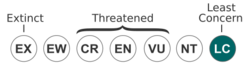
The species usually reaches 20 to 30 m (66 to 98 ft) in height and has a buttressed trunk, broad leathery leaves, scented brown flowers and winged seeds dispersed by wind.[6][7][8] Its wood is used for interior work, and the tree has been recommended for large planted spaces and mixed reforestation plantings.[8] Pterygota brasiliensis is currently listed as Least Concern.[1][2]
Taxonomy and nomenclature
The Brazilian naturalist Francisco Freire Allemão published the name Pterygota brasiliensis in 1862.[9] The species belongs to the genus Pterygota, in the mallow family Malvaceae.[3]
Some older works use the name Basiloxylon brasiliensis, a later combination based on Allemão's species. Basiloxylon rex and Sterculia rex are synonyms of Pterygota brasiliensis.[3][4] The name has caused some confusion in Brazilian material formerly placed under Basiloxylon; recent taxonomic work keeps Allemão's species as Pterygota brasiliensis.[10]
In Brazil, the tree is known by vernacular names including pau-rei, farinha-seca and maperoá.[6]
Description
Pterygota brasiliensis is a large tree, usually reaching 20 to 30 m (66 to 98 ft) in height. The trunk has basal buttresses and is about 50 to 80 cm (20 to 31 in) in diameter. The leaves are leathery and glabrous, measuring 20 to 30 cm (7.9 to 11.8 in) long and 20 to 25 cm (7.9 to 9.8 in) wide, with petioles 12 to 15 cm (4.7 to 5.9 in) long.[6]
The flowers are brown, scented and unisexual. They are radially symmetrical, with free sepals and petals. The ovary is superior and divided into several chambers, with many carpels and axile placentation. The anthers open lengthwise.[7]
The pollen is medium-sized and oblate-spheroidal, with a reticulate exine. The grains are shed singly, have radial symmetry and are isopolar, with a subtriangular outline. They are tricolporate, with short colpi and circular pores.[7]
Distribution and habitat
Pterygota brasiliensis is native and endemic to Brazil. Its range lies in eastern Brazil, from Pernambuco to Rio de Janeiro, with confirmed records in Pernambuco, Espírito Santo, Minas Gerais and Rio de Janeiro.[3][5]
The species is a large tree of the Atlantic Forest and is the only species of Pterygota recorded from Brazil.[5] It grows as a terrestrial, perennial tree in subtropical or tropical moist lowland forest, with collections from several vegetation types associated with the Atlantic Forest.[1]
Ecology
The scented flowers are pollinated by bees, and flowering has been recorded from May to September.[7] The winged seeds are dispersed by wind.[8]
Uses
Pterygota brasiliensis can be grown in large planted spaces, including parks and gardens, where its size and broad crown have room to develop. Its wood is used for interior work, especially ceilings and partitions. The species can also be used in mixed reforestation plantings because it grows quickly and tolerates full sun.[8]
Conservation
Pterygota brasiliensis is listed as Least Concern. Its 2020 conservation status rests on its wide range, recent collections, herbarium records and presence in protected areas. No population-trend data show a decline in mature individuals, and no known uses threaten the species in the wild.[1] Plants of the World Online also lists the species as Least Concern.[2]
More field and population research is still needed, especially on its distribution, population size and population trends.[1]
Gallery
-
 Leaves
 -
 Underside of the leaves
 -
 Fruit
Fruit -
 Fruit
Fruit -
 Seeds
Seeds -
 Trunk
Trunk -

-
 Petiole


Notes
- ↑ Pau-rei can be read literally as "king tree" or "king wood"; farinha-seca means "dry flour". Maperoá is retained as a Brazilian vernacular plant name.
References
- ↑ 1.0 1.1 1.2 1.3 1.4 "Pterygota brasiliensis Allemão" (in pt-BR). Jardim Botânico do Rio de Janeiro. https://proflora.jbrj.gov.br/html/Pterygota%20brasiliensis_2020.html.
- ↑ 2.0 2.1 2.2 "Pterygota brasiliensis Allemão". Royal Botanic Gardens, Kew. https://powo.science.kew.org/taxon/urn:lsid:ipni.org:names:214234-2/general-information.
- ↑ 3.0 3.1 3.2 3.3 3.4 "Pterygota brasiliensis Allemão". Royal Botanic Gardens, Kew. https://powo.science.kew.org/taxon/urn:lsid:ipni.org:names:214234-2.
- ↑ 4.0 4.1 "Pterygota brasiliensis Allemão". https://www.gbif.org/species/3668246.
- ↑ 5.0 5.1 5.2 Fernandes-Júnior, Aluisio José (2020). "Pterygota Schott & Endl." (in pt-BR). Flora do Brasil 2020. Jardim Botânico do Rio de Janeiro. https://monografiasfloradobrasil.jbrj.gov.br/pterygota.pdf.
- ↑ 6.0 6.1 6.2 6.3 Lorenzi, Harri (1992) (in pt). Árvores brasileiras: Manual de identificação e cultivo de plantas arbóreas nativas do Brasil. Nova Odessa, São Paulo: Editora Plantarum. p. 328.
- ↑ 7.0 7.1 7.2 7.3 "Basiloxylon brasiliensis (Allemão) K.Schum." (in Portuguese, English, Spanish). http://chaves.rcpol.org.br/profile/species/eco/eco:pt-BR:Basiloxylon%20brasiliensis.
- ↑ 8.0 8.1 8.2 8.3 "Pterygota brasiliensis" (in pt-BR). https://www.programaarboretum.eco.br/especie/180/folheiro.
- ↑ "Pterygota brasiliensis Allemão". Royal Botanic Gardens, Kew; Harvard University Herbaria & Libraries; Australian National Herbarium. https://www.ipni.org/n/214234-2.
- ↑ Colli-Silva, Matheus; Pirani, José Rubens (28 August 2019). "Notes on the circumscription of Pterygota (Malvaceae, Sterculioideae) with special reference to a Brazilian taxon with a misapplied name". Phytotaxa 415 (2): 103-112. doi:10.11646/phytotaxa.415.2.3.
Further reading
- Colli-Silva, Matheus; Pirani, José Rubens (28 August 2019). "Notes on the circumscription of Pterygota (Malvaceae, Sterculioideae) with special reference to a Brazilian taxon with a misapplied name". Phytotaxa 415 (2). doi:10.11646/phytotaxa.415.2.3.
External links
 Data related to Pterygota brasiliensis at Wikispecies

Wikidata ☰ Q10355382 entry
 |


