Biology:Quercus franchetii
| Zhui lian li evergreen oak | |
|---|---|

| |
Scientific classification 
| |
| Kingdom: | Plantae |
| Clade: | Tracheophytes |
| Clade: | Angiosperms |
| Clade: | Eudicots |
| Clade: | Rosids |
| Order: | Fagales |
| Family: | Fagaceae |
| Genus: | Quercus |
| Subgenus: | Quercus subg. Cerris |
| Section: | Quercus sect. Ilex |
| Species: | Q. franchetii
|
| Binomial name | |
| Quercus franchetii Skan
| |
| Synonyms[2] | |
| |
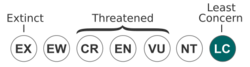
Quercus franchetii, commonly known as the zhui lian li evergreen oak, is a species of oak in the Ilex section of the genus,[3] native to a wide area of eastern Asia. It is an oak native to south-central China (Sichuan and Yunnan), Myanmar, and northern Thailand,[2] growing at elevations between 800 and 2,600 metres (2,600 and 8,500 feet).[4]
Description
In nature, it forms an evergreen tree up to 15 metres (49 feet) high.[4] Sometimes it is shrubby. When older, it has irregular and tortuous branches. The branches are covered with a creamy white, long lasting tomentum. The buds are small, globular with pointed apex, reddish and white ciliated edge.[4]
The leathery oval leaves measure 5 to 12 centimetres (2 to 4 1⁄2 inches) long by 2.5 to 6 cm (1 to 2 1⁄4 in) wide, and are evergreen (remaining on the plant over winter). They have a cuneate (wedge-shaped) or slightly rounded base, and the upper surface is smooth and shiny, while the underside is densely covered with yellowish fur.[4] The leaf margin is dentate, with 5 to 10 pairs of short teeth, though not near the base, and the leaf sits on a 1–2-cm long furry gray-yellow petiole. The fruit is an acorn which measures 0.9–1.1 cm in length by 0.8 cm across; ovoid, apex depressed but mucronate; silky; short peduncle (1.5–3 cm); enclosed two-thirds by cup; cup 0.8–1.1 cm in diameter, scaly; maturing in 1 or 2 years.[4]
Taxonomy
This species was described in 1899 and dedicated to Adrien René Franchet, a botanist at the Muséum national d'histoire naturelle in Paris. Franchet had a few months earlier named and described this species as Q. lanuginosa,[5] but his name turned out to have been used before, so Skan renamed it as Q. franchetii.[6] It is in subgenus Cerris, section Ilex,[7] resembling Q. lanata.
References
- ↑ IUCN SSC Global Tree Specialist Group.; Botanic Gardens Conservation International (BGCI). (2020). "Quercus franchetii". IUCN Red List of Threatened Species 2020. doi:10.2305/IUCN.UK.2020-1.RLTS.T78917520A162853158.en. https://www.iucnredlist.org/species/78917520/162853158. Retrieved 25 May 2023.
- ↑ 2.0 2.1 "Quercus franchetii Skan". Royal Botanic Gardens, Kew. https://powo.science.kew.org/taxon/urn:lsid:ipni.org:names:296163-1.
- ↑ Denk, Thomas; Grimm, Guido W.; Manos, Paul S.; Deng, Min; Hipp, Andrew L. (2017), "An Updated Infrageneric Classification of the Oaks: Review of Previous Taxonomic Schemes and Synthesis of Evolutionary Patterns", in Gil-Pelegrín, Eustaquio; Peguero-Pina, José Javier; Sancho-Knapik, Domingo (in en), Oaks Physiological Ecology. Exploring the Functional Diversity of Genus Quercus L., Cham: Springer International Publishing, pp. 13–38, doi:10.1007/978-3-319-69099-5_2, ISBN 978-3-319-69099-5
- ↑ 4.0 4.1 4.2 4.3 4.4 Huang, Chengjiu; Zhang, Yongtian; Bartholomew, Bruce, "Quercus franchetii", Flora of China, 4, http://www.efloras.org/florataxon.aspx?flora_id=2&taxon_id=200006292, retrieved 5 June 2012
- ↑ Franchet, Adrien René 1899. Journal de Botanique (Morot) 13: 149
- ↑ Skan in Forbes, Francis Blackwell Hemsley, William Botting. 1899. Journal of the Linnean Society, Botany 26(178): 513–514 description in Latin, commentary in English
- ↑ Denk, Thomas; Grimm, Guido W.; Manos, Paul S.; Deng, Min; Hipp, Andrew L. (2017). "Appendix 2.1: An updated infrageneric classification of the oaks" (xls). doi:10.6084/m9.figshare.5547622.v1. https://figshare.com/articles/dataset/Appendix_2_1_________An_updated_infrageneric_classification_of_the_oaks/5547622/1.
External links
Wikidata ☰ Q4111966 entry
 |  |


