Biology:Quercus phillyreoides
| Quercus phillyreoides | |
|---|---|

| |
Scientific classification 
| |
| Kingdom: | Plantae |
| Clade: | Tracheophytes |
| Clade: | Angiosperms |
| Clade: | Eudicots |
| Clade: | Rosids |
| Order: | Fagales |
| Family: | Fagaceae |
| Genus: | Quercus |
| Subgenus: | Quercus subg. Cerris |
| Section: | Quercus sect. Ilex |
| Species: | Q. phillyreoides
|
| Binomial name | |
| Quercus phillyreoides A.Gray
| |
| Synonyms[2] | |
| |
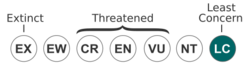
Quercus phillyreoides is a species of flowering plant in the genus Quercus, placed in subgenus Cerris and section Ilex.[3][4] It is evergreen, withstands frost and can be grown in hardiness zone 7. It is native to southern China, the Ryukyu Islands, and Japan, and has been introduced to Korea.[2]
Origin of Name
In Japanese, the common name of Quercus phillyreoides is Ubamegashi. The origin of this name is uncertain. One theory asserts that ubame means 'old woman's eyes' (from uba = ‘old woman’ + me = ‘eye’; gashi = ‘oak’). This supposedly references the yellow-brown color of new leaves on the oak, although the connection to the eyes of old women is unclear.[5] A more widely accepted theory is that the 'me' in ubame derives from a homonym that translates to 'new buds/leaves'.[6]
Uses
The Japanese use Quercus phillyreoides or ubame oak to produce binchōtan, a type of charcoal and a traditional variety of vegetal activated carbon.[7] It has found use as a street tree in a number of European cities.[8]
References
- ↑ Wenzell, K.; Kenny, L. (2020). "Quercus sadleriana". IUCN Red List of Threatened Species 2020. https://www.iucnredlist.org/species/61983039/61983041#assessment-information. Retrieved 21 November 2022.
- ↑ 2.0 2.1 "Quercus phillyreoides A.Gray" (in en). Royal Botanic Gardens, Kew. http://www.plantsoftheworldonline.org/taxon/296588-1.
- ↑ Denk, Thomas; Grimm, Guido W.; Manos, Paul S.; Deng, Min; Hipp, Andrew L. (2017). "Appendix 2.1: An updated infrageneric classification of the oaks" (xls). doi:10.6084/m9.figshare.5547622.v1. https://figshare.com/articles/dataset/Appendix_2_1_________An_updated_infrageneric_classification_of_the_oaks/5547622/1.
- ↑ Denk, Thomas; Grimm, Guido W.; Manos, Paul S.; Deng, Min; Hipp, Andrew L. (2017), "An Updated Infrageneric Classification of the Oaks: Review of Previous Taxonomic Schemes and Synthesis of Evolutionary Patterns", in Gil-Pelegrín, Eustaquio; Peguero-Pina, José Javier; Sancho-Knapik, Domingo, Oaks Physiological Ecology. Exploring the Functional Diversity of Genus Quercus L., Cham.: Springer International Publishing, pp. 13–38, doi:10.1007/978-3-319-69099-5_2, ISBN 978-3-319-69099-5, https://doi.org/10.1007/978-3-319-69099-5_2
- ↑ le Hardÿ de Beaulieu, A. & Lamant, T. (2010). Guide illustré des chênes Edilens, Geer
- ↑ Quercus phillyreoides A.Gray". Plants of the World Online. Royal Botanic Gardens, Kew. Retrieved 12 August 2026.
- ↑ Guichard-Anguis, Sylvie (2011). "Walking through World Heritage Forest in Japan: the Kumano pilgrimage". Journal of Heritage Tourism 6 (4): 285–295. doi:10.1080/1743873X.2011.620114. ISSN 1743-873X.
- ↑ Ossola, Alessandro; Hoeppner, Malin J.; Burley, Hugh M.; Gallagher, Rachael V.; Beaumont, Linda J.; Leishman, Michelle R. (2020). "The Global Urban Tree Inventory: A database of the diverse tree flora that inhabits the world's cities". Global Ecology and Biogeography 29 (11): 1907–1914. doi:10.1111/geb.13169. Bibcode: 2020GloEB..29.1907O.
Wikidata ☰ {{{from}}} entry
 |  |


