Biology:Red-headed bunting
| Red-headed bunting | |
|---|---|

| |
| Female at Timbi Lake | |
Scientific classification 
| |
| Kingdom: | Animalia |
| Phylum: | Chordata |
| Class: | Aves |
| Order: | Passeriformes |
| Family: | Emberizidae |
| Genus: | Emberiza |
| Species: | E. bruniceps
|
| Binomial name | |
| Emberiza bruniceps Brandt, 1841
| |
The red-headed bunting (Emberiza bruniceps) is a passerine bird in the bunting family Emberizidae.
It breeds in central Asia, including Afghanistan, Iran, Kazakhstan, Kyrgyzstan, Mongolia; Russian Federation (European Russia, Central Asian Russia), Tajikistan, Turkmenistan, Uzbekistan and China. It is migratory, wintering in India and Bangladesh. Its status in western Europe, where it is a vagrant, has been confused by escapes, especially as this species has been more commonly recorded than the closely related black-headed bunting, despite the latter having a more westerly breeding range. Reports in Britain have declined dramatically over recent years, coinciding with the decline in some Emberizidae species from the impact of illegal trade. An individual found on Shetland in 2010 was deemed to be wild in origin.[2]
The red-headed bunting breeds in open scrubby areas including agricultural land. It lays three to five eggs in a nest in a tree or bush. Its natural food consists of seeds, or when feeding young, insects.[3]
This bird is 17 cm long, larger than reed bunting, with a long tail. The breeding male has bright yellow underparts, green upperparts and a brownish-red face and breast.
The female is a washed-out version of the male, with paler underparts, a grey-brown back and a greyish head. The juvenile is similar, and both can be difficult to separate from the corresponding plumages of black-headed bunting bird.
The song, given from a high perch, is a jerky sweet-sweet-churri-churri-churri.
Gallery
-
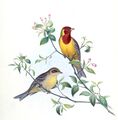 Painting
 -
 Yavatmal, Maharashtra, India.
 -
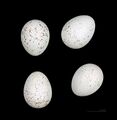 Eggs of Emberiza bruniceps MHNT
 -
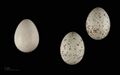 Cuculus canorus canorus in a clutch of Emberiza bruniceps MHNT


References
- ↑ BirdLife International (2017). "Emberiza bruniceps". IUCN Red List of Threatened Species 2017. doi:10.2305/IUCN.UK.2017-1.RLTS.T22720993A111138222.en. https://www.iucnredlist.org/species/22720993/111138222. Retrieved 12 November 2021.
- ↑ Dudley, Steve P.. "Changes to the British List (18 June 2024)" (in en-GB). https://bou.org.uk/british-list/changes-to-the-british-list-18-june-2024/.
- ↑ Copete, José Luis (2020). "Red-headed Bunting (Emberiza bruniceps), version 1.0" (in en). Birds of the World. ISSN 2771-3105. https://birdsoftheworld.org/bow/species/rehbun1/cur/introduction.
- Buntings and Sparrows by Byers, Olsson and Curson, ISBN 1-873403-19-4
Wikidata ☰ Q547159 entry
 |  |


