Biology:Rubus odoratus
| Rubus odoratus | |
|---|---|

| |
| Purple-flowering raspberry cultivated in Denmark | |
Scientific classification 
| |
| Kingdom: | Plantae |
| Clade: | Tracheophytes |
| Clade: | Angiosperms |
| Clade: | Eudicots |
| Clade: | Rosids |
| Order: | Rosales |
| Family: | Rosaceae |
| Genus: | Rubus |
| Subgenus: | Rubus subg. Anoplobatus |
| Species: | R. odoratus
|
| Binomial name | |
| Rubus odoratus | |
| Synonyms[1] | |
|
Synonymy
| |
Rubus odoratus, the purple-flowered raspberry,[2][3] flowering raspberry,[3] or Virginia raspberry, is a species of Rubus native to eastern North America. It is sometimes referred to as thimbleberry,[4][5][6] a name more commonly associated with the North American R. parviflorus.
Description
Rubus odoratus is a shrub growing to 3 metres (10 ft) tall,[2] with perennial, not biennial, stems (unlike many other species in the genus). Also, unlike most related species, this plant does not have thorns.[7] The leaves are palmately lobed with five (rarely three or seven) lobes, up to 25 centimetres (10 in) across, superficially resembling maple leaves.[7]
The flowers are 3–5 cm (1–2 in) in diameter,[2] with five magenta or occasionally white petals; they are produced from early summer to early fall.[7] Maturing in late summer to early autumn, the red edible fruit resembles a large, flat raspberry[7][8] with 30–60 drupelets,[9] and feels rather fuzzy.
-
 Leaves
 -
 Flower buds
 -
 Flowers
 -
 Fruits
 -
 Seeds
Seeds


Distribution and habitat
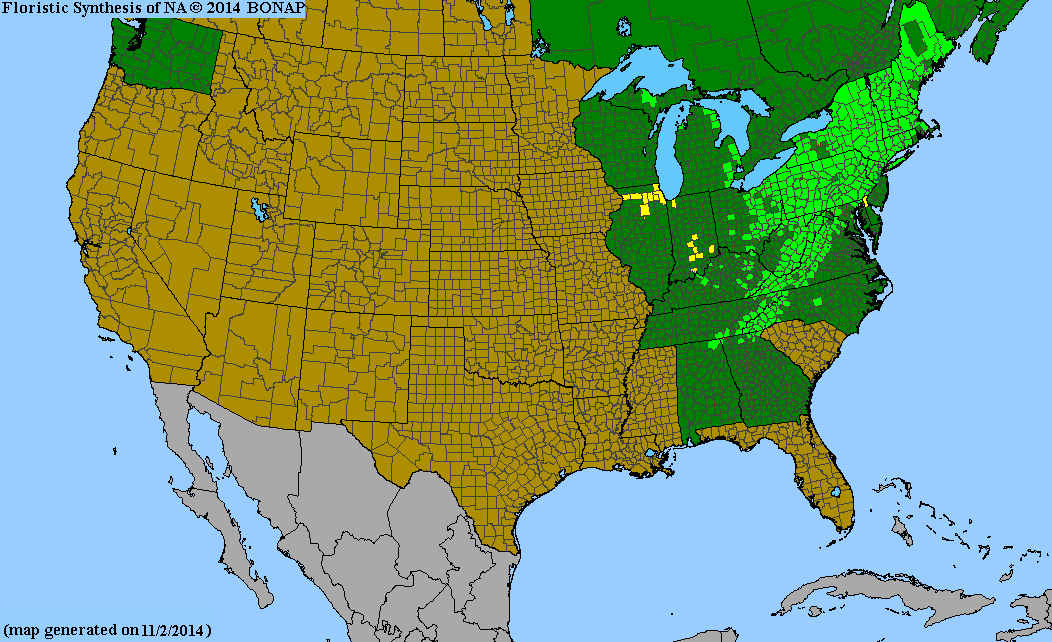
The species is native to eastern North America, from Nova Scotia west to Ontario and Wisconsin, and south along the Appalachian Mountains as far as Georgia and Alabama.[3][10] It is locally naturalized in parts of Washington state,[11] Vermont, and also in Europe, notably southeastern England.[2]
It prefers partial shade,[8] moisture,[9] and rich, slightly acidic soil.
Uses
Rubus odoratus is grown as an ornamental plant[2] for its conspicuous flowers and long flowering period.
The fruits may be edible, but are dry and flavorless.[8][9]
References
- ↑ The Plant List, Rubus odoratus L.
- ↑ 2.0 2.1 2.2 2.3 2.4 Stace, Clive. "Flora of NW Europe > Species: Rubus odoratus (Raspberry, purple-flowered)". in van der Meijden, Ruud; de Kort, Ingrid. http://wbd.etibioinformatics.nl/bis/flora.php?selected=beschrijving&menuentry=soorten&id=2607.
- ↑ 3.0 3.1 3.2 {{citation | mode = cs1 | title = Rubus odoratus | work = Germplasm Resources Information Network (GRIN) | url = | publisher = [[Organization:Agricultural Research ServAgricultural Research Service (ARS), United States Department of Agriculture (USDA) | access-date = 12 January 2018 }}
- ↑ "Rubus odoratus — flowering raspberry". https://gobotany.nativeplanttrust.org/species/rubus/odoratus/.
- ↑ "Rubus odoratus | flowering raspberry". https://www.rhs.org.uk/plants/16141/rubus-odoratus/details.
- ↑ "Rubus odoratus". University of Texas. https://www.wildflower.org/plants/result.php?id_plant=RUOD.
- ↑ 7.0 7.1 7.2 7.3 "Rubus odoratus". 2001-07-20. http://2bnthewild.com/plants/H47.htm.
- ↑ 8.0 8.1 8.2 Blanchan, Neltje; Dickinson, Asa Don (1917). Wild Flowers Worth Knowing. Project Gutenberg Literary Archive Foundation. https://www.gutenberg.org/cache/epub/8866/pg8866-images.html.
- ↑ 9.0 9.1 9.2 "Rubus odoratus in Flora of North America". http://www.efloras.org/florataxon.aspx?flora_id=1&taxon_id=250100440.
- ↑ "Biota of North America Program 2014 county distribution map". http://bonap.net/MapGallery/County/Rubus%20odoratus.png.
- ↑ "Rubus odoratus". https://plants.usda.gov/home/plantProfile?symbol=RUOD.
External links
Wikidata ☰ Q158365 entry
 |  |