Biology:Rytidosperma buchananii
| Rytidosperma buchananii | |
|---|---|
Scientific classification 
| |
| Kingdom: | Plantae |
| Clade: | Tracheophytes |
| Clade: | Angiosperms |
| Clade: | Monocots |
| Clade: | Commelinids |
| Order: | Poales |
| Family: | Poaceae |
| Genus: | Rytidosperma |
| Species: | R. buchananii
|
| Binomial name | |
| Rytidosperma buchananii (Hook.f.) Connor et Edgar
| |
Rytidosperma buchananii also known as black-striped danthonia is a species of true grass in the subfamily Danthonioideae.[1][2][3] It is endemic to New Zealand and was described in the Handbook of New Zealand Flora as Danthonia buchanani in 1853 by Joseph Dalton Hooker.[4]
Description
R. buchananii grows in loose, dull green tussocks with intravaginal branching. Panicle inflorescences grow on 50-(70) cm culms, with panicle branches closely short-scabrid and the culm minutely scabrid below the inflorescence. The panicle is erect, to 10 cm, made up of several spikelets. The spikelets contain (3)-4-5-(6) florets, with awns slightly exserted from purplish glumes. The florets contain three obvious rows of hairs, one on the callus, and two on the lemmas. The lemma is 2-3-(3.5) mm, with the upper and lower rows of hairs usually sparse between dense marginal tufts. The upper row is shorter than the lemma lobes, the lower row overlaps the upper. The palea is 3-4 mm, around the same length as the upper lemma hairs. The callus is c. 0.5 mm, with hairs much overlapping the lower lemma hairs.[5]
Similar species
R. buchananii is similar to R. thomsonii, in its robust dark coloured spikes. However, R. buchananii has an awn that exceeds the glumes, whereas in R. thomsonii the awn is very short and hardly protrudes past the glumes.[6]
Cytology
Chromosome counts of both 2n = 36, 2n=48, and 2n = c. 72 have been recorded in R. buchananii.[7]
Distribution
R. buchananii is endemic to New Zealand. In the North Island, it is found in the central mountains and Ruahine range.[8][6] In the South Island, it is found throughout, largely in mountainous areas, except in Buller and north Westland.[8] It found at sea level in a few places in the North Island, such as in the Rakaunui Scenic Reserve as well as nearby Awaroa Scenic Reserve, both on the Kawhia Harbour, as well as along the east coast of Wellington Region.[6][9]
Unusually, the cold tolerance of R. buchananii is higher than would be expected from its species distribution. Rather than temperature limiting its distribution, the authors suggest that it could be better explained by competition, time or dispersal limitation. For example, cold tolerance appeared to have emerged in Rytidosperma in the Miocene, around the time that Rytidosperma arrived in New Zealand. Cold tolerance may have provided an adaptive advantage in the context of the Southern Alps building for the first time and been conserved after distributions changed for other reasons.[10]
Holotype:
The holotype was collected in Otago by Hector and Buchanan.[11]
Habitat
R. buchananii is normally found in montane and subalpine grasslands, cliffs and rocky sites, but is also sometimes found at rocky sites at lower altitudes.[8]
Ecology
In grazed tussock grasslands, R. buchananii is a preferred species by sheep, suggesting that it may be vulnerable to herbivory.[12] However, at some sites, grazing may limit competition, allowing R. buchananii to exist at higher numbers.[13] Indeed, the removal of grazing at some sites has resulted in decline.[14]
The generalist ergot fungus Claviceps purpurea, which grows black masses of fungal spores on the florets of many grasses, is recorded growing on R. buchananii.[15] A similar smut fungus, Ustilago comburens, is found growing on a variety of Rytidosperma species, including R. buchananii.[16]
R. buchananii is also the host of Sphaerodothella danthoniae, a sac fungus that produces black, shiny leaf spots that occasionally coalesce into straight to irregular lines in the leaf surface of Rytidosperma species.[17][18][19]
Threats
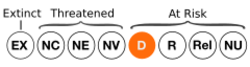
R. buchananii is classified as At Risk - Declining in the New Zealand threat classification system, however, the population trend is poorly known.[20] In Otago, it is also classified as At Risk - Declining, with an estimated 10-30% decline.[21]
Taxonomy
R. buchananii was described in the Handbook of New Zealand Flora as Danthonia buchananii in 1853 by Joseph Dalton Hooker.[22] In 1864, he moved the species to a varietal rank under Danthonia semiannularis as var. breviseta.[23] The species remained at this rank until Russian-New Zealand botanist Victor Zotov reinstated it as a full species, under the name Notodanthonia buchanani.[24]
The genus Notodanthonia was synonymised with Rytidosperma in Nicora (1973), after it was recognised that they referred to the same group.[25] The genus Notodanthonia was only described in 1963 by Zotov, whereas Rytidosperma was described in 1854 by Steudel. As such, the older name Rytidosperma took priority under the International Code of Nomenclature.[25][26]
In 1979, New Zealand botanists Henry Connor and Elizabeth Edgar moved the whole Notodanthonia genus to Rytidosperma, following Nicora (1973), and named the species Rytidosperma buchananii.[26]
Potential segregates
There are several samples of R. buchananii with confirmed chromosome counts of 2n = 36, 2n=48, and 2n = c. 72. This may be evidence of segregates that may warrant recognition as distinct species.[27]
Etymology
Rytidosperma - wrinkled seed
buchananii: Named after John Buchanan (13 October 1819-1898) who was a New Zealand botanist and scientific artist and fellow of the Linnean Society, and collected the holotype of R. buchananii.[28]
References
- ↑ "Flora of New Zealand | Taxon Profile | Rytidosperma buchananii". https://www.nzflora.info/factsheet/Taxon/Rytidosperma-buchananii.html.
- ↑ Connor, H. E.; Edgar, E. (1979). "Rytidosperma Steudel (Notodanthonia Zotov) in New Zealand" (in en). New Zealand Journal of Botany 17 (3): 311–337. doi:10.1080/0028825X.1979.10426906. ISSN 1175-8643. https://onlinelibrary.wiley.com/doi/abs/10.1080/0028825X.1979.10426906.
- ↑ Chris Woolmore (2011). "The vegetation of braided rivers in the upper Waitaki basin South Canterbury, New Zealand". https://www.doc.govt.nz/documents/conservation/land-and-freshwater/Freshwater/braided-river-vegetation.pdf.
- ↑ Hooker (1864). "Handb. New Zealand Fl.". https://www.biodiversitylibrary.org/page/53745548#page/421/mode/1up.
- ↑ "Rytidosperma buchananii (Hook.f.) Connor & Edgar - Flora of New Zealand Series" (in en). https://floraseries.landcareresearch.co.nz/taxa/e4f3005c-3ed6-44f1-8434-2a103bf6eab9.
- ↑ 6.0 6.1 6.2 "Rytidosperma buchananii" (in en). https://www.nzpcn.org.nz/flora/species/rytidosperma-buchananii/.
- ↑ de Lange, P. J.; Murray, B. G. (March 2002). "Contributions to a chromosome atlas of the New Zealand flora—37. Miscellaneous families" (in en). New Zealand Journal of Botany 40 (1): 1–23. doi:10.1080/0028825X.2002.9512767. ISSN 0028-825X. https://rsnz.onlinelibrary.wiley.com/doi/10.1080/0028825X.2002.9512767.
- ↑ 8.0 8.1 8.2 "Rytidosperma buchananii (Hook.f.) Connor & Edgar - Flora of New Zealand Series" (in en). https://floraseries.landcareresearch.co.nz/taxa/e4f3005c-3ed6-44f1-8434-2a103bf6eab9.
- ↑ "Goats' and Possums' Effects on Threatened North Island Plants: A Preliminary Report". https://www.doc.govt.nz/documents/science-and-technical/srir111.pdf.
- ↑ Humphreys, Aelys M.; Linder, H. Peter (June 2013). "Evidence for recent evolution of cold tolerance in grasses suggests current distribution is not limited by (low) temperature" (in en). New Phytologist 198 (4): 1261–1273. doi:10.1111/nph.12244. ISSN 0028-646X. https://nph.onlinelibrary.wiley.com/doi/10.1111/nph.12244.
- ↑ H. E. Connor; E. Edgar (September 1979). "Rytidosperma Steudel (Notodanthonia Zotov) in New Zealand" (in en). New Zealand Journal of Botany 17 (3): 311–337. doi:10.1080/0028825x.1979.10426906.
- ↑ Hercus, J. M. (1963). "Botanical sampling as a means of identifying the components of sheep's diet in tussock grassland" (in en). New Zealand Journal of Agricultural Research 6 (1-2): 83–89. doi:10.1080/00288233.1963.10419323. ISSN 1175-8775. https://onlinelibrary.wiley.com/doi/abs/10.1080/00288233.1963.10419323.
- ↑ "Botanical inspection of Birch hill flats, Mount Cook National Park". https://www.doc.govt.nz/documents/science-and-technical/casn84.pdf.
- ↑ "Effects of removing grazing from native grasslands in the eastern South Island of New Zealand: a literature review". https://www.doc.govt.nz/documents/science-and-technical/dsis168.pdf.
- ↑ McKenzie, E. H. C.; Latch, G. C. M. (January 1984). "New plant disease records in New Zealand: Graminicolous fungi" (in en). New Zealand Journal of Agricultural Research 27 (1): 113–123. doi:10.1080/00288233.1984.10425739. ISSN 0028-8233. https://rsnz.onlinelibrary.wiley.com/doi/10.1080/00288233.1984.10425739.
- ↑ "Tranzscheliella comburens (F. Ludw.) Vánky & McKenzie 2002 - Biota of NZ" (in en). https://biotanz.landcareresearch.co.nz/scientific-names/03f458ed-ab3b-4703-bcb7-88b2dc7f400f/associations.
- ↑ "Walker, J.; Francis, S.M. 1977: Sphaerodothis danthoniae (McAlp.) comb. nov. Transactions of the British Mycological Society 69(1): 151-152. - Biota of NZ" (in en). https://biotanz.landcareresearch.co.nz/references/1cb0efc1-36b9-11d5-9548-00d0592d548c/associations.
- ↑ Pearce (2001). "Two new genera in the Phyllachoraceae: Sphaerodothella to accommodate Sphaerodothis danthoniae, and Parberya gen. nov". https://www.researchgate.net/publication/288153643_Two_new_genera_in_the_Phyllachoraceae_Sphaerodothella_to_accommodate_Sphaerodothis_danthoniae_and_Parberya_gen_nov.
- ↑ "Dingley, J.M. 1969: Records of plant diseases in New Zealand. New Zealand Department of Scientific and Industrial Research, Bulletin. 192. - Biota of NZ" (in en). https://biotanz.landcareresearch.co.nz/references/1cb0df28-36b9-11d5-9548-00d0592d548c.
- ↑ De Lange, Peter James; Gosden, Jane; Shannel P. Courtney; Fergus, Alexander J.; Barkla, John; Beadel, Sarah M.; Champion, Paul D.; Hindmarsh-Walls, Rowan et al. (2024). "Conservation status of vascular plants in Aotearoa New Zealand, 2023" (in en). doi:10.13140/RG.2.2.11940.49288. https://www.researchgate.net/doi/10.13140/RG.2.2.11940.49288.
- ↑ Scott Jarvie; John Barkla; Brian Rance; Geoff Rogers; Richard Ewans; Mike Thorsen (2026). "Conservation status of indigenous vascular plants in Otago". doi:10.13140/RG.2.2.11428.39044. https://www.researchgate.net/doi/10.13140/RG.2.2.11428.39044.
- ↑ Hooker (1853). "Bot. Antarct. Voy. II. (Fl. Nov.-Zel.) Part I". https://www.biodiversitylibrary.org/item/54141#page/355/mode/1up.
- ↑ Hooker (1864). "Handbook of the New Zealand flora". https://www.biodiversitylibrary.org/item/228754#page/421/mode/1up.
- ↑ Zotov, V. D. (1963). "Synopsis of the grass subfamily Arundinoideae in New Zealand" (in en). New Zealand Journal of Botany 1 (1): 78–136. doi:10.1080/0028825X.1963.10429323. ISSN 0028-825X. Bibcode: 1963NZJB....1...78Z. https://rsnz.onlinelibrary.wiley.com/doi/10.1080/0028825X.1963.10429323.
- ↑ 25.0 25.1 Nicora, Elisa G. (1973). "Novedades agrostológicas patagónicas". Darwiniana 18 (1/2): 80–106. ISSN 0011-6793.
- ↑ 26.0 26.1 Connor, H. E.; Edgar, E. (September 1979). "Rytidosperma Steudel ( Notodanthonia Zotov) in New Zealand" (in en). New Zealand Journal of Botany 17 (3): 311–337. doi:10.1080/0028825X.1979.10426906. ISSN 0028-825X. Bibcode: 1979NZJB...17..311C. https://rsnz.onlinelibrary.wiley.com/doi/10.1080/0028825X.1979.10426906.
- ↑ Murray, B. G.; de Lange, P. J.; Ferguson, A. R. (2005-10-21). "Nuclear DNA Variation, Chromosome Numbers and Polyploidy in the Endemic and Indigenous Grass Flora of New Zealand". Annals of Botany 96 (7): 1293–1305. doi:10.1093/aob/mci281. ISSN 1095-8290. PMID 16243852. PMC 4247080. https://www.tesble.com/10.1093/aob/mci281.
- ↑ "Rytidosperma buchananii" (in en). https://www.nzpcn.org.nz/flora/species/rytidosperma-buchananii/.
External links
 |
Wikimedia Commons has media related to Rytidosperma buchananii. |
 |
Wikispecies has information related to Rytidosperma buchananii |
Wikidata ☰ Q15521753 entry
 |  |


