Biology:Semecarpus sandakanus
| Semecarpus sandakanus | |
|---|---|
Scientific classification 
| |
| Kingdom: | Plantae |
| Clade: | Tracheophytes |
| Clade: | Angiosperms |
| Clade: | Eudicots |
| Clade: | Rosids |
| Order: | Sapindales |
| Family: | Anacardiaceae |
| Genus: | Semecarpus |
| Species: | S. sandakanus
|
| Binomial name | |
| Semecarpus sandakanus Kochummen[2]
| |
Semecarpus sandakanus is a flowering plant in the family Anacardiaceae. It is native to Borneo.[3]
Description
Semecarpus sandakanus grows as a tree up to 5 m (16 ft) tall. It has grey, slender twigs. The leathery leaves are elliptic and measure up to 30.5 cm (12 in) long and to 10 cm (3.9 in) wide. The inflorescences, in panicles, measure up to 10 cm (4 in) long.[3]
Taxonomy
Semecarpus sandakanus was described by Malaysian botanist Kizhakkedathu Mathai Kochummen in Sandakania in 1996.[2] The type specimen was collected in Sandakan District in Sabah, Borneo. The species is named for Sandakan.[3]
Distribution and habitat
Semecarpus sandakanus is endemic to Borneo, where it is known only from a single collection in Sandakan District. Its habitat is in lowland forest.[1][3]
Conservation
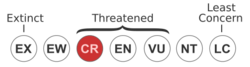
Semecarpus sandakanus has been assessed as critically endangered (possibly extinct) on the IUCN Red List. Its single habitat has been converted to a palm oil plantation and the species has not been encountered since 1977. It is not known to be present in any protected areas.[1]
References
- ↑ 1.0 1.1 1.2 Damit, A.; Hoo, P.K.; Khoo, E.; Maryani, A.; Maycock, C.R.; Nilus, R.; Pereira, J.T.; Sugau, J. et al. (2019). "Semecarpus sandakanus". IUCN Red List of Threatened Species 2019. doi:10.2305/IUCN.UK.2019-3.RLTS.T136619670A136620040.en. https://www.iucnredlist.org/species/136619670/136620040. Retrieved 2 May 2026.
- ↑ 2.0 2.1 "Semecarpus sandakanus Kochummen" (in en). Royal Botanic Gardens, Kew. http://www.plantsoftheworldonline.org/taxon/991562-1.
- ↑ 3.0 3.1 3.2 3.3 Kochummen, K. M. (1996). "Semecarpus L.f.". in Soepadmo, E.; Wong, K. M.; Saw, L. G.. Tree Flora of Sabah and Sarawak. 2. Forest Research Institute Malaysia. p. 84. ISBN 983-9592-56-4.
Wikidata ☰ Q18080094 entry
 |  |


