Biology:Salamander mussel
 | This article may incorporate text from a large language model. (January 2026) (Learn how and when to remove this template message) |
| Salamander mussel | |
|---|---|
_-_Unionidae_-_Mollusc_shell.jpeg)
| |
Scientific classification 
| |
| Kingdom: | Animalia |
| Phylum: | Mollusca |
| Class: | Bivalvia |
| Order: | Unionida |
| Family: | Unionidae |
| Tribe: | Anodontini |
| Genus: | Simpsonaias Frierson, 1914 |
| Species: | S. ambigua
|
| Binomial name | |
| Simpsonaias ambigua (Say, 1825)
| |
| Synonyms[3] | |
| |
Simpsonaias ambigua, the salamander mussel or mudpuppy mussel, is a species of bivalve in the family Unionidae. It is unique among freshwater mussels in using mudpuppies as its glochidial host.[4]
Ecology
Salamander mussels are a unique freshwater mussel species notable for their obligate parasitic relationship with the mudpuppy salamander (Necturus maculosus).[5] Its larvae (glochidia) attach to the gills of mudpuppies, where they receive necessary nutrients and dispersal, eventually metamorphosing before dropping off into suitable benthic substrate. The species tends to occur in low-density populations, often associated with mudpuppy parameters such as population size and microhabitats that support them (e.g., refugia such as flat rocks and crevices).[6] Adult S. ambigua typically inhabit clean, well-oxygenated, fine-sand or silt substrates in medium- to large-sized rivers with stable flow.[6]
Like many freshwater mussels, S. ambigua contributes to ecosystem processes such as nutrient cycling and substrate stabilization. By filtering suspended particles, individuals improve water clarity and support aquatic food webs.[7]
Distribution
The historical range of the salamander mussel includes the Mississippi, Ohio, and Great Lakes drainages, spanning 25 U.S. states and parts of southern Ontario, Canada.[6] Adult S. ambigua typically inhabit clean, well-oxygenated, fine-sand or silt substrates in medium- to large-sized rivers with stable flow.[6] It has been documented in rivers such as the Wabash, Maumee, Ohio, and Tennessee, though it is now considered rare or extirpated from much of its former range.[8]
Recent records show persistence in several areas once thought to have lost populations. For example, S. ambigua was rediscovered in Illinois using environmental DNA (eDNA) analysis,[9] and continues to occupy isolated sites in southern Ontario, where populations exhibit small size structure and low density but evidence of continued reproduction.[7] A 2020 record from the Harpeth River in Tennessee extended the known distribution within the lower Cumberland system.[8]
Because the species’ occurrence is closely tied to that of the mudpuppy salamander, its range mirrors the distribution of this host. Declines in mudpuppy populations due to habitat degradation and pollution are likely to contribute to the mussel’s reduced distribution.[10]
Conservation
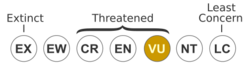
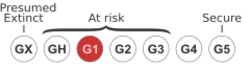
The Salamander Mussel is considered rare throughout its range, listed as a Special Concern in most U.S. states and Threatened in Canada.[5][7] Recovery is limited by the species’ dependence on both pristine benthic habitats and healthy populations of its mudpuppy salamander host.[6] Modern molecular and habitat-based tools are increasingly used to aid in the detection and management of the species. Environmental DNA (eDNA) surveys have confirmed its persistence in regions where it was previously thought extirpated, including Illinois and Ontario.[9][11] Research continues to refine methods for identifying suitable habitats and assessing the ecological conditions that support viable populations.[8][6]
Threats
Major threats to the Salamander Mussel include habitat degradation, pollution, and declines in its amphibian host. Channelization, sedimentation, and dam construction have reduced suitable substrates and altered natural flow regimes, limiting available habitat.[7] Runoff from agricultural and industrial activities further degrades water quality, negatively affecting both the mussel and the mudpuppy host.[6] Declines in mudpuppy populations, linked to pollution and habitat loss, directly limit mussel reproduction and dispersal.[10][6] Surviving mussel populations are often small and isolated, leaving them vulnerable to stochastic events and local extirpation.[11]
References
- ↑ Bogan, A.E.; Woolnough, D.; Seddon, M.B. (2017). "Simpsonaias ambigua". IUCN Red List of Threatened Species 2017. doi:10.2305/IUCN.UK.2017-3.RLTS.T20247A62905797.en. https://www.iucnredlist.org/species/20247/62905797. Retrieved 16 November 2021.
- ↑ NatureServe. "Simpsonaias ambigua" (in en). Arlington, Virginia. https://explorer.natureserve.org/Taxon/ELEMENT_GLOBAL.2.114652/.
- ↑ "Simpsonaias ambigua (Say, 1825)". MolluscaBase. World Register of Marine Species. http://www.marinespecies.org/aphia.php?p=taxdetails&id=857395.
- ↑ "Simpsonaias ambigua Michigan Natural Features Inventory". https://mnfi.anr.msu.edu/abstracts/zoology/Simpsonaias_ambigua.pdf.
- ↑ 5.0 5.1 Minnesota Department of Natural Resources. "Rare Species Guide: Simpsonaias ambigua (Salamander Mussel)". Minnesota Department of Natural Resources. https://www.dnr.state.mn.us/rsg/profile.html?action=elementDetail&selectedElement=IMBIV41010.
- ↑ 6.0 6.1 6.2 6.3 6.4 6.5 6.6 6.7 U.S. Fish and Wildlife Service (May 2023). "Species Status Assessment Report for the Salamander Mussel (Simpsonaias ambigua) Version 1.1". U.S. Fish and Wildlife Service — Region 3. https://www.fws.gov/sites/default/files/documents/Salamander%20Mussel%20SSA%20Final%20May%202023_0.pdf.
- ↑ 7.0 7.1 7.2 7.3 Porto-Hannes, I.; McNichols-O’Rourke, K. A.; Gibson, M. P.; Morris, T. J. (2025). "Status and Life History Traits of Simpsonaias ambigua (Salamander Mussel) in Ontario, Canada". Diversity 17 (2): 133. doi:10.3390/d17020133. Bibcode: 2025Diver..17..133P.
- ↑ 8.0 8.1 8.2 Womble, K. I.; Dinkins, G. R.; Alford, J. B.; Harris, M. H. (2020). "New Species Distribution Record for Simpsonaias ambigua (Say) (Salamander Mussel, Bivalvia: Unionidae) in the Harpeth River, Tennessee". Southeastern Naturalist 19 (1). doi:10.1656/058.019.0116. https://doi.org/10.1656/058.019.0116.
- ↑ 9.0 9.1 Douglass, S. A.; Palmer, S.; McCallum, A. R.; Reves, O. P.; Robinson, H. A.; Rutledge, A. J.; Hartman, J. H.; Larson, E. R. et al. (2025). "Environmental DNA reveals the Salamander Mussel Simpsonaias ambigua alive in Illinois, USA, after a century in obscurity". Ecology 106 (7). doi:10.1002/ecy.70145. PMID 40605396. PMC 12223466. Bibcode: 2025Ecol..10670145D. https://doi.org/10.1002/ecy.70145.
- ↑ 10.0 10.1 McDaniel, T. V.; Martin, P. A.; Barrett, G. C.; Hughes, K.; Gendron, A. D.; Shirose, L.; Bishop, C. A. (2009). "Relative abundance, age structure, and body size in mudpuppy populations in southwestern Ontario". Journal of Great Lakes Research 35 (2): 182–189. doi:10.1016/j.jglr.2008.12.009. Bibcode: 2009JGLR...35..182M. https://doi.org/10.1016/j.jglr.2008.12.009.
- ↑ 11.0 11.1 Porto-Hannes, I.; Sassoubre, L. M.; Sansom, B. J.; Morris, T. J. (2023). "Applying Environmental DNA Methods to Inform Detection of Simpsonaias ambigua under Varying Water Velocities in a River". Freshwater Mollusk Biology and Conservation 26 (2): 54–68. doi:10.31931/fmbc-d-21-00013. https://doi.org/10.31931/fmbc-d-21-00013.
Wikidata ☰ {{{from}}} entry
 |  |


