Biology:Blue-headed quail-dove
| Blue-headed quail-dove | |
|---|---|
.JPG)
| |
| Blue-headed quail-dove Near Playa Larga, Cuba | |
Scientific classification 
| |
| Kingdom: | Animalia |
| Phylum: | Chordata |
| Class: | Aves |
| Order: | Columbiformes |
| Family: | Columbidae |
| Genus: | Starnoenas Bonaparte, 1838 |
| Species: | S. cyanocephala
|
| Binomial name | |
| Starnoenas cyanocephala | |

| |
| Synonyms | |
|
Columba cyanocephala Linnaeus, 1758 | |
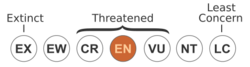
The blue-headed quail dove (Starnoenas cyanocephala), or blue-headed partridge-dove, is a species of bird in the pigeon and dove family Columbidae that is endemic to the island of Cuba. It is monotypic within the subfamily Starnoenadinae and genus Starnoenas.[2][3]
Taxonomy
In 1734 the English naturalist Eleazar Albin included a picture and a description of the blue-headed quail-dove in his A Natural History of Birds. His drawing was made from a live bird that had been brought to England from the East Indies.[4] When in 1758 the Swedish naturalist Carl Linnaeus updated his Systema Naturae for the tenth edition, he placed the blue-headed quail-dove with all the other pigeons in the genus Columba. Linnaeus included a brief description, coined the binomial name Columba cyanocephala and cited Albin's work.[5] The specific epithet combines the Ancient Greek kuanos meaning "dark blue" and -kephalos meaning "-headed".[6] It is now the only species placed in the genus Starnoenas that was introduced by the French naturalist Charles Lucien Bonaparte in 1838.[7][8] The species is monotypic; no subspecies are accepted.[8]
A taxonomic review of the species' taxonomic history, morphology, anatomy, behavior, distribution, and zoogeography was published in 2016. It found that this species is unlike any other New World Columbidae and shares characteristics with many Australasian genera, the most similar being the Australian Geophaps and related terrestrial pigeons. The study recommended that the species be placed in its own subfamily, Starnoenadinae. However, additional data, including molecular, must be studied to further refine its relationship with Australasian pigeons. The study has also recommended that the English name be changed to "blue-headed partridge-dove" to distinguish it from New World quail-doves.[2]
A more detailed molecular phylogenetic study published in 2025 examining many additional pigeon species found that the blue-headed quail dove was sister to the subfamily Columbinae, and not closer to the group including Geophaps as the 2016 study had suggested.[9]
Description
This bird has a mainly cinnamon-brown body with a bright blue crown, black eye stripe, white facial stripe, and a black gorget narrowly bordered with white markings and blue mottling on the sides. 30–33 cm in length.[1]
Behavior
This species lives primarily on the forest floor where it forages for seeds, berries, and snails. It is generally found in pairs, though larger groups have been recorded with 18 birds found at a water hole in 1995. Breeding occurs mainly between April and June, with nests made on or close to the ground.[1]
Habitat
This species is endemic to Cuba. Its natural habitat is lowland forests and swampy areas. It can occasionally be found in highland forests.[1]
Conservation
It is protected under national law, though this is not enforced and hunting continues. The only known highland population is protected in the La Güira National Park.[1]
References
- ↑ 1.0 1.1 1.2 1.3 1.4 BirdLife International (2020). "Starnoenas cyanocephala". IUCN Red List of Threatened Species 2020. doi:10.2305/IUCN.UK.2020-3.RLTS.T22690970A178419260.en. https://www.iucnredlist.org/species/22690970/178419260. Retrieved 17 November 2021.
- ↑ 2.0 2.1 Olson, Storrs L.; Wiley, James W. (2016). "The Blue-headed Quail-Dove (Starnoenas cyanocephala): an Australasian dove marooned in Cuba". The Wilson Journal of Ornithology 128 (1): 1–21. doi:10.1676/1559-4491-128.1.1.
- ↑ Thomas M. Brooks; John D. Pilgrim; Ana S. L. Rodrigues; Gustavo A. B. Da Fonseca (2005). "Conservation status and geographic distribution of avian evolutionary history". Phylogeny and Conservation. Conservation Biology. 8. Cambridge University Press. pp. 267–294. ISBN 978-0-521-82502-3. https://books.google.com/books?id=3W_TN0790vEC&pg=PA291.
- ↑ Albin, Eleazar; Derham, William (1734). A Natural History of Birds: Illustrated with a Hundred and One Copper Plates, Curiously Engraven from the Life. 2. London: Printed for the author and sold by William Innys. p. 45, Plate 49. https://www.biodiversitylibrary.org/page/41130717.
- ↑ Linnaeus, Carl (1758) (in Latin). Systema Naturae per regna tria naturae, secundum classes, ordines, genera, species, cum characteribus, differentiis, synonymis, locis. 1 (10th ed.). Holmiae:Laurentii Salvii. p. 163. https://www.biodiversitylibrary.org/page/727070.
- ↑ Jobling, James A. (2010). The Helm Dictionary of Scientific Bird Names. London: Christopher Helm. p. 126. ISBN 978-1-4081-2501-4.
- ↑ Bonaparte, Charles Lucien (1838). A Geographical and Comparative List of the Birds of Europe and North America. London: John Van Voorst. p. 41. https://www.biodiversitylibrary.org/page/33208430.
- ↑ 8.0 8.1 Gill, Frank; Donsker, David; Rasmussen, Pamela, eds (2020). "Pigeons". IOC World Bird List Version 10.1. International Ornithologists' Union. https://www.worldbirdnames.org/bow/pigeons/.
- ↑ Oswald, J.A.; Boyd, B.M.; Szewczak, A.R.; LeFebvre, M.J.; Stucky, B.J.; Guralnick, R.P.; Johnson, K.P.; Allen, J.M. et al. (2025). "Genomic data reveal that the Cuban blue-headed quail-dove (Starnoenas cyanocephala) is a biogeographic relict". Biology Letters 21 (1). doi:10.1098/rsbl.2024.0464.
External links
Template:Columbimorphae Genera Wikidata ☰ Q649940 entry
 |  |


