Biology:Transvenidae
Transvenidae is a family of parasitic spiny-headed (or thorny-headed) worms in the order Echinorhynchida. This family contains three species divided into two genera.
Taxonomy and description
Phylogenetic analysis has been conducted.[1]
Species
There are three genera and six species in the family Transvenidae:[2][3][lower-alpha 1][lower-alpha 2]
Paratrajectura
Paratrajectura Amin, Heckmann et Ali, 2018 contains one species:
- Paratrajectura longcementglandatus Amin, Heckmann et Ali, 2018
Sclerocollum
Sclerocollum Schmidt and Paperna, 1978 contains three species:
- Sclerocollum robustum (Edmonds, 1964)
- Sclerocollum rubrimaris Schmidt and Paperna, 1978
- Sclerocollum saudii Al-Jahdali, 2010
Trajectura
Trajectura Pichelin & Cribb, 2001[6] contains two species: Trajectura is distinguished by the possession of only two cement glands and an anterior conical projection (function unknown) on the females.[6]
- Trajectura ikedai (Machida, 1992)[7]
Diplosentis ikedai was found to share similar anatomical features (only two cement glands and an anterior conical projection on females) was renamed T. ikedai.[6]
- Trajectura perinsolens Pichelin and Cribb, 2001
T. perinsolens Was found parasitising the New Guinea wrasse Anampses neoguinaicus from the Great Barrier Reef, Queensland, Australia.[6]
Transvena
Transvena Pichelin & Cribb, 2001[6] contains one species:
- Transvena annulospinosa Pichelin and Cribb, 2001
Hosts
- Hosts for Transvenidae species
-
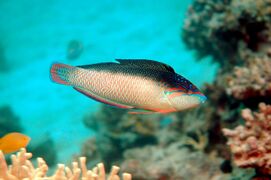 The New Guinea wrasse (Anampses neoguinaicus) is one of the hosts of T. perinsolens

Notes
- ↑ A binomial authority in parentheses indicates that the species was originally described in a genus other than the present genus.
- ↑ Pararhadinorhynchus Johnston & Edmonds, 1947[4] including Pararhadinorhynchus magnus.[5] Pararhadinorhynchus is sometimes classified within the Diplosentidae.[5]
References
- ↑ Sharifdini, M.; Amin, O. M.; Heckmann, R. A. (2020). "The molecular profile of Paratrajectura longcementglandatus Amin, Heckmann et (Acanthocephala: Transvenidae) from percid fishes in the marine waters of Iran and Iraq". Helminthologia 57 (1): 1–11. doi:10.2478/helm-2020-0007. PMID 32063734.
- ↑ "ITIS - Report: Transvenidae". https://www.itis.gov/servlet/SingleRpt/SingleRpt?search_topic=TSN&search_value=993534#null.
- ↑ Huston, D. C., Cribb, T. H., & Smales, L. R. (2020). Molecular characterisation of acanthocephalans from Australian marine teleosts: proposal of a new family, synonymy of another and transfer of taxa between orders. Systematic Parasitology, 1-23.
- ↑ Johnston, T. H.; Edmonds, S. J. (1947). "Australian Acanthocephala No. 5". Transactions of the Royal Society of Australia 71: 13–19.
- ↑ 5.0 5.1 Van Ha, Nguyen; Amin, Omar M.; Ngo, Ha Duy; Heckmann, Richard A. (2018). "Descriptions of acanthocephalans, Cathayacanthus spinitruncatus (Rhadinorhynchidae) male and Pararhadinorhynchus magnus n. sp. (Diplosentidae), from marine fish of Vietnam, with notes on Heterosentis holospinus (Arhythmacanthidae)". Parasite 25: 35. doi:10.1051/parasite/2018032. ISSN 1776-1042. PMID 30040609.

- ↑ 6.0 6.1 6.2 6.3 6.4 Cite error: Invalid
<ref>tag; no text was provided for refs namedI - ↑ MACHIDA, M. (1992). A new species of the genus Diplosentis (Acanthocephala, Diplosentidae) from a wrasse of southern Japan. Jpn. J. Parasitol, 41(1), 37-39.
Wikidata ☰ Q2195375 entry
 |  |


