Biology:Red and blue damsel
| Red and blue damsel | |
|---|---|

| |
| Male, Tasmania, Australia | |

| |
| Female | |
Scientific classification 
| |
| Kingdom: | Animalia |
| Phylum: | Arthropoda |
| Class: | Insecta |
| Order: | Odonata |
| Suborder: | Zygoptera |
| Family: | Coenagrionidae |
| Genus: | Xanthagrion Selys 1876[3] |
| Species: | X. erythroneurum
|
| Binomial name | |
| Xanthagrion erythroneurum Selys, 1876[2]
| |

| |
The red and blue damsel, (Xanthagrion erythroneurum) is a damselfly in the family Coenagrionidae.[4][1] It is the only member of the monotypic genus Xanthagrion.[5][6]
Description
A red and blue damsel has a bright red face and thorax.[7] Its abdomen is pale in colour[7] and 2.2-2.4 cm long.[8] Females and males are similar in colour.[7]
Distribution and habitat
The red and blue damsel is widespread across all Australian states,[8] as well as Fiji, New Caledonia, and other islands in the Pacific.[9] It is found in north and eastern Tasmania. It is typically found near dams, marshes and slow watercourses.[8]
Etymology
The genus name Xanthagrion is derived from the Greek ξανθός (xanthos, "yellow") and Agrion, a genus name derived from the Greek ἄγριος (agrios, "wild"). Agrion was the name applied by Johan Christian Fabricius in 1775 to all damselflies.[3][10]
The species name erythroneurum is derived from the Greek ἐρυθρός (erythros, "red") and νεῦρον (neuron, "nerve" or "sinew"), referring to the colour of the major wing veins.[2][10]
Gallery
-
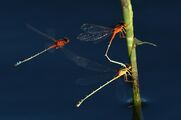 Mating I. The male holds the female behind her head.
 -
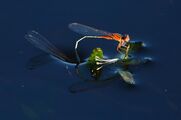 Mating II. The male pushes the female under the water.
 -
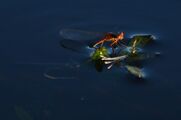 Mating III. The female is completely under the water. Both male and female dragonflies go under.
 -
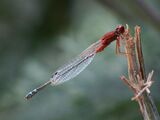 Male
Male -
 Female wings
 -
 Male wings
.jpg)
.jpg)
.jpg)

.jpg)
.jpg)
References
- ↑ 1.0 1.1 Dow, R.A. (2017). "Xanthagrion erythroneurum". IUCN Red List of Threatened Species 2017. doi:10.2305/IUCN.UK.2017-1.RLTS.T83152243A83381754.en. https://www.iucnredlist.org/species/83152243/83381754. Retrieved 20 November 2021.
- ↑ 2.0 2.1 Selys-Longchamps, E. (1876). "Synopsis des Agrionines (suite du genre Agrion)" (in fr). Bulletin de la Classe des Science, Académie Royale de Belgique 42: 490–531, 952–991 [521]. https://www.biodiversitylibrary.org/page/34716953.
- ↑ 3.0 3.1 Selys-Longchamps, E. (1876). "Synopsis des Agrionines (suite du genre Agrion)" (in fr). Bulletin de la Classe des Science, Académie Royale de Belgique 42: 490–531, 952–991 [520]. https://www.biodiversitylibrary.org/page/34716952.
- ↑ "Species Xanthagrion erythroneurum (Selys, 1876)". Australian Biological Resources Study. 2012. https://biodiversity.org.au/afd/taxa/Xanthagrion_erythroneurum.
- ↑ "Genus Xanthagrion Selys, 1876". Australian Biological Resources Study. 2012. https://biodiversity.org.au/afd/taxa/Xanthagrion.
- ↑ "World Odonata List". University of Puget Sound. https://www.pugetsound.edu/academics/academic-resources/slater-museum/biodiversity-resources/dragonflies/world-odonata-list2/.
- ↑ 7.0 7.1 7.2 "Red and Blue Damselfly - Xanthagrion erythroneurum". Brisbane Insects. http://www.brisbaneinsects.com/brisbane_dragons/RedAndBlue.htm.
- ↑ 8.0 8.1 8.2 Daley, Elizabeth (2007). Wings: An introduction to Tasmania's winged insects. Riffles Pty Ltd.
- ↑ Watson, J.A.L.; Theischinger, G.; Abbey, H.M. (1991). The Australian Dragonflies: A Guide to the Identification, Distributions and Habitats of Australian Odonata. Melbourne: CSIRO. ISBN 978-0-643-05136-2.
- ↑ 10.0 10.1 Endersby, Ian; Fliedner, Heinrich (2015). The Naming of Australia's Dragonflies. Eltham, Victoria, Australia: Busybird Publishing. ISBN 9781925260625. https://www.researchgate.net/publication/283318421_The_Naming_of_Australia's_Dragonflies.
 |
Wikispecies has information related to Xanthagrion erythroneurum |
Wikidata ☰ {{{from}}} entry
 |  |


