Biology:Xylopia acutiflora
| Xylopia acutiflora | |
|---|---|
Scientific classification 
| |
| Kingdom: | Plantae |
| Clade: | Tracheophytes |
| Clade: | Angiosperms |
| Clade: | Magnoliids |
| Order: | Magnoliales |
| Family: | Annonaceae |
| Genus: | Xylopia |
| Species: | X. acutiflora
|
| Binomial name | |
| Xylopia acutiflora (Dunal) A.Rich.
| |
| Synonyms[2] | |
| |
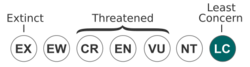
Xylopia acutiflora is a species of flowering plant in the Annonaceae family. It is small tree that grows up to 15 m high. It is native to Guinea, Sierra Leone, Liberia, and western Côte d'Ivoire in west Africa.[2]
Description
Brown pubescent twigs mixed with erect and short hairs. Leaf blades chartaceous, concolorous–slightly discolorous, elliptic–elliptic-lanceolate, larger blades, 5.3 - 11.7 cm long and 2.3 - 4.3 cm wide; acute to acuminate at apex and cuneate at base. Flowers are solitary[3] Fruit green - reddish tinged exterior, scarlet endocarp, up to born on a pedicel. Seed, ovate- ellipsoid, monocarps have two rows of seed.[3]
Distribution
It is native to Guinea, Sierra Leone, Liberia, and western Côte d'Ivoire,[2] where it grows in lowland moist forests.[4]
Uses
In Ghana and among the Ehotile people of Akanland, root extracts from the species is used as a sexual stimulant and as a chewing stick.[5] Seeds are crushed and used as spice, wood obtained are used as material to make canoe paddles, spears or bows.
References
- ↑ Botanic Gardens Conservation International (BGCI).; IUCN SSC Global Tree Specialist Group. (2019). "Xylopia acutiflora" (in en). IUCN Red List of Threatened Species 2019. doi:10.2305/IUCN.UK.2019-1.RLTS.T137016079A143272642.en. https://www.iucnredlist.org/species/137016079/143272642. Retrieved 25 June 2026.
- ↑ 2.0 2.1 2.2 "Xylopia acutiflora (Dunal) A.Rich.". Royal Botanic Gardens, Kew. https://powo.science.kew.org/taxon/urn:lsid:ipni.org:names:76055-1.
- ↑ 3.0 3.1 Johnson, David M.; Murray, Nancy A. (2018-04-24). "A revision of Xylopia L. (Annonaceae): the species of Tropical Africa". PhytoKeys (97): 1–252. doi:10.3897/phytokeys.97.20975. ISSN 1314-2003. PMC 10865103. https://phytokeys.pensoft.net/articles.php?id=20975.
- ↑ Hasan, Choudhury M.; Healey, Terence M.; Waterman, Peter G. (1985). "Acutifloric acid: A diterpene dimer from the stem bark of Xylopia acutiflora" (in en). Phytochemistry 24 (1): 192–194. doi:10.1016/S0031-9422(00)80841-9. Bibcode: 1985PChem..24..192H. https://linkinghub.elsevier.com/retrieve/pii/S0031942200808419.
- ↑ Malan, Djah F; Neuba, Danho F R; Kouakou, Kouakou L (2015). "Medicinal plants and traditional healing practices in ehotile people, around the aby lagoon (eastern littoral of Côte d'Ivoire)" (in en). Journal of Ethnobiology and Ethnomedicine 11 (1): 21. doi:10.1186/s13002-015-0004-8. ISSN 1746-4269. PMID 25888765.
Wikidata ☰ Q15366855 entry
 |  |


