Chemistry:4-Methylcyclohexene
4-Methylcyclohexene is an organic compound consisting of cyclohexene with a methyl group substituent attached to carbon most distant from the alkene group. Two other structural isomers are known: 1-methylcyclohexene and 3-methylcyclohexene. All are colorless volatile liquids classified as a cyclic olefins. They are specialized reagents.
Methylcyclohexenes are formed by the partial hydrogenation of toluene to methylcyclohexane over ruthenium catalyst.[1]
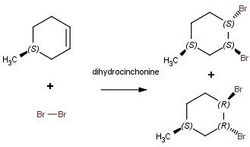
Bromination of methylcyclohexene

In the presence of a Cinchona alkaloid, bromination of an alkene can leads to optically active dibromides.[2] For 4-methylcyclohexene, the (S)-configuration leads to two different products: the bromines can add at the axial positions, giving the orientation (1S,3R,4R), or at the equatorial positions, giving the orientation (1S,3S,4S). Similarly, the (R)-configuration produces two different products: axial addition yields the configuration (1R,3S,4S) and equatorial addition yields (1R,3R,4R).
References
- ↑ Belohlav, H.; Kluson, P.; Cerveny, L. (1997). "Partial Hydrogenation of Toluene Over A Ruthenium Catalyst, A Model Treatment of A Deactivation Process". Res. Chem. Intermed. 32 (2): 161–168. doi:10.1163/156856797X00312.
- ↑ Bellucci, G.; Giordano, C.; Marsili, A.; Berti, G. (1969). "Asymmetric Bromination of 4-Methylcyclohexene in the Presence of Dihydrocinchonine". Tetrahedron 25 (18): 4515–4522. doi:10.1016/S0040-4020(01)82993-8.
 |  |


