Chemistry:Terpineol
Terpineol is any of four isomeric monoterpenoids. Terpenoids are terpene that are modified by the addition of a functional group, in this case, an alcohol. Terpineols have been isolated from a variety of sources such as cardamom, cajuput oil, pine oil, and petitgrain oil.[1] Four isomers exist: α-terpineol, β-terpineol, γ-terpineol, and terpinen-4-ol. β-Terpineol and γ-terpineol differ only by the location of the double bond. Terpineol is usually a mixture of these isomers with α-terpineol as the major constituent.

Terpineols: alpha-, beta-, gamma-, and the 4-terpineol isomer

Terpineol has a pleasant odor similar to lilac and is a common ingredient in perfumes, cosmetics, and flavors. α-Terpineol is one of the two most abundant aroma constituents of lapsang souchong tea; the α-terpineol originates in the pine smoke used to dry the tea.[2] (+)-α-Terpineol is a chemical constituent of skullcap.
α-Terpineol has an aroma described as "pine, terpenic, lilac, citrus, woody, floral, resinous, cooling, lemon, lime".[3] Whilst both enantiomers of α-terpineol exhibit a floral lilac aroma,[4][5] the laevo form (−)-α-terpineol, is reportedly more terpenic. The aroma of β-terpineol is described as "pungent, earthy, woody".[6]. The aroma of γ-terpineol is "pine, floral, lilac".[7] The aroma of 4-terpinenol (also known as terpinen-4-ol or 4-carvomenthenol), is described as "peppery, woody, earthy, musty, sweet, mentholic, citrus, terpenic, spicy".[8]
Synthesis and biosynthesis
Although it is naturally occurring, terpineol is commonly manufactured from alpha-pinene, which is hydrated in the presence of sulfuric acid.[9]
An alternative route starts from limonene:[10]
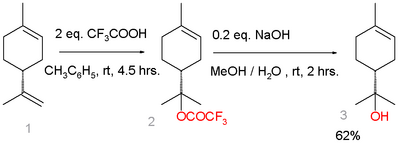
Terpineol synthesis from limonene

Limonene reacts with trifluoroacetic acid in a Markovnikov addition to a trifluoroacetate intermediate, which is easily hydrolyzed with sodium hydroxide to α-terpineol with 7% selectivity. Side-products are β-terpineol in a mixture of the cis isomer, the trans isomer, and 4-terpineol.
The biosynthesis of α-terpineol proceeds from geranyl pyrophosphate, which releases pyrophosphate to give the terpinyl cation. This carbocation is the precursor to many terpenes and terpenoids. Its hydrolysis gives terpineol.

Biosynthetic conversion of geranyl pyrophosphate to the terpenes α-pinene and β-pinene (right) and to α-terpineol (bottom left).[11]

References
- ↑ An Encyclopedia of Chemicals, Drugs, and Biologicals (11th ed.), Merck, 1989, p. 9103, ISBN 091191028X
- ↑ Yao, Shan-Shan; Guo, Wen-Fei; Lu, Yi; Jiang, Yuan-Xun (2005). "Flavor Characteristics of Lapsang Souchong and Smoked Lapsang Souchong, a Special Chinese Black Tea with Pine Smoking Process". Journal of Agricultural and Food Chemistry 53 (22): 8688–93. doi:10.1021/jf058059i. PMID 16248572. Bibcode: 2005JAFC...53.8688Y. http://d.wanfangdata.com.cn/NSTLQK_NSTL_QK10615205.aspx.
- ↑ "alpha-terpineol". Scents and Flavors. https://scentsandflavors.com/database/9dbb5015-fa2b-41f8-b35a-ca01a4d81ef8.
- ↑ "(+)-alpha-terpineol". Scents and Flavors. https://scentsandflavors.com/database/9dbb56dc-3c69-4941-9c60-5b2e9104c16c.
- ↑ "(−)-alpha-terpineol". Scents and Flavors. https://scentsandflavors.com/database/9dbb5385-fca8-44da-a482-7b657f14d108.
- ↑ "beta-terpineol". Scents and Flavors. https://scentsandflavors.com/database/9dbb511e-74cd-4aed-bc09-6c723bb99a01.
- ↑ "gamma-terpineol". Scents and Flavors. https://scentsandflavors.com/database/9dbb51e7-21f2-46d9-ad96-5d1381b4e383.
- ↑ "4-carvomenthenol". Scents and Flavors. https://scentsandflavors.com/database/9dbb50aa-eb18-4874-bde4-3a99de690275.
- ↑ Gscheidmeier, Manfred; Fleig, Helmut. "Ullmann's Encyclopedia of Industrial Chemistry". Ullmann's Encyclopedia of Industrial Chemistry. Weinheim: Wiley-VCH. doi:10.1002/14356007.a27_267.
- ↑ Yuasa, Yoshifumi; Yuasa, Yoko (2006). "A Practical Synthesis of d-α-Terpineol via Markovnikov Addition of d-Limonene Using Trifluoroacetic Acid". Organic Process Research & Development 10 (6): 1231–1232. doi:10.1021/op068012d.
- ↑ Davis, Edward M.; Croteau, Rodney (2000). "Cyclization enzymes in the biosynthesis of monoterpenes, sesquiterpenes, and diterpenes". Biosynthesis. 209. 53–95. doi:10.1007/3-540-48146-X_2. ISBN 978-3-540-66573-1.
External links
 |  |


