Continuous distribution
This category corresponds roughly to MSC {{{id}}} {{{title}}}; see {{{id}}} at MathSciNet and {{{id}}} at zbMATH.
A probability distribution without atoms. Thus, a continuous distribution is the opposite of a discrete distribution (see also Atomic distribution). Discrete and continuous distributions together from the basic types of distributions. By a theorem of C. Jordan, every probability distribution is a mixture of a discrete and a continuous distribution. For example, let <img align="absmiddle" border="0" src="https://www.encyclopediaofmath.org/legacyimages/c/c025/c025620/c0256201.png" /> be the distribution function corresponding to a certain distribution on the real line. Then <img align="absmiddle" border="0" src="https://www.encyclopediaofmath.org/legacyimages/c/c025/c025620/c0256202.png" />, where <img align="absmiddle" border="0" src="https://www.encyclopediaofmath.org/legacyimages/c/c025/c025620/c0256203.png" /> and <img align="absmiddle" border="0" src="https://www.encyclopediaofmath.org/legacyimages/c/c025/c025620/c0256204.png" /> are distribution functions of the discrete and the continuous type, respectively, is such a mixture. The distribution function of a continuous distribution is a continuous function. The absolutely-continuous distributions occupy a special position among the continuous distributions. This class of distributions <img align="absmiddle" border="0" src="https://www.encyclopediaofmath.org/legacyimages/c/c025/c025620/c0256205.png" /> on a measurable space <img align="absmiddle" border="0" src="https://www.encyclopediaofmath.org/legacyimages/c/c025/c025620/c0256206.png" /> is defined, relative to a reference measure <img align="absmiddle" border="0" src="https://www.encyclopediaofmath.org/legacyimages/c/c025/c025620/c0256207.png" />, by the fact that <img align="absmiddle" border="0" src="https://www.encyclopediaofmath.org/legacyimages/c/c025/c025620/c0256208.png" /> can be represented in the form
| <img align="absmiddle" border="0" src="https://www.encyclopediaofmath.org/legacyimages/c/c025/c025620/c0256209.png" /> |
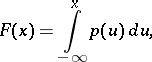
Here <img align="absmiddle" border="0" src="https://www.encyclopediaofmath.org/legacyimages/c/c025/c025620/c02562010.png" /> is in <img align="absmiddle" border="0" src="https://www.encyclopediaofmath.org/legacyimages/c/c025/c025620/c02562011.png" /> and <img align="absmiddle" border="0" src="https://www.encyclopediaofmath.org/legacyimages/c/c025/c025620/c02562012.png" /> is a measurable function on <img align="absmiddle" border="0" src="https://www.encyclopediaofmath.org/legacyimages/c/c025/c025620/c02562013.png" /> with <img align="absmiddle" border="0" src="https://www.encyclopediaofmath.org/legacyimages/c/c025/c025620/c02562014.png" />. The function <img align="absmiddle" border="0" src="https://www.encyclopediaofmath.org/legacyimages/c/c025/c025620/c02562015.png" /> is called the density of <img align="absmiddle" border="0" src="https://www.encyclopediaofmath.org/legacyimages/c/c025/c025620/c02562016.png" /> relative to <img align="absmiddle" border="0" src="https://www.encyclopediaofmath.org/legacyimages/c/c025/c025620/c02562017.png" /> (usually, <img align="absmiddle" border="0" src="https://www.encyclopediaofmath.org/legacyimages/c/c025/c025620/c02562018.png" /> is Lebesgue measure and <img align="absmiddle" border="0" src="https://www.encyclopediaofmath.org/legacyimages/c/c025/c025620/c02562019.png" />). On the line, the corresponding distribution function <img align="absmiddle" border="0" src="https://www.encyclopediaofmath.org/legacyimages/c/c025/c025620/c02562020.png" /> then has the representation
| <img align="absmiddle" border="0" src="https://www.encyclopediaofmath.org/legacyimages/c/c025/c025620/c02562021.png" /> |
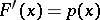
and here <img align="absmiddle" border="0" src="https://www.encyclopediaofmath.org/legacyimages/c/c025/c025620/c02562022.png" /> almost-everywhere (with respect to Lebesgue measure). A distribution is absolutely continuous with respect to Lebesgue measure if and only if the corresponding distribution function is absolutely continuous (as a function of a real variable). In addition to absolutely-continuous distributions there are continuous distributions that are concentrated on sets of <img align="absmiddle" border="0" src="https://www.encyclopediaofmath.org/legacyimages/c/c025/c025620/c02562023.png" />-measure zero. Such distributions are called singular (cf. Singular distribution) with respect to a certain measure <img align="absmiddle" border="0" src="https://www.encyclopediaofmath.org/legacyimages/c/c025/c025620/c02562024.png" />. By Lebesgue's decomposition theorem, every continuous distribution is a mixture of two distributions, one of which is absolutely continuous and the other is singular with respect to <img align="absmiddle" border="0" src="https://www.encyclopediaofmath.org/legacyimages/c/c025/c025620/c02562025.png" />.
Some of the most important (absolutely-) continuous distributions are: the arcsine distribution; the beta-distribution, the gamma-distribution, the Cauchy distribution, the normal distribution, the uniform distribution, the exponential distribution, the Student distribution, and the "chi-squared" distribution.
References
| [1] | W. Feller, "An introduction to probability theory and its applications", 2, Wiley (1971) |
| [2] | M. Loève, "Probability theory", Princeton Univ. Press (1963) MR0203748 Template:ZBL |
Comments
Atoms are those points of the sample space that have positive probability. A discrete distribution is a distribution in which all probability is concentrated in the atoms.
An absolutely-continuous distribution <img align="absmiddle" border="0" src="https://www.encyclopediaofmath.org/legacyimages/c/c025/c025620/c02562026.png" /> as defined above is also called absolutely continuous with respect to <img align="absmiddle" border="0" src="https://www.encyclopediaofmath.org/legacyimages/c/c025/c025620/c02562027.png" />.
 |  |