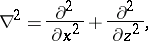
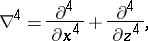
Consider a fluid flow in a layer of uniform depth where the temperature difference, <img align="absmiddle" border="0" src="https://www.encyclopediaofmath.org/legacyimages/c/c110/c110380/c1103801.png" />, between the upper and lower bounding planes is kept constant. Such a system has a steady-state solution in which there is no fluid motion and the temperature varies linearly. If this solution is unstable, convection should develop. When all motion is parallel to the <img align="absmiddle" border="0" src="https://www.encyclopediaofmath.org/legacyimages/c/c110/c110380/c1103802.png" />-plane, the governing equations are [a1]:
where <img align="absmiddle" border="0" src="https://www.encyclopediaofmath.org/legacyimages/c/c110/c110380/c1103805.png" /> is the height of the layer (in the <img align="absmiddle" border="0" src="https://www.encyclopediaofmath.org/legacyimages/c/c110/c110380/c1103806.png" />-direction),
stands for the Jacobian determinant, <img align="absmiddle" border="0" src="https://www.encyclopediaofmath.org/legacyimages/c/c110/c110380/c11038010.png" /> is a stream function for the two-dimensional fluid motion, and <img align="absmiddle" border="0" src="https://www.encyclopediaofmath.org/legacyimages/c/c110/c110380/c11038011.png" /> is the deviation of the temperature from the case where no convection occurs. The coefficients <img align="absmiddle" border="0" src="https://www.encyclopediaofmath.org/legacyimages/c/c110/c110380/c11038012.png" />, <img align="absmiddle" border="0" src="https://www.encyclopediaofmath.org/legacyimages/c/c110/c110380/c11038013.png" />, <img align="absmiddle" border="0" src="https://www.encyclopediaofmath.org/legacyimages/c/c110/c110380/c11038014.png" />, <img align="absmiddle" border="0" src="https://www.encyclopediaofmath.org/legacyimages/c/c110/c110380/c11038015.png" /> are, respectively, kinematic viscosity, gravity acceleration, thermal expansion, and thermal conductivity. The part of the first equation that does not depend upon <img align="absmiddle" border="0" src="https://www.encyclopediaofmath.org/legacyimages/c/c110/c110380/c11038016.png" /> is the third component of the vorticity equation
where <img align="absmiddle" border="0" src="https://www.encyclopediaofmath.org/legacyimages/c/c110/c110380/c11038018.png" /> is the velocity vector and <img align="absmiddle" border="0" src="https://www.encyclopediaofmath.org/legacyimages/c/c110/c110380/c11038019.png" /> is the vorticity.
See [a4], [a5], and also Curl and Vector product.
By expanding <img align="absmiddle" border="0" src="https://www.encyclopediaofmath.org/legacyimages/c/c110/c110380/c11038020.png" /> and <img align="absmiddle" border="0" src="https://www.encyclopediaofmath.org/legacyimages/c/c110/c110380/c11038021.png" /> in double Fourier series with coefficients depending on <img align="absmiddle" border="0" src="https://www.encyclopediaofmath.org/legacyimages/c/c110/c110380/c11038022.png" /> and truncating to three terms, the Lorenz equations result [a2].
References
| [a1] | B. Saltzman, "Finite amplitude free convection as an initial value problem. I" J. Atmos. Sci. , 19 (1962) pp. 329–341 |
| [a2] | E.N. Lorenz, "Deterministic non-periodic flow" J. Atmos. Sci. , 20 (1963) pp. 130–141 |
| [a3] | G.K. Batchelor, "An introduction to fluid dynamics" , Cambridge Univ. Press (1967) |
| [a4] | B.K. Shivamoggi, "Theoretical fluid dynamics" , Martinus Nijhoff (1985) pp. 13–14 |
| [a5] | "Modern developments in fluid dynamics" S. Goldstein (ed.) , Dover, reprint (1965) pp. 114 |
 | From The Encyclopedia of Math: Convection equations. |