Earth:Avshalom Cave
| Avshalom Nature Reserve | |
|---|---|
| Soreq/Sorek Cave, Avshalom Cave, Stalactites Cave | |
 | |
| Location | On the western slopes of the Judean Hills, south of Nahal Soreq and approximately 2 kilometers east of Bet Shemesh. |
| Nearest city | Bet Shemesh |
| Governing body | Israel Nature and Parks Authority |
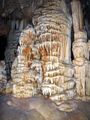
Avshalom Cave (Hebrew: מערת אבשלום, romanized: Me'arat Avshalom), known in academic literature as Soreq Cave (Hebrew: מערת שׂורק, romanized: Me'arat Soreq; Arabic: مغارة سوريك, romanized: Mghar Suriq) and popularly as Stalactites Cave (Hebrew: מערת הנטיפים, romanized: Me'arat HaNetifim), is a 5,000 m2 cave on the western side of Mt. Ye'ela, in the Judean hills in Israel, unique for its dense concentration of stalactites and other cave formations. It is a popular show cave, as well as a highly valued witness of the climate evolution over the last 185,000 years.
Name
The cave is named after the Soreq/Sorek Valley (Nahal Sorek) and after Avshalom Shoham, an Israeli soldier killed in the War of Attrition.
Location
Avshalom Cave is situated near Hartuv, 3 km east of Bet Shemesh, Israel.
Discovery
The cave was discovered accidentally in May 1968, while quarrying with explosives.
After its discovery, the location of the cave was kept a secret for several years for fear of damage to its natural treasures.
Description
The cave is 83 m long, 60 m wide, and 15 m high.
The temperature and the humidity in the cave are constant year round.[1]
Some of the stalactites found in the cave are four meters long, and some have been dated as 300,000 years old. Some meet stalagmites to form stone pillars.[2]
Paleoclimate research: significance
The cave has been the focus of paleoclimate research, which allowed reconstruction of the region's semi-arid climate for the past 185,000 years.[3] According to the American geologist James Aronson, the Soreq Cave is the Rosetta Stone of climate history in the Eastern Mediterranean.[4]
Tourism
The cave is now open to visitors, in the heart of the 67-dunam Avshalom Nature Reserve, declared in 1975.[1] In 2012, a new lighting system was installed to prevent the formation and growth of algae.[5]
Gallery
-
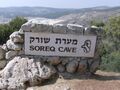 Sign at entrance to the cave
 -
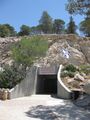 Cave entrance
 -
-
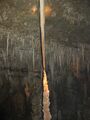 Stalactite meeting stalagmite to form a pillar
 -
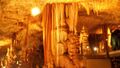 Speleothems
 -
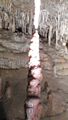 A stalagmite and stalactite almost touch
 -
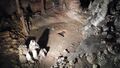 Cave pond almost covered over by calcareous sinter
 -
 Cave formation
_Cave_sign.JPG)


.JPG)


See also
- Geography of Israel
- Tourism in Israel
References
- ↑ 1.0 1.1 "List of National Parks and Nature Reserves" (in Hebrew). Israel Nature and Parks Authority. http://parks.org.il/sigalit/muchrazim.pdf.
- ↑ "Avshalom Cave". http://old.parks.org.il/BuildaGate5/general2/data_card.php?Cat=~25~~739243154~Card12~&ru=&SiteName=parks&Clt=&Bur=218003539.
- ↑ Ian J. Fairchild, Andy Baker (2012). Speleothem Science: From Process to Past Environments. Section III.12.1.2, "Composite speleothem records: Soreq Cave, Israel", pp. 355-358.
- ↑ Eminent Jewish Geologist Voyages to Tiberias to Connect With His Roots, Haaretz, 23 March 2012.
- ↑ Sanders, Edmund (18 September 2012). "Israel's prehistoric Soreq Cave now a clean, eerily lighted place". Los Angeles Times. https://www.latimes.com/world/la-xpm-2012-sep-18-la-fg-israel-cave-20120918-story.html.
External links
- Stalactite Cave Nature Reserve at Israel Nature and Parks Authority website
- Photos of Avshalom Stalactites Cave, Flickr
Template:Caves in Israel Template:Nature reserves of Israel [ ⚑ ] 31°45′21″N 35°01′24″E / 31.75583°N 35.02333°E
 |  |


