Earth:Noosfera (icebreaker)
 RRS James Clark Ross at Rothera wharf
| |
| History | |
|---|---|
 Ukraine Ukraine | |
| Name | Noosfera |
| Namesake | research in the noosphere by Vladimir Vernadsky |
| Owner | National Antarctic Scientific Center of Ukraine |
| Operator | National Antarctic Scientific Center of Ukraine |
| Acquired | 2021 |
| In service | August 2021[1] |
| Homeport | Odesa, Ukraine |
| Identification | IMO number: 8904496 |
| Status | In service |
 United Kingdom United Kingdom | |
| Name | RRS James Clark Ross |
| Namesake | James Clark Ross |
| Operator | British Antarctic Survey |
| Builder | Swan Hunter, Wallsend, Tyne and Wear, United Kingdom |
| Launched | 1 December 1990 |
| Sponsored by | HM Queen Elizabeth II |
| Out of service | March 2021 |
| Homeport | Stanley, Falkland Islands |
| Identification |
|
| Fate | Sold to National Antarctic Scientific Center of Ukraine |
| Notes | [2][3][4] |
| General characteristics | |
| Type: | Research vessel |
| Displacement: | 7,767 tonnes (loaded) |
| Length: | 99.04 m (324 ft 11 in) |
| Beam: | 18.85 m (61 ft 10 in) |
| Draught: | 6.30 m (20 ft 8 in) |
| Propulsion: |
|
| Speed: | 12 knots (22 km/h; 14 mph) |
| Endurance: | 57 days |
| Capacity: |
|
| Complement: | 11 officers, 15 crew and up to 50 scientific personnel |
Noosfera (Ukrainian: Ноосфера) is a polar supply and research ship operated by the National Antarctic Scientific Center of Ukraine. Until 2021, she was operated by the British Antarctic Survey and named RRS James Clark Ross.
History
British Antarctic Survey
RRS James Clark Ross was constructed at Swan Hunter Shipbuilders in Wallsend, UK and was named after the British explorer James Clark Ross.[5] She replaced the RRS John Biscoe in 1991. She was launched by Her Majesty Queen Elizabeth II 1st December 1990.[6]
In March 2018, RRS James Clark Ross was due to sample the marine life around the world's biggest iceberg, A-68, but was unable to reach the site due to sea ice conditions.[7]
After 30 years’ service, James Clark Ross was sold to the National Antarctic Scientific Center of Ukraine, in August 2021.[8]
Gallery
-
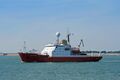 James Clark Ross outward bound from Portsmouth Naval Base 1 September 2010

See also
- Vernadsky Research Base
- RRS Ernest Shackleton, a former British Antarctic Survey Royal Research Ship.
- RRS Sir David Attenborough, a new Royal Research Ship which entered service in 2021.
- James Ross Island
Footnotes
- ↑ "Twitter - British Antarctic Survey". British Antarctic Survey. https://twitter.com/BAS_News/status/1428360353717514250. Retrieved 2021-09-08.
- ↑ "Technical Data - RRS James Clark Ross". British Antarctic Survey. Archived from the original on 6 September 2007. https://web.archive.org/web/20070906154414/http://www.antarctica.ac.uk/living_and_working/research_ships/rrs_james_clark_ross/technical_data.php. Retrieved 2007-08-20.
- ↑ "BAS Public Information Leaflet - Ships". British Antarctic Survey. http://www.antarctica.ac.uk/about_bas/publications/bas_ships.rtf. Retrieved 2007-11-24.
- ↑ Mike Gloistein. "RRS James Clark Ross". Archived from the original on 2008-04-06. https://web.archive.org/web/20080406042123/http://www.gm0hcq.com/james.htm. Retrieved 2007-11-24.
- ↑ "RRS James Clark Ross". British Antarctic Survey. http://www.antarctica.ac.uk/living_and_working/research_ships/rrs_james_clark_ross/. Retrieved 2007-11-24.
- ↑ "RRS James Clark Ross" (in en-GB). https://www.bas.ac.uk/polar-operations/sites-and-facilities/facility/rrs-james-clark-ross/.
- ↑ Jonathan Amos (2 March 2018). "Mission to giant A-68 berg thwarted by sea-ice". BBC News. https://www.bbc.com/news/science-environment-43257289. Retrieved 12 April 2018.
- ↑ "RRS James Clark Ross sold". British Antarctic Survey. 19 August 2021. https://www.bas.ac.uk/media-post/rrs-james-clark-ross-sold. Retrieved 19 August 2021.
 |  |


