Engineering:Drywall anchor

A drywall anchor, also known as a wall anchor, is an insert that, combined with the appropriate screw, can create a mounting point anywhere on a drywall panel or similar hollow wall.[1] A drywall anchor goes between the screw and the drywall, gripping the drywall much more effectively than a screw would.[2] Some have toggle arms that either drop behind the wall or expand within the cavity. Others include wide threads that carve out grooves in the wallboard to create resistance against tension forces when tightened. All drywall anchors are designed to create a mounting point in a substrate that cannot support a screw or other fastener by itself by distributing the applied load over an increased surface area.
Drywall anchors are specifically used when creating a mounting point that does not have a wall stud behind it.[2]
Common forms of drywall anchor include expandable plastic wall plugs and metal (molly bolts), WallClaw anchors, toggle bolts, and self-drilling drywall anchors.[3]
| Anchor Type | Common Material | Typical Tension Strength
(Pull-out) |
Typical Shear Strength
(Downward load) |
Primary Substrates and Common Use Cases |
|---|---|---|---|---|
| Plastic expansion anchor | Plastic / Nylon | 10 to 20 lb (4.5 to 9.1 kg) | 20 to 30 lb (9.1 to 13.6 kg) | Drywall, plaster, concrete, brick; intended for lightweight items. |
| Self-drilling / threaded anchor | Zinc alloy or plastic | 25 to 50 lb (11 to 23 kg) | 40 to 75 lb (18 to 34 kg) | Drywall, gypsum board; medium-weight fixtures without pre-drilling. |
| Toggle bolt | Steel / Zinc-plated steel | 50 to 150 lb (23 to 68 kg) | 75 to 250 lb (34 to 113 kg) | Drywall, plaster, hollow block; heavy items and ceilings. |
| Strap toggle | Plastic strap, steel channel | 80 to 265 lb (36 to 120 kg) | 100 to 356 lb (45 to 161 kg) | Drywall, hollow concrete block; heavy-duty and allows bolt removal. |
| Molly bolt | Zinc-plated steel | 25 to 50 lb (11 to 23 kg) | 40 to 80 lb (18 to 36 kg) | Drywall, plaster; medium to heavy fixtures. |
| Concrete screw (e.g., Tapcon) | Carbon steel or stainless steel | 300 to 600 lb (140 to 270 kg) | 400 to 900 lb (180 to 410 kg) | Concrete, brick, cinder block; direct masonry anchoring only. |
| Hammer-driven anchor | Carbon steel or zinc alloy | 15 to 30 lb (6.8 to 13.6 kg) | 30 to 50 lb (14 to 23 kg) | Drywall, drywall over wood or metal studs; high-speed installation. |
| Tapered universal anchor | High-strength polymer | 30 to 60 lb (14 to 27 kg) | 50 to 90 lb (23 to 41 kg) | Drywall, concrete, hollow brick, ceramic tile; versatile substrate use. |
| Spring toggle anchor | Zinc-plated steel | 40 to 90 lb (18 to 41 kg) | 60 to 120 lb (27 to 54 kg) | Drywall, hollow ceilings, plaster; heavy overhead lighting fixtures. |
| Winged plastic anchor | Nylon / Plastic | 20 to 35 lb (9.1 to 15.9 kg) | 30 to 60 lb (14 to 27 kg) | Drywall, hollow doors, plaster; light-to-medium duty. |
-
 Plastic wall plugs
-
 Expandable metal Molly bolt
-
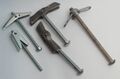
-
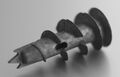 Self-drilling wall anchor


See also
References
- ↑ Sloane, Steve. "The Purpose and Use of Drywall Anchors" (in en-US). https://homeguides.sfgate.com/purpose-use-drywall-anchors-99223.html. Retrieved 2018-08-29.
- ↑ 2.0 2.1 Lloyd, Craig (2017-07-31). "How to Install Drywall Anchors to Hang Heavy Stuff on Your Walls" (in en-US). How-To Geek. https://www.howtogeek.com/319669/how-to-install-drywall-anchors-to-hang-heavy-stuff-on-your-walls/.
- ↑ Joseph, Truini (2013-10-21). "Hollow-Wall Anchors: How to Hang Something on the Wall Without a Stud" (in en-US). Popular Mechanics. https://www.popularmechanics.com/home/interior-projects/how-to/g1320/what-to-know-about-hollow-wall-anchors/.
 |  |


