Engineering:Hongqi H7
| Hongqi H7 | |
|---|---|
 | |
| Overview | |
| Manufacturer | Hongqi (FAW Group) |
| Production |
|
| Body and chassis | |
| Class | Executive car (E) |
| Body style | 4-door Sedan |
The Hongqi H7 is a executive sedan produced by Chinese automobile manufacturer Hongqi, a subsidiary of FAW Group. It is the successor to the Hongqi HQ3 built between 2006 and 2010.
First generation (2013–2021)
| First generation | |
|---|---|
 | |
| Overview | |
| Production | 2013–2021 |
| Assembly | China: Changchun, Jilin |
| Body and chassis | |
| Class | Executive car (E) |
| Body style | 4-door sedan |
| Layout | Front-engine, rear-wheel-drive |
| Powertrain | |
| Engine |
|
| Power output |
|
| Transmission | 6-speed automatic |
| Dimensions | |
| Wheelbase | 2,970 mm (116.9 in) |
| Length | 5,095 mm (200.6 in) |
| Width | 1,875 mm (73.8 in) |
| Height | 1,485 mm (58.5 in) |
| uk|uk|Kerb|Curb}} weight | 1,800–1,805 kg (3,968–3,979 lb) |
| Chronology | |
| Predecessor | Hongqi Shengshi |
| Successor |
|
The first generation H7 was first presented to the public at the Beijing Motor Show in April 2012, and officially went on sale at the end of May 2013.[1] The first 500 Hongqi H7 vehicles had been sold before launch to the Chinese government.[2]
-
 Rear view

2016 facelift
At the Beijing Motor Show 2016, Hongqi presented a revised version of the H7. In addition, a plug-in hybrid version was presented.[3]
-
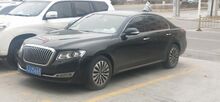 Hongqi H7 (facelift)
-
 Rear view


News of a second generation model surfaced in 2019. However, the actual model launched later was named the Hongqi H9 which was more upmarket and sold alongside the H7.[4]
Second generation (2026–present)
| Second generation | |
|---|---|
 | |
| Overview | |
| Production | 2026–present[5] |
| Assembly | China: Changchun, Jilin |
| Body and chassis | |
| Class | Executive car (E) |
| Body style | 4-door sedan |
| Layout | Front-engine, front-wheel-drive |
| Powertrain | |
| Engine |
|
| Transmission | 1-speed DHT |
| Battery |
|
| Electric range |
|
| Plug-in charging | DC: 100–115 kW |
| Dimensions | |
| Wheelbase | 2,970 mm (116.9 in) |
| Length | 5,060 mm (199.2 in) |
| Width | 1,910 mm (75.2 in) |
| Height | 1,480 mm (58.3 in) |
| uk|uk|Kerb|Curb}} weight | 1,800–1,805 kg (3,968–3,979 lb) |
| Chronology | |
| Predecessor | Hongqi H7 (first generation) |
The second generation H7 was unveiled on 24 April 2026 at the Beijing Auto Show. The powertrain is a plug-in hybrid with a 1.5 liter turbo engine developing 110kW.[6]
It has a 15.6-inch 2.5K-resolution central infotainment touchscreen and a 30-inch AR-HUD both powered by a Qualcomm Snapdragon 8295P SoC.[7]
It is equipped with a Level 2 ADAS system powered by one mmWave radar and a 10-camera array and is capable of urban and highway assisted driving.[7]
-
 Rear view
-
 Interior


Powertrain
The second-generation H7 is available exclusively as a plug-in hybrid. It is powered by a 1.5-liter turbocharged petrol engine in Miller cycle outputting 141 hp (105 kW; 143 PS) (gross power: 147 hp (110 kW; 149 PS)) and paired to a 1-speed DHT. It is joined by a permanent magnet synchronous motor at the front axle and optionally with another on the rear axle for dual-motor all-wheel drive. All versions have a top speed of 200 km/h (124 mph).
The H7 set the Guinness World Record for the farthest distance traveled by a production plug-in hybrid sedan without recharging or refueling with a distance of 2,916.171 km (1,812.025 mi).[7]
| Battery | Power | Torque | Electric range | DC charging | 0–100 km/h (62 mph) |
Kerb weight | |||||||
|---|---|---|---|---|---|---|---|---|---|---|---|---|---|
| Type | Weight | Engine | Motor | System | Engine | Motor | System | WLTP | CLTC | Peak | 20–80% | ||
| 23.9 kWh LFP CANE | 203.5 kg (449 lb) |
141 hp (105 kW; 143 PS) at 5,000rpm |
225 hp (168 kW; 228 PS) |
373 hp (278 kW; 378 PS) |
225 N⋅m (166 lb⋅ft) at 3,000–4,000rpm |
340 N⋅m (251 lb⋅ft) |
565 N⋅m (417 lb⋅ft) |
151 km (94 mi) |
180 km (112 mi) |
115 kW | 10.4 min | 7.4 s | 1,970 kg (4,343 lb) |
| 30.3 kWh NMC Zenergy | 196.5 kg (433 lb) |
191 km (119 mi) |
240 km (149 mi) |
100 kW | 13.6 min | 6.9 s | 1,975 kg (4,354 lb) | ||||||
| 495 hp (369 kW; 502 PS) |
642 hp (479 kW; 651 PS) |
646 N⋅m (476 lb⋅ft) |
871 N⋅m (642 lb⋅ft) |
171 km (106 mi) |
210 km (130 mi) |
3.9 s | 2,090 kg (4,608 lb) | ||||||
References
- ↑ Tycho de Feijter (2013-05-31). "Hongqi H7 launched on the Chinese car market". https://carnewschina.com/2013/05/31/hongqi-h7-launched-on-the-chinese-car-market/.
- ↑ Tycho de Feijter (2013-04-01). "FAW says it sold 500 (five hundred) Hongqi H7 sedans to the Government". https://carnewschina.com/2013/04/01/faw-says-it-sold-500-five-hundred-hongqi-h7-sedans-to-the-government/.
- ↑ Tycho de Feijter (2016-05-03). "Facelifted Hongqi H7 Hits The Beijing Auto Show In China". https://carnewschina.com/2016/05/03/facelifted-hongqi-h7-hits-the-beijing-auto-show-in-china/.
- ↑ Brad Anderson (2019-12-11). "New Hongqi H7 Luxury Sedan Looks Derivative, Yet Has Our Attention". carscoops.com. https://www.carscoops.com/2019/12/hongqis-new-h7-has-striking-european-looks/.
- ↑ "全新红旗H7整车正式下线 搭载1.5T插混系统" (in zh). https://news.yiche.com/zonghexinwen/20260622/20110940013.html.
- ↑ "2026北京车展:红旗全新H9/H7等多款新车领衔 红旗展台王炸阵容" (in zh-CN). https://www.autohome.com.cn/news/202604/1313877.html#pvareaid=103453.
- ↑ 7.0 7.1 7.2 Qing, Yuan (2026-09-16). "Error: no
|title=specified when using {{Cite web}}". https://www.ithome.com/1/003/317.htm. - ↑ "参数配置" (in zh-CN). https://www.autohome.com.cn/config/series/4845.html#pvareaid=100134.
External links
 |  |


