Engineering:Hwasong-9
The Hwasong-9[1][lower-alpha 1] (Korean: 《화성-9》형; lit. Mars Type 9) is a North Korean single-stage, liquid-fueled medium-range ballistic missile.
Description
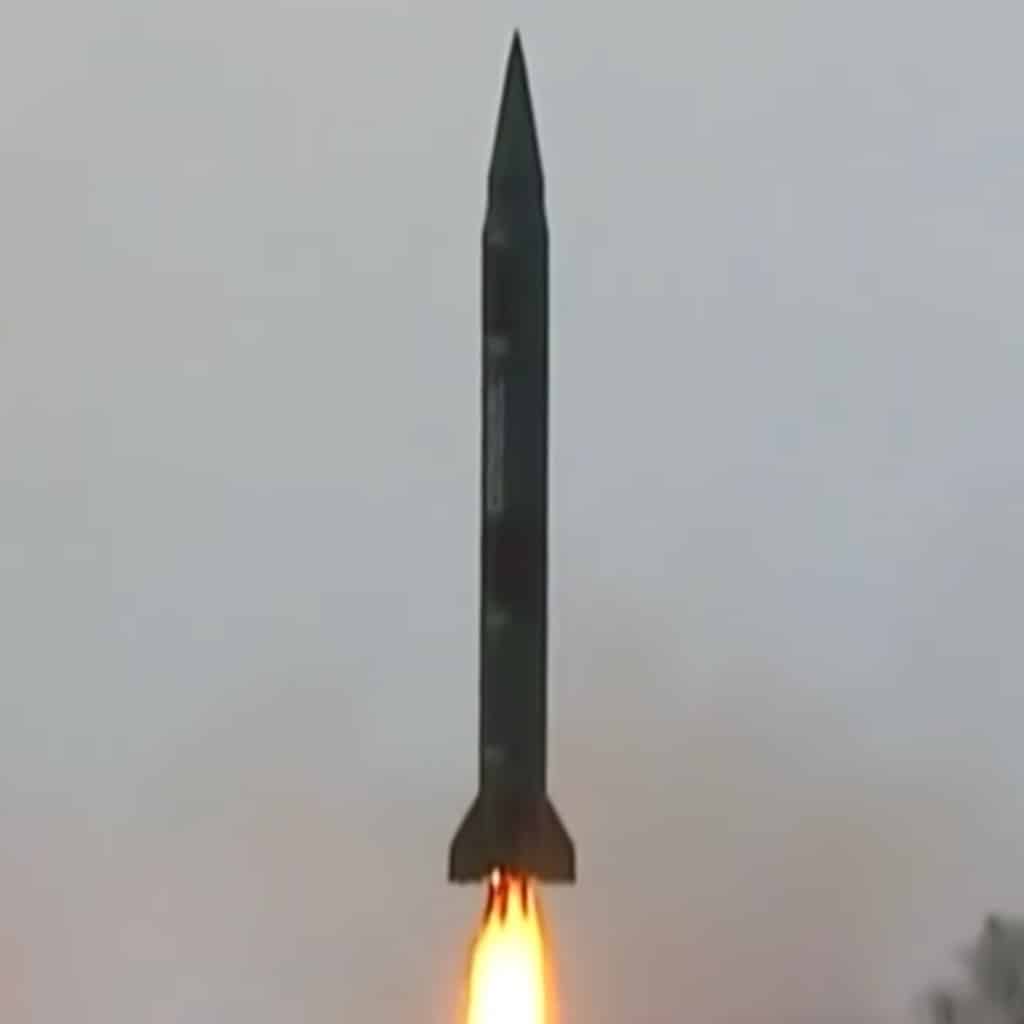
 September 2016 test September 2016 test | |
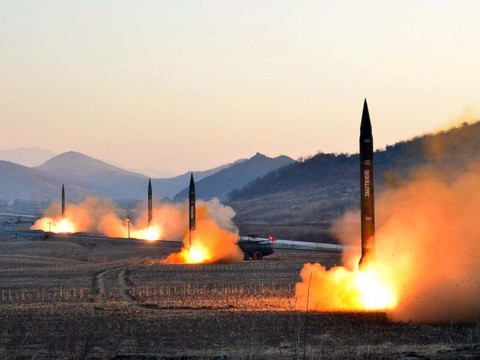
| March 2017 test |
The Hwasong-9 is an advanced version of Hwasong-6 with a longer, lighter and wider body to storing more propellants. The Hwasong-9's estimated length, diameter and mass are 12.8–13.5 m (42–44 ft), 0.88 m (2 ft 11 in) and 6,400–9,200 kg (14,100–20,300 lb) respectively. The missile's transporter erector launcher is a MAZ-543 truck with four axles. It also has a separable warhead that is separated after engine burnout to improve the trajectory stability and reduce the radar signature.[2][3][4]
As an enlarged, extended-range version of Hwasong-6, it can exchange payload for greater range. The Hwasong-9 is capable of travelling 700–1,000 km (430–620 mi) with a reduced payload of 500 kg (1,100 lb) and enlarging the propellant tanks. It is a single-stage, road mobile missile that can employ a high-explosive, submunition, chemical, or potentially miniaturized nuclear warhead with a 3 km (1.9 mi) CEP. Its range allows the North Korean military to strike anywhere on the Korean peninsula and threaten areas of Japan. It is possible that Hwasong-9 is nuclear-capable.[2][3][5]
History
Reportedly, North Korea began developing Hwasong-9 in 1991 and could start production from 1994. Before starting production, North Korea reportedly tested Hwasong-9 in 1993.[2]
Reports suggest Syria received these missiles in 2000, enabling them to target all of Israel and southeastern Turkey, including Ankara. Syria also converted its own Hwasong-6 production line in order to make the Hwasong-9.[2][5]
According to the United Nations, since 2008, North Korea has assisted Syria in development of manoeuvrable vehicles for Hwasong-9.[6]
Hwasong-9 was test-fired in September 2016 and March 2017.[7]
In 2024, Hwasong-9 was reported to be used during Russian invasion of Ukraine from November 2023.[8]
According to the International Institute for Strategic Studies (IISS), as of 2025, North Korea is possessing "some" Hwasong-9 launchers.[9]: 268
List of tests
| Attempt | Date (Pyongyang Standard Time) | Location | Number of missiles tested | Outcome | Additional notes | Reference(s) |
|---|---|---|---|---|---|---|
| 1 | 1993 | Unknown | Unknown | Unknown | First reported test of Hwasong-9, but difficult to confirm due to its similar to Hwasong-6. | [2] |
| 2 | 5 September 2016, 12:14 p.m. | Hwangju, North Hwanghae Province | 3 | Success | These missiles flew for nine minutes, achieved 1,000 km (620 mi) range and around 200 km (120 mi) apogee. The launch was supervised by Kim Jong Un. | [7][10][11] |
| 3 | 6 March 2017, 7:36 a.m. | Sohae Satellite Launching Station | 4 (or 5) | Success (four missiles) Failure (possible fifth missile) |
These missiles were launched simultaneously, achieved 260 km (160 mi) apogee and 1,000 km (620 mi) range. Three of four missiles landed just inside Japan's exclusive economic zone. Kim Jong Un also supervised the launch. It is possible that a fifth missile was launched in this salvo, but it appears to be failed shortly after launch. | [12][13][14][15] |
North Korea may also test Hwasong-9 in 2006, 2009, and 2014, but due to the similarities between their Scud variants, it is difficult to confirm the exact missile used for each launch.[2]
Notes
- ↑ Also known as Scud-ER (Scud Extended Range) and KN-04 (United States’s designation).[2][3]
References
- ↑ Vladimir Khrustalev (2017-07-16). "Real Name!". http://www.neams.ru/real-name/.
- ↑ 2.0 2.1 2.2 2.3 2.4 2.5 2.6 "Hwasong-9 (Scud-ER)". Center for Strategic and International Studies. 8 August 2016. https://missilethreat.csis.org/missile/scud-er/.
- ↑ 3.0 3.1 3.2 "DPRK Military Parade Viewbook 2022". 2022-04-21. p. 6. https://opennuclear.org/sites/default/files/2022-04/DPRK%20Parade%20ViewBook%2020220421.pptx_.pdf.
- ↑ "Flashback to the Past: North Korea's "New" Extended-Range Scud". 8 November 2016. https://www.38north.org/wp-content/uploads/2016/11/Scud-ER-110816_Schiller_Schmucker.pdf.
- ↑ 5.0 5.1 "Hwasong-9 (Scud-ER/Scud-D Variant)". https://missiledefenseadvocacy.org/missile-threat-and-proliferation/todays-missile-threat/north-korea/scud-er/.
- ↑ James Bingham (2018-04-04). "UN report reveals extent of North Korean arms sales". http://www.janes.com/article/78999/un-report-reveals-extent-of-north-korean-arms-sales.
- ↑ 7.0 7.1 "The CNS North Korea Missile Test Database". https://www.nti.org/wp-content/uploads/2021/10/north_korea_missile_test_database.xlsx.
- ↑ Thế Duy (2024-10-21). "Tên lửa Triều Tiên Hwasong-9 được phát hiện tấn công mục tiêu ở Ukraine" (in vi). https://congthuong.vn/ten-lua-trieu-tien-hwasong-9-duoc-phat-hien-tan-cong-muc-tieu-o-ukraine-353771.html.
- ↑ International Institute for Strategic Studies (12 February 2025). The Military Balance 2025 (1st ed.). Routledge. ISBN 978-1041049678.
- ↑ "Kim Jong Un Guides Fire Drill of Ballistic Rockets". 6 September 2016. http://kcna.co.jp/item/2016/201609/news06/20160906-01ee.html.
- ↑ "Triều Tiên phóng 3 tên lửa đạn đạo ra vùng biển phía Đông" (in vi). Gia Lai Newspaper and Radio, Television. 2016-09-05. https://gialaitv.vn/trieu-tien-phong-3-ten-lua-dan-dao-ra-vung-bien-phia-dong/.
- ↑ John Schilling (8 March 2017). "Much Ado About Nothing: DPRK's Latest Missile Test Reveals No New Capabilities". https://www.38north.org/2017/03/jschilling030817/.
- ↑ "Kim Jong Un Supervises Ballistic Rockets Launching Drill of Hwasong Artillery Units of KPA Strategic Force". 7 March 2017. http://kcna.co.jp/item/2017/201703/news07/20170307-01ee.html.
- ↑ Dave Schmerler (16 March 2017). "Did North Korea test a fifth missile last week?". NK News. https://www.nknews.org/pro/did-north-korea-test-a-fifth-missile-last-week/.
- ↑ Trần Phương (2017-03-06). "Triều Tiên bắn nhiều tên lửa mạnh" (in vi). An Giang Newspaper and Radio, Television. https://angiangtv.vn/tin-tuc-va-su-kien/trieu-tien-ban-nhieu-ten-lua-manh/.
 |  |