Engineering:Oldsmobile Vista Cruiser
| Oldsmobile Vista Cruiser | |
|---|---|
.jpg) 1966 Oldsmobile Vista Cruiser | |
| Overview | |
| Manufacturer | Oldsmobile (General Motors) |
| Model years | 1964–1977 |
| Body and chassis | |
| Class | Mid-size |
| Body style | Station Wagon |
| Layout | FR layout |
| Platform | A-body |
| Chassis | body on frame |
| Related | (station wagons) Chevrolet Chevelle Greenbrier Pontiac Tempest Custom Safari Buick Sport Wagon (coupes & sedans) Oldsmobile Cutlass Chevrolet Chevelle Pontiac Tempest Buick Skylark |
| Chronology | |
| Successor | Oldsmobile Cutlass Supreme Cruiser |
The Oldsmobile Vista Cruiser is a station wagon manufactured and marketed by Oldsmobile over three generations from 1964 to 1977.
The first and second generation Vista Cruisers are noted for their fixed-glass, roof-mounted skylights over the second-row seating with sun visors for the second row passengers, a raised roof behind the skylight and lateral glass panels over the rear cargo area along the raised roof, and access to the third row of forward-facing passenger seating was accomplished by a second row split bench seat that retracted forward.
Sharing its bodystyle with the Buick Sport Wagon, Pontiac Tempest Safari and Chevrolet Chevelle Greenbrier, the Vista Cruiser was introduced on February 4, 1964, as a 1964 model, based on the Oldsmobile Cutlass/F-85 Series.[1] The skylight roof panel was only shared with the Buick Sport Wagon and was not available on the Chevrolet Chevelle or Pontiac Tempest station wagons.[1] Prior to the 1973 model year the Vista Cruiser utilized a wheelbase which was 5 inches (127 mm) longer than that of the Cutlass/F-85 sedan.
Subsequent Oldsmobile mid-size wagons featured a skylight as did the 1991–92 full-size Oldsmobile Custom Cruiser wagon and the 1991–96 Buick Roadmaster Estate.
Reminiscent of earlier models, the third generation Vista Cruiser (1973–1977) featured optional rear-facing third row seating, while incorporating a single flat venting moonroof over the front row seating.
First generation (1964–1967)
| First generation | |
|---|---|
.jpg) 1965 Vista Cruiser | |
| Overview | |
| Model years | 1964–1967 |
| Assembly | United States: Lansing, Michigan (Lansing Car Assembly)[1] Fremont Assembly, Fremont, California[1] |
| Body and chassis | |
| Platform | GM A-body |
| Related | Buick Sport Wagon Pontiac Tempest Safari Chevrolet Chevelle Greenbrier |
| Powertrain | |
| Engine |
|
| Transmission | 2-speed Jetaway automatic 3-speed Roto Hydramatic 4-speed manual 3-speed manual |
| Dimensions | |
| Wheelbase | 120 in (3,048 mm) |
| Length | 208 in (5,283 mm) |
| Width | 73.6 in (1,869 mm) |
| |uk|Kerb|Curb}} weight | 3,405 lb (1,544 kg) |
_cropped.jpg)
.jpg)
.jpg)
.jpg)
.jpg)
The first-generation Vista Cruiser pioneered a standard[1] raised roof with split skylight that began over the second-row seating, with lateral glass panels over the rear cargo area that was earlier introduced in 1954 on the GMC Scenicruiser Bus. Sun visors for second row passengers, and a third row of forward-facing passenger seating, were available as an option. Access to the third row was gained by a split-folding second row seat that could be retracted forward.
In 1964, the Vista Cruiser was one of three station wagons offered by Oldsmobile, the others being the F-85 station wagon which shared the "A" platform intermediates, and the full-sized GM B platform Dynamic 88 Fiesta.[1]
From 1965 Oldsmobile discontinued the full-sized Oldsmobile Dynamic 88 wagon, making the Vista Cruiser the division's longer model; the shorter-wheelbase F-85 station wagon became the entry-level trim package of the Vista Cruiser and was not offered the raised roof skylights.[1]
Engines in the Vista Cruiser paralleled other Olds intermediates, with a 330 cu in (5.4 L) Rocket V8 offered from 1964 to 1967 producing from 210 to 320 horsepower (160 to 240 kW) depending on year and carburetion. For 1964, Buick's 225 cu in (3.7 L) V6 was the standard engine.[1]
Transmission included the two-speed Jetaway automatic transmission and two rarely equipped manual transmissions, a three-speed column shift and a four-speed floor shift.
Beginning in 1966 it revived the long-standing tradition offering optional simulated woodgrain using DI-NOC vinyl wrap appearance.[1]
| First-generation Vista Cruiser production (6- and 9 passenger combined)[1] | ||
|---|---|---|
| Year | Vista Cruiser | Vista Cruiser Custom |
| 1964 | 3,394 | 10,606 |
| 1965 | 5,445 | 26,540 |
| 1966 | 3,529 | 23,077 |
| 1967 | 2,748 | 24,806 |
Second generation (1968–1972)
| Second generation | |
|---|---|
| File:1970 Oldsmobile Vista Cruiser, front right (ISWC meet, July 15, 2023).jpg 1970 Vista Cruiser | |
| Overview | |
| Model years | 1968–1972 |
| Assembly | United States: Lansing, Michigan (Lansing Car Assembly)[1] Framingham Assembly, Framingham, Massachusetts[1] Fremont Assembly, Fremont, California[1] Linden Assembly, Linden, New Jersey[1] Canada: Oshawa Car Assembly, Oshawa, Ontario[1] |
| Body and chassis | |
| Platform | GM A-body |
| Related | Buick Sport Wagon Pontiac Tempest Safari Chevrolet Chevelle Greenbrier |
| Powertrain | |
| Engine | 350 cu in (5.7 L) Rocket V8 400 cu in (6.6 L) Rocket V8 455 cu in (7.5 L) Rocket V8 |
| Transmission | 2-speed Jetaway automatic 3-speed Turbo Hydramatic automatic 4-speed manual 3-speed manual |
| Dimensions | |
| Wheelbase | 121 in (3,073 mm) |
| Length | 218.2 in (5,542 mm) |
| Width | 77.2 in (1,961 mm) |
| Height | 58.6 in (1,488 mm) |
| |uk|Kerb|Curb}} weight | 4,064 lb (1,843 kg) |
Transmission offerings through the years included one of two automatics—the two-speed Jetaway (1968) or three-speed Turbo Hydramatic (1968–72), or very rarely, a standard three-speed manual with column shift or optional four-speed manual with floor-mounted Hurst shifter borrowed from the Oldsmobile 442.
In 1969, the "Dual-Action" tailgate was introduced as an option on two-row models and standard equipment on three-row.
In 1970, an exterior redesign sharpened edges and curves. Although it closely resembled the 1968-69 models, and is essentially regarded a second-generation car (The GM Skywagon Club recognizes the 1970-72 models as "Generation 2a"), many body parts were no longer interchangeable. The dashboard was also completely redesigned.
For 1971, Oldsmobile brought back the full-sized Custom Cruiser wagon on a 127.0 in (3,226 mm) wheelbase 98 C-body chassis, featuring GM's disappearing clamshell tailgate, but the glass-roofed Vista Cruiser continued until 1972.[1]
A small number of 1972 Vista Cruisers were modified by Hurst Performance for support car duties at the 1972 Indianapolis 500, joining the 1972 Hurst/Olds official pace car. Both were equipped with the 455 cu in (7.5 L) Rocket V8. Two modified Vista Cruisers are known to survive as of 2012, a press car and a medical director's car. As of 2012, the medical director's car is owned by a relative of Ray Harroun, the winner of the first Indianapolis 500 in 1911.
-
 1969 Oldsmobile Vista Cruiser
 -
 1970 Oldsmobile Vista Cruiser
 -
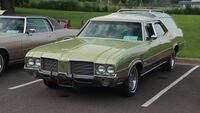 1971 Oldsmobile Vista Cruiser
 -
 1972 Oldsmobile Vista Cruiser
.jpg)
.jpg)
.jpg)
.jpg)
| Second-generation Vista Cruiser production[1] | ||
|---|---|---|
| Year | Vista Cruiser 6 passenger | Vista Cruiser 8 passenger |
| 1968 | 13,375 | 22,768 |
| 1969 | 11,879 | 21,508 |
| 1970 | 10,758 | 23,336 |
| 1971 | 9,317 | 20,566 |
| 1972 | 10,573 | 21,340 |
Third generation (1973–1977)
| Third generation | |
|---|---|
 1977 Vista Cruiser | |
| Overview | |
| Model years | 1973–1977 |
| Assembly | United States: Lansing, Michigan (Lansing Car Assembly)[1] Arlington Assembly, Arlington, Texas Doraville Assembly, Doraville, Georgia Framingham Assembly, Framingham, Massachusetts[1] |
| Body and chassis | |
| Platform | GM A-body |
| Related | Buick Century Estate Pontiac Grand LeMans Safari Chevrolet Malibu Estate |
| Powertrain | |
| Engine | 350 cu in (5.7 L) Rocket V8 403 cu in (6.6 L) Rocket V8 (1977) 455 cu in (7.5 L) Rocket V8 (1973–76) |
| Transmission | 3-speed Turbo Hydramatic automatic |
| Dimensions | |
| Wheelbase | 116 in (2,946 mm) |
| Length | 211 in (5,359 mm) |
| Width | 76.5 in (1,943 mm) |
| Height | 58.6 in (1,488 mm) |
| |uk|Kerb|Curb}} weight | 4,392 lb (1,992 kg) |
For 1973, the GM A-body intermediate platform was completely redesigned and the separate wheelbase used by the Vista Cruiser and Buick Sport Wagon eliminated; all A-body wagons were now built on the 116-inch sedan wheelbase. While its Buick counterpart was replaced with the Buick Century Estate station wagon, the Vista Cruiser was the woodgrained version, and the new Cutlass Supreme Cruiser joined the station wagon list for 1974. Despite the shortened wheelbase, three-row seating returned, with the third row direction changed to facing rearward. The "Dual-Action" tailgate was replaced by a one-piece hatchback with a fixed rear window that did not retract into the door. Ventilation to the third row was limited to the second row side windows.[1]
The model's distinctive skylights gave way to boxy "Colonnade" styling, including the loss of the front door vent windows. A pop-up sunroof over the front seats was optional.
-
 1975 Oldsmobile Vista Cruiser
 -
 1976 Oldsmobile Vista Cruiser
.JPG)

| Third-generation Vista Cruiser production[1] | ||
|---|---|---|
| Year | Vista Cruiser 6 passenger | Vista Cruiser 8 passenger |
| 1973 | 10,894 | 13,531 |
| 1974 | 4,191 | 7,013 |
| 1975 | 4,963 | 9,226 |
| 1976 | n/a | 20,560 |
| 1977 | n/a | 25,816 |
In popular culture
A 1969 Aztec Gold Vista Cruiser was a key component of That '70s Show, with the pilot of the series revolving around Red Forman's decision to pass the car down to his son, Eric Forman. The car would remain a fixture through the series' eight-season run, with many key scenes occurring on or in the car. In the sequel series That '90s Show, Red gives the car to Eric and Donna's daughter, Leia for her 15th birthday. In 2016, Rod Authority named Eric's Vista Cruiser #22 on their list of the 50 greatest television automobiles.[2]
References
- ↑ 1.00 1.01 1.02 1.03 1.04 1.05 1.06 1.07 1.08 1.09 1.10 1.11 1.12 1.13 1.14 1.15 1.16 1.17 1.18 1.19 1.20 Gunnell, John, ed (1995). The Standard Catalog of American Cars 1946–1975. Kraus Publications. pp. 481–518. ISBN 0-87341-204-4.
- ↑ Garage Girl (September 30, 2016). "Top 50 TV Cars of All Time". Power Automedia. https://www.rodauthority.com/news/top-50-tv-cars-of-all-time-no-22-that-70s-show-oldsmobile-wagon/.
- General
- Gunnell, John (2005). American Cars of the 1960s. Krause Publications. p. 194. ISBN 978-0-89689-131-9. https://books.google.com/books?id=_apeyhD-Dj8C&q=Buick+Sport+wagon+history&pg=PA194.
External links
Template:Oldsmobile Template:Oldsmobile postwar timeline
 |  |


.jpg)