Engineering:Philips Pavilion
 | This article includes a list of references, related reading or external links, but its sources remain unclear because it lacks inline citations. (July 2020) (Learn how and when to remove this template message) |
| Philips Pavilion | |
|---|---|
 The Philips Pavilion during the 1958 Brussels World's Fair (Expo 58) | |
| General information | |
| Type | Pavilion |
| Architectural style | Modernism |
| Town or city | 1020 Laeken, City of Brussels, Brussels-Capital Region |
| Country | Belgium |
| Opened | 1958 |
| Demolished | 1959 |
| Technical details | |
| Material | Reinforced concrete |
| Design and construction | |
| Architect | Iannis Xenakis |
| Architecture firm | Le Corbusier |
The Philips Pavilion (French: Pavillon Philips; Dutch: Philipspaviljoen) was a modernist pavilion in Brussels, Belgium, constructed for the 1958 Brussels World's Fair (Expo 58). Commissioned by electronics manufacturer Philips and designed by the office of Le Corbusier, it was built to house a multimedia spectacle that celebrated postwar technological progress. Because Le Corbusier was busy with the planning of Chandigarh, much of the project management was assigned to Iannis Xenakis, who was also an experimental composer and was influenced in the design by his composition Metastaseis.
Le Corbusier's floor plan was "a vague diagram of a stomach with two narrow entrances at either end". To this outline, Xenakis added the "tent-like enclosure" composed of prefabricated concrete panels and connecting cables. Xenakis would later go on to split with Le Corbusier over credit for the pavilion's development.[1]
The reinforced concrete pavilion was a cluster of nine hyperbolic paraboloids in which Edgard Varèse's Poème électronique was spatialized by sound projectionists using telephone dials. To this purpose 325 loudspeakers were set into the walls;[2] the latter were coated in asbestos, giving them a textured look. Varèse, assisted by Philips engineers, worked in a facility provided by Philips in the Strijp III complex in Eindhoven from September 1957 to April 1958.[3] They drew up a detailed spatialization scheme for the entire piece, which made great use of the pavilion's physical layout, especially its height. The asbestos hardened the walls, which created a cavernous acoustic. As audiences entered and exited the building, Xenakis's musique concrète composition Concret PH was heard.
The building, planned to be temporary from the outset, was demolished on 30 January 1959.[2] The European Union later funded a virtual recreation of the Philips Pavilion, which was chaired by Vincenzo Lombardi from the University of Turin.
Arseniusz Romanowicz's Warszawa Ochota train station in Poland is supposedly inspired by the Philips Pavilion.
Construction
-
 Floor plan
 -
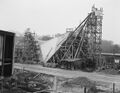 During construction (13 November 1957)
 -
 Near opening (20 March 1958)


References
- ↑ Murphy, Douglas (2022). Last Futures: Nature, Technology and the End of Architecture. London: Verso Books. p. 12-13. ISBN 9781781689820.
- ↑ 2.0 2.1 "Philips Pavilion". https://www.fondationlecorbusier.fr/en/work-architecture/achievements-philips-pavilion-brussels-belgium-1957-1958.
- ↑ Izzo, Leo (1 December 2023). "Edgard Varèse's Poème Électronique: From the Sketches to the Sound Spatialization". Computer Music Journal 47 (4): 5-28. doi:10.1162/COMJ_a_00700. https://direct.mit.edu/comj/article/47/4/5/127576/Edgard-Varese-s-Poeme-Electronique-From-the. Retrieved 29 June 2025.
Further reading
- Marc Treib, Space Calculated in Seconds: The Philips Pavilion, Le Corbusier, Edgard Varèse, Princeton: Princeton Architectural Press, 1996
- James Harley, Xenakis: his life in music, London: Taylor & Francis Books, 2004
- Richard Jarvis, Music to my Eyes: The design of the Philips Pavilion by Ianis Xenakis, Boston: Boston Architectural Center, 2002
- "The Architectural Design of Le Corbusier and Xenakis" in Philips Technical Review v. 20 n. 1 (1958/1959)
- Joe Drew, "Recreating the Philips Pavilion", ANABlog. January 16, 2010.
- Jan de Heer and Kees Tazelaar, From Harmony to Chaos: Le Corbusier, Varèse, Xenakis and Le poème électronique, Amsterdam: 1001 Publishers, 2017
- Wever, Peter (2015). Inside Le Corbusier's Philips Pavilion. nai010 publishers. ISBN 9789462082076.
External links
- Film De Bouw van het Philips Paviljoen (Building the Philips Pavilion), a Dutch documentary about the construction project.
- Virtual Electronic Poem Project, a site about a virtual reconstruction of the Philips Pavilion with extensive information about the original site.
Template:Le Corbusier Template:Iannis Xenakis
 |  |


