Engineering:Post in ground
.jpg)
.jpg)
A post in ground construction, also called earthfast[1] or hole-set posts, is a type of construction in which vertical, roof-bearing timbers, called posts, are in direct contact with the ground. They may be placed into excavated postholes,[2] driven into the ground, or on sills which are set on the ground without a foundation. Earthfast construction is common from the Neolithic period to the present and is used worldwide. Post-in-the-ground construction is sometimes called an "impermanent" form, used for houses which are expected to last a decade or two before a better quality structure can be built.[3]
Post in ground construction can also include sill on grade, wood-lined cellars, and pit houses. Most pre-historic and medieval wooden dwellings worldwide were built post in ground.
History
This type of construction is often believed [by whom?] to be an intermediate form between a palisade construction and a stave construction. Because the postholes are easily detected in archaeological surveys, they can be distinguished from the other two.
The Japanese also used a type of earthfast construction until the eighteenth century, which they call Hottate-bashira (literally "embedded pillars").[4]
The Dogon people in Africa use post in ground construction for their toguna, community gathering places typically located in the center of villages for official and informal meetings.
Poteaux-en-terre
In the historical region of New France in North America, poteaux-en-terre was a historic style of earthfast timber framing. This method is similar to poteaux-sur-sol, but the boulin (hewn posts) are planted in the ground rather than landing on a sill plate. The spaces between the boulin are filled with bousillage (reinforced mud) or pierrotage (stones and mud). One extant example of post in ground construction is the Bequtte-Ribault House in Ste. Genevieve, Missouri. There is also archeological evidence of similar houses in St. Louis near the original boat landing.[5]
Gallery of poteaux-en-terre
-
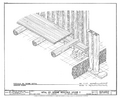 Drawing of poteaux-en-terre in the Beauvais House in Ste. Genevieve, Missouri
 -
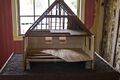 A cross section of a poteaux-en-terre house.
 -
 A model of the Beauvais-Amoureux House, showing poteaux-en-terre construction.
 -
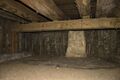 Poteaux-en-Terre-Cellar of the Maison Beauvais-Amoureux.
 -
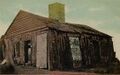 First Courthouse, St. Louis, Missouri; from a c. 1915 postcard.


See also
- French colonization of the Americas
- Old Spanish Fort (Pascagoula, Mississippi). The La Pointe-Krebs House.
- Pit-house
- Post church
- Ste. Genevieve, Missouri
- Stilt house
References
- ↑ Oxford English Dictionary Second Edition on CD-ROM (v. 4.0). Oxford University Press, 2009
- ↑ "Home". http://www.stavkirke.org/.
- ↑ Carson, Cary, Norman F. Barka, William M. Kelso, Garry Wheller Stone, and Dell Upton. "Impermanent Architecture in the Southern American Colonies." Material Life in America, 1600-1860, edited by Robert Blair St. George, 113-158. Boston: Northern University Press, 1988.
- ↑ Gina Lee Barnes. Yamato: archaeology of the first Japanese state. googlebooks?id=S-sDAQAAIAAJ
- ↑ Ekberg, Carl J.; Person, Sandra K. (2015). St. Louis Rising: The French Regime of Louis St. Ange de Bellerive. University of Illinois Press. p. 112. ISBN 978-0-252-03897-6. https://archive.org/details/stlouisrisingfre0000ekbe/page/112/mode/2up. Retrieved December 27, 2025.
External links
- EARTHFAST ARCHITECTURE IN EARLY MAINE
- Earthfast Architecture at the Association for the Preservation of Virginia Antiquities
Hut dwelling designs and semi-permanent human shelters | ||
|---|---|---|
| Traditional immobile |
|  Note: This topic belongs to "Housing" portal |
| Traditional mobile | ||
| Open-air | ||
| Modern | ||
| Named huts | ||
| Related topics | ||


ja:掘立柱
 |  |


