History:Gorkha kingdom
Kingdom of Gorkha गोरखा राज्य Gōrakhā Rājya | |||||||||
|---|---|---|---|---|---|---|---|---|---|
| 1559–1768 | |||||||||
 Flag
 Coat of arms of Shah dynasty
| |||||||||
 Territory, expansion and vassals states of Gorkha Empire. | |||||||||
| Status | Confederation[1] later Kingdom | ||||||||
| Capital | Gorkha | ||||||||
| Common languages | Khas (later Nepali) Newar[2][3][4][lower-alpha 1] | ||||||||
| Religion | Hinduism | ||||||||
| Government | Monarchy | ||||||||
| Mahārājādhirāj | |||||||||
• 1559–1570 | Dravya Shah (first) | ||||||||
• 1743–1768 | Prithvi Narayan Shah (last) | ||||||||
| Sardar | |||||||||
• 1767–1771 | Ram Krishna Kunwar (first and last) | ||||||||
| History | |||||||||
• Established | 1559 | ||||||||
• Disestablished | 1768 | ||||||||
| Currency | Mohar | ||||||||
| |||||||||
| Today part of | Nepal | ||||||||

The Gorkha Kingdom, also known as the Gorkha Confederation or the Gorkha Empire, was one of the Chaubisi states, situated at the junction of the Himalayas and the Indian subcontinent. In 1743, the kingdom began a campaign of military expansion, annexing several neighbors and laying the foundations of present-day Nepal.
Following the disintegration of the Magarat confederation—formerly ruled by the Magar—the region fragmented into the Baise Rajya (22 principalities) in the far west and the Chaubisi Rajya (24 principalities) in central Nepal.[6]
The Gorkha Kingdom extended to the Marshyangdi River in the west, forming its border with the Kingdom of Lamjung. To the east, the kingdom extended to the Trishuli River, forming its border with the Nepal Mandala.[6] The Gorkha kingdom was established in 1559 CE by Prince Dravya Shah, the second son of King Yasho Brahma Shah of Lamjung. Dravya Shah replaced the Magar King Mansingh Khadka Magar who previously ruled the region.[7]
Origin and history
The Kingdom of Gorkha was established in 1559 CE by Dravya Shah, the youngest son of Yasho Brahma Shah, the king of Lamjung, a hill principality in what is now western Nepal.
At the time, the area around Liglig and Gorkha was ruled by local Magar kings, notably King Dalshur Ghale Magar[8] of ligligkot and King Mansingh Khadka Magar of Gorkha. These regions were part of the historical Magarat confederation, a loose alliance of Magar principalities.
Dravya Shah rose to power with the assistance of influential local Magars, including Gongaram Rana Magar, during the traditional Ligligkot race where the winner would assume kingship. After capturing Ligligkot, he went on to conquer Gorkhakot from King Mansingh Khadka Magar, thereby founding the Kingdom of Gorkha in 1559 CE.
The name Gorkha is believed to be derived from the yogi saint Gorakhnath, who is said to have blessed Dravya Shah's rise to power. His influence continues to be revered in the region, including at the Gorakhnath Temple in Gorkha.
Dravya Shah's descendants eventually unified much of what is now Nepal under the leadership of Prithvi Narayan Shah, initiating the unification of Nepal in the 18th century.
-
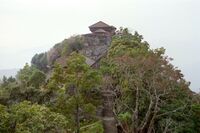 The old king's Darbar at Gorkha
 -
 Mohar of Gorkha king Prithvi Narayan Shah dated Saka Era 1685 (1763 CE)


List of kings of Gorkha

Template:Succession table monarch
Expansion campaign
From the 1730s, the Gorkha Kingdom began expanding under King Nara Bhupal Shah, although most of the significant conquests occurred during the reign of his son, Prithvi Narayan Shah, starting in 1743. His campaigns were later continued by his younger son, Bahadur Shah. Over time, they extended their control over large areas to the east and west of Gorkha.
Among their most important acquisitions was the wealthy Newar confederacy of Nepal Mandala, centered in the Kathmandu Valley. Beginning in the 1760s, the Gorkhalis imposed a blockade to weaken the valley’s kingdoms. In response, the Malla kings appealed to the British East India Company for assistance. In 1767, the Company sent an expedition led by Captain George Kinloch, which failed before reaching Kathmandu.
The three Newar capitals—Kathmandu, Lalitpur, and Bhaktapur—fell to the Gorkhalis between 1768 and 1769. Prithvi Narayan Shah then declared Kathmandu the new capital of his unified kingdom.
In 1788, the Gorkhalis turned their attention northward and invaded Tibet, seizing the towns of Kyirong and Kuti, and forcing the Tibetan government to pay tribute. When Tibet stopped the payments, the Gorkhas launched a second invasion in 1791, during which they looted the Tashilhunpo Monastery in Shigatse. In response, the Qing dynasty of China sent an army into Nepal. The Chinese forces advanced to Nuwakot but were halted due to stiff resistance and logistical challenges.
The Gorkha regent Bahadur Shah requested military assistance from the British, including 10 howitzers, but the arms deal fell through. Eventually, peace was negotiated, and the Sino-Nepalese War concluded with the signing of the Treaty of Betrawati in 1792.
A later conflict, the Nepalese–Tibetan War (1855–1856), resulted in a Nepalese victory and the signing of the Treaty of Thapathali, which granted Nepal financial indemnities and trade privileges.
By the early 19th century, the Gorkha dominion stretched from Kumaon and Garhwal in the west to Sikkim in the east. However, after their defeat in the Anglo-Nepalese War (1814–1816), the Gorkhalis were forced to sign the Treaty of Sugauli, ceding large territories to the British East India Company and reducing the kingdom to its current borders.
Gorkha to Nepal


The Gorkha dominion continued to be known as "Gorkha Rajya" (lit. Gorkha kingdom) as well as Asal Hindustan until the beginning of the 20th century. Historically, the name 'Nepal' referred mainly to Kathmandu valley, the homeland of the Newars. Since the 1930s, the state began using it to refer to the entire country and 'Nepal Khaldo' (Nepal Valley) became 'Kathmandu Valley'.[9][10] The name Gorkha Sarkar (meaning Gorkha government) was also changed to Nepal government.
Similarly, the Gorkhali language was renamed as Nepali in 1933.[11] The term Gorkhali in the former national anthem entitled "Shreeman Gambhir" was changed to Nepali in 1951.[12] The government newspaper, launched in 1901, is still known as Gorkhapatra (meaning Gorkha gazette).
The Shah dynasty ruled Nepal until 2008 when it became a republic following a people's movement.[13] Current Gorkha District and Dhading District (across the Trishuli River) are roughly similar to the territory of the former Gorkha Kingdom.[14]
Gurkhas

The Gurkhas are renowned soldiers recruited mainly from Nepal and parts of India, serving in the British and Indian armies. Their military tradition began after the Anglo-Nepalese War and the Treaty of Sugauli (1816), which allowed the British East India Company to enlist men from the hills of the former Gorkha kingdom.
The Magar and Gurung were the largest groups recruited into the British Gurkha Rifles during World War I and World War II, followed by the Rai and Limbu, who also made significant contributions to the war efforts.
Several Gurkhas have been awarded the Victoria Cross for exceptional bravery, including Kulbir Thapa Magar, Tul Bahadur Pun Magar, Karanbahadur Rana Magar, Lalbahadur Thapa Magar, Netrabahadur Thapa Magar, Rambahadur Limbu, Ganju Lama, Gaje Ghale, and Dipprasad Pun was the first and only Gurkha to receive the Conspicuous Gallantry Cross in the 21st century.
During World War II (1939–1945), over 250,000 Gurkhas served in various battalions and specialized units, earning 2,734 bravery awards and suffering around 32,000 casualties across multiple theatres of war.[15]
Gallery
-
 Metal window
 -
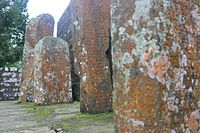 Stone history
 -
 Gorkha Durbar
 -
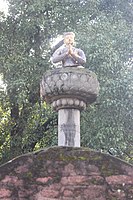 King Prithavi Pal
 -
 Image of goddess & Gorkha Palace
 -
 Gorkha Tallo Durbar
 -
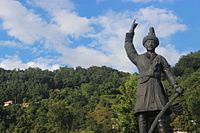 Shree Panch Bada Maharajadhiraj Prithavi Narayan Shah Dev
 -
 Nepali cannon
 -
 Nagada


See also
- Gurkha
- Battle of Kathmandu
- Kingdom of Nepal
- List of Hindu empires and dynasties
- Shah dynasty
- Rana dynasty
Notes
- ↑ Newari continued to remain in official use in Shah dynasty as shown by the 1775 treaty with Tibet, which was written in Newari. Newari remained as the administration and official language of Nepal till the early 19th centuries. Later since 1906, official documents written in Newari were declared illegal. Since then the use of the language for administration and literary purposes was forbidden.[5]
References
- ↑ Hamilton, Francis Buchanan (1819). An Account of the Kingdom Of Nepal and of the Territories Annexed to This Dominion by the House of Gorkha. Edinburgh: Longman. http://www.gutenberg.org/files/30364/30364-h/30364-h.htm#page7. Retrieved 12 January 2013. Page 237.
- ↑ Nepal Bhasa Sahityaya Itihas: History of Nepalbhasa Literature.Tuladhar, Prem Shanti (2000). Kathmandu: Nepal Bhasa Academy. ISBN 99933-56-00-X. Page 37: "The early new rulers cultivated Newari language. Kings Prithvi Narayan Shah, Rana Bahadur and Rajendra Bikram Shah composed poetry and wrote many plays in Newari".
- ↑ Levy, Robert I. (1990) Mesocosm: Hinduism and the Organization of a Traditional Newar City in Nepal. Delhi: Motilal Banarsidass Publishers. ISBN 81-208-1038-4. Page 15:"Following the advent of the Shahs, the Gorkhali language became the court language, and Newari was replaced as the language of administration".
- ↑ Malla, kamal. History of the Nepal. Kathmandu, Nepal: Rolwaling press. p. 155
- ↑ Lienhard 1992, p. 3.
- ↑ 6.0 6.1 Kirkpatrick, Colonel (1811). An Account of the Kingdom of Nepaul. London: William Miller. https://archive.org/details/bub_gb_ijxAAAAAYAAJ. Retrieved 12 January 2013. Page 123.
- ↑ Marie Lecomte-Tilouine (Senior Researcher, Anthropology) CNRS, Paris, France. "The Enigmatic Pig: On Magar Participation in the State Rituals of Nepal, pp. 81-120 in M. Lecomte-Tilouine: Hindu Kingship, Ethnic Revival and Maoist Rebellion in Nepal. Delhi: Oxford University Press, "Collected Essays", 2009, 294 p". Oxford University Press. https://www.academia.edu/12163822. - Page 85, p.95
- ↑ "King Dalsur Ghale Magar of LigligKot - The tradition of selecting the King by Magar people". Organising committee convenor, Purna Bahadur Rana. Thehimalayantimes.com. 8 October 2016. https://thehimalayantimes.com/sports/anish-thapa-magar-wins-crown-liglige-race-gorkha#:~:text=It%20is%20believed%20that%20Dalsur%20Ghale%20Magar%20became%20the%20first%20king%20of%20Liglig%20Kot.
- ↑ Planet, Lonely. "History of Nepal - Lonely Planet Travel Information". http://www.lonelyplanet.com/nepal/history.
- ↑ Bindloss, Joseph (2010-09-15) (in en). Nepal 8. Lonely Planet. ISBN 9781742203614. https://books.google.com/books?id=wiIw2_WFwC4C.
- ↑ Lienhard, Siegfried (1992). Songs of Nepal: An Anthology of Nevar Folksongs and Hymns. New Delhi: Motilal Banarsidas. p. 3. ISBN 81-208-0963-7.
- ↑ "The kings song". Himal Southasian. June 2003. http://www.himalmag.com/component/content/article/4214-.html.
- ↑ "Nepal's Gorkha kingdom falls". The Times of India. 2 June 2008. http://articles.timesofindia.indiatimes.com/2008-06-02/rest-of-world/27770497_1_narayanhity-dipendra-prithvi-narayan-shah.
- ↑ Kirkpatrick, William (1811). An Account of the Kingdom of Nepaul. London: William Miller. p. 123. https://archive.org/details/bub_gb_ijxAAAAAYAAJ. Retrieved 12 January 2013.
- ↑ Cite error: Invalid
<ref>tag; no text was provided for refs namedwwii_gurkhas
 |  |


