Place:Banpo
Banpo is a Neolithic archaeological site located in the Yellow River valley, east of present-day Xi'an, China. Discovered in 1953 by Shi Xingbang,[1] the site represents the first phase of the Yangshao culture (c. 5000 – c. 3000 BCE) and features the remains of several well organized settlements—including Jiangzhai, which has been radiocarbon dated to c. 4700 – c. 3600 BCE).[2][3][4][5] An area of 5 to 6 hectares (12 to 15 acres) was surrounded by a ditch, probably a defensive moat 5 to 6 meters (16 to 20 ft) wide. The houses at Banpo were circular, built of mud and wood on low foundations, with overhanging thatched roofs. There also appear to have been communal burials.[6]
Site
The settlement was surrounded by a moat, with graves and pottery kilns located outside the moat perimeter. Many of the houses were semi-subterranean with the floor typically 1 meter (3 ft) below the ground surface. The houses were supported by timber poles and had steeply pitched thatched roofs. Population estimates for the site typically range between 100-500 people,[7] though estimations are limited because of the large portion of the settlement still unexcavated.[8]
Early Banpo society is generally held to be egalitarian.[8] However, nineteenth-century literature like Friedrich Engels' The Origin of the Family, Private Property and the State, which linked matriarchy to the early phases of developing societies, was introduced into Chinese theoretical thought in the 1930s and applied to Banpo as it was being excavated.[8] Thus, as it favored the Marxist doctrine at the time, the settlement was determined to be matrilineal. Excavators pointed towards gender-segregated collective burials, settlement pattern, and a lavish burial—which they believed belonged to a young girl—as proof for a matrilineal settlement.[8] However, many modern archaeologists have criticized the weakness of these claims, pointing out that one cannot decipher the sex of such a young skeleton as that which was found in the rich burial, and the Marxist paradigm is gradually being phased out in modern Chinese archaeological research.[9][8] The archaeological evidence to date has not allowed for deeper insight or analysis concerning the religious or political structure of Banpo society.[6][10]
The site is now home to the Xi'an Banpo Museum, built in 1957 to preserve the archaeological collection.[11]
Agriculture
Banpo is regarded as one of North China's earliest instances of farming,[12] and excavations at the site have uncovered a number of agricultural tools and evidence of both plant and animal cultivation. Of the 6,347 tools excavated at Banpo, 4,271 are believed to be gathering or agricultural tools.[13] Tools found during excavations include hoes, spades, knives, and mortars and pestles,[14] as well as adzes, axes, and digging-stick weights.[15] Many tools, such as adzes and axes, were made of stone, but others like hoes and knives were sometimes made of bone and ceramic instead. Ceramic knives, specifically, were significantly more common than their stone counterparts.[16]
Lack of flotation work during excavations has left a shortage of concrete data. However, theories can potentially be drawn from other early Yangshao sites such as Yuhuazhai, another archaeological site located in Xi'an City near Banpo.[14]
Animals
The primary animals domesticated and cultivated at Banpo were pigs and dogs.[15] Certain oblong structures located in the village without evidence of hearths are suggested to be the remnants of pigsties or other animal pens.[17] The recovery of dog skeletons near food remains have led to speculation that dogs were raised for consumption, however lack of data regarding butchering or cutting marks on the bones prevents a definitive answer. A select few horse remains have also been discovered at the Banpo site.[12]
Aside from pigs and dogs, the people of Banpo also cultivated sheep, cattle, and goats to some extent.[15] Evidence for sheep in faunal assemblage dates back to roughly 4,900-3,800 B.C.E., though information is inconclusive on whether they were domesticated.[12]
Recovered deer bones are evidence that hunting contributed to Banpo diets, and fishing is also believed to have been a source of food. Evidence for fishing includes bone fishhooks and net-sinkers.[15] There is some debate regarding the extent to which fishing was a part of Banpo society, though, as only 5.5% of the over 6,000 tools discovered were confirmed fishing tools.[13] Popular understandings of Banpo assume a strong fishing culture in the village due to the extensive presence of fish in the recovered pottery art,[13] as well as depictions of fish nets.[18]
Plants
In terms of plant cultivation, carbonized millet remains were found inside pottery artifacts, leading researchers to conclude that agriculture, especially the cultivation of millet, were an integral part of Banpo's sustenance. While limited flotation work has been conducted at the Banpo site, research done at the nearby site of Yuhuazhai, nearly identical to Banpo in culture and form, produced a 9:10 ratio of millet in discovered crop remains and has been used to assume ideas about Banpo's agricultural sources.[14]
Millet agriculture at the Banpo site is also supported by environmental reconstruction suggesting a dry climate suitable for millet farming.[13] The millet remains uncovered in Banpo were specifically foxtail millet,[8] which appears to have overtaken broomcorn millet in the Loess Plateau around 5500 BP.[19] Other plant remains uncovered included hazelnuts, chestnuts, pine nuts, and hackberry seeds.[8] Hemp was likely cultivated for medicinal purposes.[15]
Cabbage remains were also discovered at Banpo, however, debates over the validity of these claims arise from misconstrued information on the findings. A 1963 Banpo site report cited by many as support for the presence of cabbage seeds has been unfortunately misinterpreted. The original report confirms the discovery of general vegetable seeds but does not specify cabbage seeds. Other sources seem to confirm that cabbage seeds were, in fact, uncovered. One such discovery by Chen Wenhua of carbonized remains in a pottery container were first believed to be cabbage seeds but were later identified as mustard seeds. Kateřina Šamajová argued in 2023 that the misinterpretation of past reports, limited findings of cabbage remains, and linguistic inconsistencies suggest that cabbage was not an established part of agriculture in Neolithic China.[20]
Banpo culture
Banpo is the type site of the Banpo culture, first phase of the Yangshao Culture. Archaeological sites with similarities to the site at Banpo are considered to be part of the "Banpo phase" (4th-3rd millennium BCE) of the Yangshao culture. Banpo was excavated from 1954 to 1957 and was the first Yangshao culture site to undergo large-scale excavation.[8]
Burial traditions
In total, 174 adult burials and 73 child burials have been excavated at Banpo.[8] Deceased infants and small children were placed in large redware pottery jars and buried near the settlement.[15] Adults had a distinct cemetery on the northern outskirts of the site and, with a few exceptions, were buried laying flat in individual, 2 meter deep pits, often interred with pottery.[15]
One of the most lavish burials was a child, who was buried in a wooden tomb with pottery, bone and green jade jewelry, and three stone pellets.[15] These stone balls are considered to be one of the earliest examples of children's toys.[21] In addition, the opulence suggests the presence of social stratification at the time of the burial, which was in the late Banpo phase.[8]
Pottery
The Banpo site is characterized by its abundance of pottery. Over 500,000 pieces of ceramic potsherds have been recovered from the Banpo site, and almost 1,000 vessels have been reassembled.[8] Since the site was stationed on terraces rich with loess, fine-grained clay materials were present in high amounts, supplying the materials necessary for such a high output of pottery.[22]
Restored vessels were divided into one of four categories: serving receptacles, water containers, cooking utensils, and storage vessels.[8] However, debate over the specific uses of Banpo amphorae has persisted for decades, and many explanations have been offered, such as employment as water-drawing jars, ritual vessels, and fermentation or storage for alcohol.[23] Though a purpose relating to water-drawing is most generally accepted, the practical applications of this function are highly contested, and research completed on Banpo and Jiangzhai amphorae has found residue promoting beer-brewing as a major function of early Yangshao ceramic vessels.[23] Carbon residue on some sherds has also supported the usage of some pottery as cookware.[22]
Pottery innovations
Banpo was the first culture to use the potter's wheel in China, while other cultures continued to use coiling techniques, and the potter's wheel only became generalized by the end of the Yangshao period.[24] Banpo also had the first pottery kilns in China.[24] The designs of the Banpo were often geometric, and animal or anthropomorphic figures.[24]
-
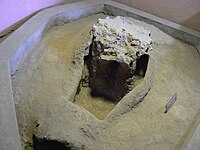 Banpo pottery kiln
 -
 Banpo pottery made on a potter's wheel
 -
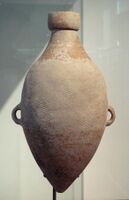 Yangshao traditional cordmarked amphora (Banpo phase, 4800 BC, Shaanxi
.jpg)
.jpg)

Designs
.png)
Banpo decorative pottery, usually in the form of clay bowls or basins with rolled lips, is typically distinguished by a red exterior and black, geometrical drawings on the interior or exterior of the ceramic.[25] Similarities have been noted between the motifs of the Afanasievo culture and Okunev culture of the Minusinsk basin in Siberia, and those on the potteries of Banpo.[26] Pottery style emerging from the Yangshao culture spread westward to the Majiayao culture, and then further to Xinjiang and Central Asia.[27]
Fish patterns are the most common design, with two notable types: "single" fish and "complex" fish, the latter of which is a connected chain of two or more fish.[25] The complex fish gained popularity over time as designs became more abstract and geometrical.[25] Another prevalent motif are human heads, pronounced by triangles and seen often in tandem with the fish. Though there are many theories, no definite explanations for this anthropomorphic design exist, thought most conjectures cite the importance of fish to the Banpo people and culture, subsisting them and perhaps representing prosperity, life, and fertility.[28]
Though more ceramics were red with black decoration, there were also some white and red designs, as well as, most rarely, vessels with red exteriors and gray interiors.[22] Research by Xinyuan Su on the "inner-outer stratification" of Banpo's ceramic-making, where the exterior of a given ceramic piece is a different hue from the interior, posits that the red exterior of Banpo pottery was not caused by traditional masking techniques, but was rather the result of firing techniques which would have exposed the ceramic to various oxygen levels and therefore varied iron oxidation.[22] Firing temperature was typically around 1010 °C, or 1850 °F, and various methods were employed, including buried, enclosed, and stacked firing.[22]
The typical black pigment used for designs on Banpo pottery was derived from pyrolusite; the red designs came from hematite, cinnabar, and ocher; the white designs came from calcite.[22] Several of the potteries have symbol marks, and are part of the Neolithic signs in China, but each sign occurs singly, which is antinomic with the function of a written script. They could instead be the personal mark of individual potters.[8]
-
 Pottery pot with human and fish design, Shaanxi province. Beijing Capital Museum
 -
 Human faced–fish decorated bowl recovered at Banpo.
 -
 Banpo anthropomorphic motif
 -
 Banpo burial
 -
 A skull recovered at Banpo displayed at the Xi'an Banpo Museum.
 -
 Banpo pottery symbols (c.4700-3600 BC)
._Found_in_Shaanxi_province._Beijing_Capital_Museum.jpg)


See also
- Banpo symbols
- Sanxingdui
- Cishan culture
- Nanzhuangtou
- Jiangzhai
- Yangguanzhai
Footnotes
- ↑ "Pioneering archaeologist who helped excavate Terracotta Warriors dies at 99". South China Morning Post. 24 October 2022. https://www.scmp.com/news/people-culture/trending-china/article/3197015/shi-xingbang-pioneering-chinese-archaeologist-who-helped-excavate-terracotta-warriors-and-was.
- ↑ Yang, Xiaoping (2010). "Climate Change and Desertification with Special Reference to the Cases in China". Changing Climates, Earth Systems and Society. pp. 177–187. doi:10.1007/978-9-048-18716-4_8. ISBN 978-9-048-18715-7.
- ↑ Crawford, Garry W. (2004). "East Asian plant domestication". in Stark, Miriam T.. Archaeology of Asia. Blackwell. pp. 77–95. http://faravashi.ir/download/Stark%20(ed.)%202006%20Archaeology%20of%20Asia.pdf.
- ↑ Fuller, Dorian Q.; Qin, Ling; Harvey, Emma (2008). "A Critical Assessment of Early Agriculture in East Asia, with emphasis on Lower Yangzte Rice Domestication". Pragdhara: 17–52. https://www.homepages.ucl.ac.uk/~tcrndfu/articles/china%20overview%20pre.pdf.
- ↑ Meng, Y; Zhang, H. Q.; Pan, F.; He, Z. D.; Shao, J-.L.; Ding, Y. (2011). "Prevalence of dental caries and tooth wear in a Neolithic population (6700-5600 years BP) from northern China". Archives of Oral Biology 56 (11): 1424–1435. doi:10.1016/j.archoralbio.2011.04.003. PMID 21592462.
- ↑ 6.0 6.1 Jarzombek, Mark M.; Prakash, Vikramaditya (2011). A Global History of Architecture. Wiley. pp. 8–9. ISBN 978-0-470-90245-5. https://books.google.com/books?id=dEBY37og6PYC.
- ↑ Peterson, Christian E.; Shelach, Gideon (2012-09-01). "Jiangzhai: Social and economic organization of a Middle Neolithic Chinese village". Journal of Anthropological Archaeology 31 (3): 265–301. doi:10.1016/j.jaa.2012.01.007. ISSN 0278-4165. Bibcode: 2012JAnAr..31..265P. https://www.sciencedirect.com/science/article/pii/S0278416512000086.
- ↑ 8.00 8.01 8.02 8.03 8.04 8.05 8.06 8.07 8.08 8.09 8.10 8.11 8.12 Liu, Li (2020). "Banpocun, Archaeology of". in Smith, Claire. Encyclopedia of Global Archaeology (2nd ed.). Springer, Cham. pp. 1298–1302.
- ↑ Liu, Li (2004). The Chinese Neolithic. Cambridge University Press. p. 11. ISBN 978-1-139-44170-4. https://books.google.com/books?id=lhT0Z4L4g-kC.
- ↑ Lu, H.; Zhang, J.; Liu, K.-b.; Wu, N.; Li, Y.; Zhou, K.; Ye, M.; Zhang, T. et al. (2009). "Earliest domestication of common millet (Panicum miliaceum) in East Asia extended to 10,000 years ago". Proceedings of the National Academy of Sciences 106 (18): 7367–72. doi:10.1073/pnas.0900158106. PMID 19383791. Bibcode: 2009PNAS..106.7367L.
- ↑ "Banpo Museum in Xi'an". chinamuseums.com. http://www.chinamuseums.com/ban_po.htm.
- ↑ 12.0 12.1 12.2 Wang, Hua (28 June 2011). Animal Subsistence of the Yangshao Period in the Wei River Valley: A Case-Study from the Site of Wayaogou in Shaanxi Province, China. University College London.
- ↑ 13.0 13.1 13.2 13.3 Wei Ming Jia, (Peter) (2007-12-31). Transition from Foraging to Farming in Northeast China. BAR Publishing. doi:10.30861/9781407300436. ISBN 978-1-4073-0043-6. https://doi.org/10.30861/9781407300436.
- ↑ 14.0 14.1 14.2 Zhao, Zhijun (2011). "New Archaeobotanic Data for the Study of the Origins of Agriculture in China". Current Anthropology 52: S295–S306. doi:10.1086/659308.
- ↑ 15.0 15.1 15.2 15.3 15.4 15.5 15.6 15.7 Price, T. Douglas; Feinman, Gary (2024). Images of the Past (9th ed.). New York, NY: McGraw Hill LLC. pp. 226–228.
- ↑ Jacques, Guillaume; Stevens, Chris (2024-11-30). "Linguistic, archaeological and genetic evidence suggests multiple agriculture-driven migrations of Sino-Tibetan speakers from Northern China to the Indian subcontinent". Quaternary International 711: 1–20. doi:10.1016/j.quaint.2024.09.001. ISSN 1040-6182. Bibcode: 2024QuInt.711....1J. https://www.sciencedirect.com/science/article/pii/S1040618224002702.
- ↑ Jin, Dan; Shang, Xue; Jiang, Hongen; Guo, Xiaoning; Zhang, Pengcheng; Wang, Liangliang (2024-02-01). "Agricultural practices during the middle and late Yangshao periods (6000-4500 BP) in the Guanzhong Basin, North China". Journal of Archaeological Science: Reports 53. doi:10.1016/j.jasrep.2023.104345. ISSN 2352-409X. Bibcode: 2024JArSR..53j4345J. https://www.sciencedirect.com/science/article/pii/S2352409X23005205.
- ↑ Wu, Kejian; Tang, Peifu (2021), Tang, Peifu; Wu, Kejian; Fu, Zhongguo et al., eds., "The History of Knots and Surgical Suturing" (in en), Tutorials in Suturing Techniques for Orthopedics (Singapore: Springer): pp. 1–8, doi:10.1007/978-981-33-6330-4_1, ISBN 978-981-336-330-4
- ↑ Yang, Yishi; Wang, Jia; Li, Gang; Dong, Jiajia; Cao, Huihui; Ma, Minmin; Chen, Guoke; Dong, Guanghui (2022-07-26). "Shift in subsistence crop dominance from broomcorn millet to foxtail millet around 5500 BP in the western Loess Plateau" (in English). Frontiers in Plant Science 13. doi:10.3389/fpls.2022.939340. ISSN 1664-462X. PMID 35958202. Bibcode: 2022FrPS...1339340Y.
- ↑ Šamajová, Kateřina; Westlake, Renata; Kučera, Ondřej; Kučera, Lukáš (2023-12-21). "Combined archaeobotanical and linguistic evidence does not support the early domestication of Brassica rapa varieties" (in en). Vegetation History and Archaeobotany 33 (1): 25–37. doi:10.1007/s00334-023-00970-w. ISSN 0939-6314. https://link.springer.com/10.1007/s00334-023-00970-w.
- ↑ Guo, Li; Eyman, Douglas; Sun, Hongmei (2024). "Introduction". in Guo, Li. Games & Play in Chinese & Sinophone Cultures. Seattle, WA: University of Washington Press. p. 6. ISBN 978-0-295-75240-2.
- ↑ 22.0 22.1 22.2 22.3 22.4 22.5 Su, Xinyuan; Peng, Zhanhui; Tan, Tao; Liu, Huifang; Xing, Huiping; Liu, Baoying; Chao, Xiaolian (2025). "Comprehensive analysis and study of the stratification phenomena of painted pottery unearthed from the Banpo site in China". Advances in Archaeomaterials 6 (100054). doi:10.1016/j.aia.2025.100054. https://doi.org/10.1016/j.aia.2025.100054.
- ↑ 23.0 23.1 Liu, Li; Wang, Jiajing; Liu, Huifang (2020). "The brewing function of the first amphorae in the Neolithic Yangshao culture, North China". Archaeological and Anthropological Sciences 12 (6). doi:10.1007/s12520-020-01069-3. Bibcode: 2020ArAnS..12..118L. https://doi.org/10.1007/s12520-020-01069-3.
- ↑ 24.0 24.1 24.2 Chang, Kwang-chih; Xu, Pingfang; Lu, Liancheng; Pingfang, Xu; Wangping, Shao; Zhongpei, Zhang; Renxiang, Wang (1 January 2005) (in en). The Formation of Chinese Civilization: An Archaeological Perspective. Yale University Press. p. 64. ISBN 978-0-300-09382-7. https://books.google.com/books?id=sP-PN2StH2cC&pg=PA64.
- ↑ 25.0 25.1 25.2 Chen, Ting (2024). "Prehistoric Arts". Illustrated History of Chinese Art. Springer, Singapore. pp. 1–21.
- ↑ Kiselov (Киселёв), С.В. (1962). Study of the Minusinsk stone sculptures (К изучению минусинских каменных изваяний). Historical and archaeological collection ( Историко-археологический сборник). pp. 53–61. http://kronk.spb.ru/library/kiselov-sv-1962b.htm. "During the excavations of the world-famous Yanshao [Yangshao] culture site near the village of Banpo near Xi'an, among numerous painted vessels, two large open bowls with paintings were found, especially important for comparison with images of masks from the Minusinsk-Khakass basin. Inside these bowls are painted masks that are strikingly similar to Minusinsk ones. They are distinguished by a horizontal division of the face into three zones, the presence of horns and a triangular figure above the head, as well as triangles on the chin (Fig. 2 ). Such coincidences can hardly be explained by mere chance. Even a few years before the discoveries in Ban-po, I had to pay attention to a number of features that bring the Eneolithic Afanasiev culture of the middle Yenisei closer to the culture of painted ceramics of Northern China. Apparently, the finds in Ban-po once again confirm these observations. At the same time, the noted finds and comparisons show that the appearance of images, so characteristic of the ancient stone sculptures of the middle Yenisei, not only goes back to the deep antiquity of the pre-Afanasiev time, but is apparently associated with the complex world of symbolic images of the Far East, now known from monuments of the Neolithic of Ancient China."
- ↑ Zhang, Kai (4 February 2021). "The Spread and Integration of Painted pottery Art along the Silk Road". Region - Educational Research and Reviews 3 (1): 18. doi:10.32629/RERR.V3I1.242. "The early cultural exchanges between the East and the West are mainly reflected in several aspects: first, in the late Neolithic period of painted pottery culture, the Yangshao culture (5000-3000 BC) from the Central Plains spreadwestward, which had a great impact on Majiayao culture (3000-2000 BC), and then continued to spread to Xinjiang and Central Asia through the transition of Hexi corridor".
- ↑ Łakomska, Bogna (January 2021). "Images of Animals in Neolithic Chinese Ceramic". Athens Journal of Humanities & Arts 8 (1): 63–80.
References
- Allan, Sarah (ed), The Formation of Chinese Civilization: An Archaeological Perspective, ISBN 0-300-09382-9
- Chang, Kwang-chih. The Archaeology of Ancient China, ISBN 0-300-03784-8
Prehistoric cultures of China | |
|---|---|
| Northeastern China | |
| Upper Yellow River | |
| Middle Yellow River | |
| Lower Yellow River | |
| Middle and Upper Yangtze | |
| Lower Yangtze and Huai | |
| Southern China | |
| Tibet | |
| Xinjiang | |
| Taiwan | |


 |  |


