Place:Livonia
Livonia,[lower-alpha 1] known in earlier records as Livland,[1][lower-alpha 2] is a historical region on the eastern shores of the Baltic Sea. It is named after the Livonians, who lived on the shores of present-day Latvia.
By the end of the 13th century, the name was extended to most of present-day Estonia and Latvia, which the Livonian Brothers of the Sword had conquered during the Livonian Crusade (1193–1290). Medieval Livonia, or Terra Mariana, reached its greatest extent after the Saint George's Night Uprising (1343–1345), which forced Denmark to sell the Duchy of Estonia (northern Estonia conquered by Denmark in the 13th century) to the State of the Teutonic Order in 1346. Livonia, as understood after the retreat of Denmark in 1346, bordered on the Gulf of Finland in the north, Lake Peipus and Russia to the east, and Lithuania to the south.
As a consequence of the Livonian War (1558–1583), the territory of Livonia was reduced to the southern half of Estonia and the northern half of Latvia.
The indigenous inhabitants of Livonia were various Finnic tribes in the north and Baltic tribes in the south. The descendants of the crusaders formed the nucleus of the new ruling class of Livonia after the Livonian Crusade, and they eventually became known as Baltic Germans.
History

Beginning in the 12th century, Livonia became a target for economic and political expansion by Danes and Germans, particularly for the Hanseatic League and the Cistercian Order. Around 1160, Hanseatic traders from Lübeck established a trading post on the site of the future city of Riga, which Bishop Albrecht von Buxthoeven founded in 1201.[1]
Livonian Crusade and the Livonian Brothers of the Sword (1198–1229)
The Livonian Chronicle of Henry from the 1220s gives a firsthand account of the Christianization of Livonia, granted as a fief by the Hohenstaufen (de facto but not known as) the King of Germany, Philip of Swabia (r. 1198–1208), to Bishop Albert of Riga (Albert of Buxhoeveden), nephew of Hartwig II, the Archbishop of Bremen, who sailed (1200) with a convoy of ships filled with armed crusaders to carve out a Catholic territory in the east as part of the Livonian Crusade. Bishop Albert founded the military order of the Livonian Brothers of the Sword (Latin: Fratres militiæ Christi Livoniae, German: Schwertbrüderorden) in 1202; Pope Innocent III sanctioned the establishment in 1204. Albert did so in order to aid the Bishopric of Riga in the conversion of the pagan Curonians, Livonians, Semigallians, and Latgalians living on the shores of the Gulf of Riga. The membership of the order comprised German "warrior monks". Alternative names of the order include the Christ Knights, Sword Brethren, and the Militia of Christ of Livonia. From its foundation, the undisciplined Order tended to ignore its supposed vassalage to the bishops. In 1215, Albert ordered the construction of a cathedral in Riga. In 1218, he asked King Valdemar II of Denmark for assistance, but Valdemar instead arranged a deal with the Brotherhood and conquered the north of Estonia for Denmark. The Brotherhood had its headquarters at Fellin (Viljandi) in present-day Estonia, where the walls of the Master's castle still[update] stand. Other strongholds included Wenden (Cēsis), Segewold (Sigulda) and Ascheraden (Aizkraukle). The commanders of Fellin, Goldingen (Kuldīga), Marienburg (Alūksne), Reval (Tallinn), and the bailiff of Weißenstein (Paide) belonged to the five-member entourage of the Order's Master.
Pope Gregory IX asked the Brothers to defend Finland from Novgorodian attacks in his letter of 24 November 1232;Cite error: Closing </ref> missing for <ref> tag[2]
From the 14th to the 16th centuries, Middle Low German – as spoken in the towns of the Hanseatic League — functioned as the established language of the Livonian lands, but High German subsequently succeeded it as the official language in the course of the 16th and 17th centuries.[3]
Livonian War (1558–1583)


It is, however, more difficult to estimate the scope and magnitude of the support Magnus received in Livonian cities. Compared to the Harrien-Wierland gentry, the Reval city council, and hence probably the majority of citizens, demonstrated a much more reserved attitude towards Denmark and towards King Magnus of Livonia. Nevertheless, there is no reason to speak about any strong pro-Swedish sentiments among the residents of Reval. The citizens who had fled to the Bishopric of Dorpat or had been deported to Muscovy hailed Magnus as their saviour until 1571. Analysis indicates that during the Livonian War a pro-independence wing emerged among the Livonian gentry and townspeople, forming the so-called "Peace Party".{{citation needed|date=June 2020} rces perceived an agreement with Muscovy as a chance to escape the atrocities of war and to avoid the division of Livonia. Thus Magnus, who represented Denmark and later struck a deal with Ivan IV, proved a suitable figurehead for this faction.[citation needed]
During the many years of the Livonian War (1558–1582), the Livonian Order suffered a decisive defeat at the hands of troops of Muscovite Russia in the Battle of Ergeme in 1560 and continued living under great threat. Letters to the Holy Roman Emperor arrived from many European countries, warning that Moscow has its eyes on much more than only a few harbors or the province of Liefland ... the East Sea (Ostsee-Baltic Sea) and the West Sea (Atlantic) are equally in danger. Duke Barnim the Elder, 50 years duke of Pomerania, warned, that never before did he experience the fear than now, where even in his land, where people send by Moscow are everywhere. At stake was the Narva-trade-route and practically all trade in the North, and with that all of Europe. Due to the religious upheavals of the Reformation the distant Holy Roman Empire could not send troops, which it could not afford anyway. The Duchy of Prussia was not able to help for much of the same reason, and Duke Albrecht (r. 1525–1568) was under continuous ban by the Empire. The Hanseatic League was greatly weakened by this[clarification needed] and the city state of Luebeck fought its last great war. The emperor Maximilian II (r. 1564–1576) diffused the greatest threat by remaining on friendly terms with Tsar Ivan IV of Russia (r. 1533–1584), but not sending Ivan IV troops as requested in his struggles with the Polish–Lithuanian Commonwealth.{{citation needed|date=November 2
Duchy of Livonia (1561–1621)
Template:Rzeczpospolita 1618 In 1561, during the Livonian War, Livonia fell to the Grand Duchy of Lithuania[4][5][6] and became a dependent vassal of Lithuania.[6] Eight years later, in 1569, when the Grand Duchy of Lithuania and the Kingdom of Poland formed the Polish–Lithuanian Commonwealth, Livonia became a joint domain administered directly by the king and grand duke.[4][6][7][8][9][10] Having rejected peace proposals from its enemies, Ivan the Terrible found himself in a difficult position by 1579, when Crimean Khanate devastated Muscovian territories and burnt down Moscow (see Russo-Crimean Wars), the drought and epidemics have fatally affected the economy, Oprichnina had thoroughly disrupted the government, while The Grand Principality of Lithuania had united with The Kingdom of Poland (1385–1569) and acquired an energetic leader, Stefan Batory, supported by Ottoman Empire (1576). Stefan Batory replied with a series of three offensives against Muscovy, trying to cut The Kingdom of Livonia from Muscovian territories. During his first offensive in 1579, with 22,000 men, he retook Polotsk; during the second, in 1580, with 29,000-strong army, he took Velikie Luki, and in 1581 with a 100,000-strong army he started the Siege of Pskov. Frederick II of Denmark and Norway had trouble continuing the fight against Muscovy unlike Sweden and Poland. He came to an agreement with John III in 1580, giving him the titles in Livonia. That war would last from 1577 to 1582. Muscovy recognized Polish–Lithuanian control of Ducatus Ultradunensis only in 1582. After Magnus von Lyffland died in 1583, Poland invaded his territories in The Duchy of Courland, and Frederick II decided to sell his rights of inheritance. Except for the island of Œsel, Denmark was out of the Baltic by 1585. As of 1598 Inflanty Voivodeship was divided onto:
- Wenden Voivodeship (województwo wendeńskie, Kieś)
- Dorpat Voivodeship (województwo dorpackie, Dorpat)
- Parnawa Voivodeship (województwo parnawskie, Parnawa)
Based on a guarantee by Sigismund II Augustus from the 1560s, the German language retained its official status.[3]
Kingdom of Livonia (1570–1578)

The armies of Ivan the Terrible were initially successful, taking Polotsk (1563) and Parnawa (1575) and overrunning much of Grand Duchy of Lithuania up to some 250 km (160 mi) proximity of Vilnius. Eventually, the Grand Duchy of Lithuania and Kingdom of Poland formed the Polish–Lithuanian Commonwealth in 1569 under the Union of Lublin. Eric XIV of Sweden did not like this, and the Northern Seven Years' War between the Free City of Lübeck, Denmark, Poland, and Sweden broke out. While only losing land and trade, Frederick II of Denmark and Magnus von Lyffland of the Œsel-Wiek did not fare well. But, in 1569, Erik XIV became insane and his brother John III of Sweden took his place. After all parties had been financially drained, Frederick II let his ally, King Zygmunt II August, know that he was ready for peace. On 15 December 1570, the Treaty of Stettin was concluded.
Swedish Livonia (1629–1721)
Sweden was given roughly the same area as the former Duchy of Livonia after the 1626–1629 Polish–Swedish War. The area, usually known as Swedish Livonia, became a very important Swedish dominion, with Riga being the second largest Swedish city and Livonia paying for one third of the Swedish war costs. Sweden lost Swedish Livonia, Duchy of Estonia and Swedish Ingria to the Russian Empire almost 100 years later, by the Capitulation of Estonia and Livonia in 1710 and the Treaty of Nystad in 1721.[11]
Livonian Voivodeship (1620s–1772)

The Livonian Voivodeship (Lithuanian: Livonijos vaivadija; Polish: Województwo inflanckie) was a unit of administrative division and local government in the Duchy of Livonia, part of the Polish–Lithuanian Commonwealth, since it was formed in the 1620s out of the Wenden Voivodeship until the First Partition of Poland in 1772.
Riga Governorate (1721–1796)
Governorate of Livonia (1796–1918)

In 1796, the Riga Governorate was renamed as the Governorate of Livonia (Russian: Лифляндская губе́рния / Liflyandskaya guberniya, Latvian: Vidzemes guberņa, Estonian: Liivimaa kubermang). From 1845 to 1876, the Baltic governorates of Estonia, Livonia, and Courland — an area roughly corresponding to the historical medieval Livonia — were administratively subordinated to a common Governor-General. Among the holders of this post were Count Alexander Arkadyevich Suvorov[12] and Count Pyotr Andreyevich Shuvalov.
Legacy
The historical land of Livonia has been split between Latvia and Estonia ever since 1918. The Livonian language is spoken by fewer than 100 individuals as a second language, and is understood to be fast approaching extinction. The last native Livonian speaker died in June 2013.
The unofficial anthem of the Livonians, "Min izāmō", shares the melody of the Finnish and Estonian national anthems.
See also
|
|
Gallery
-
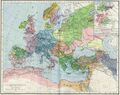 Livonia in Europe, 1190.
 -
 Europe, 1550.
 -
 Livonia on a 1570 map
 -
 Europe, 1740.
 -
 Europe, 1815.
 -
 Livonia, 1898.


Notes
- ↑ /lɪˈvoʊniə/ liv-OH-nee-ə – from Latin Livonia, derived from Estonian Liivimaa (lit. Sand Land); Livonian: Līvõmō; Finnish: Liivinmaa; Latvian and Lithuanian: Livonija; Polish: Inflanty
- ↑ /ˈlɪvlənd/ LIV-lənd; German: Livland, Liefland or Eifland; Norwegian, Danish and Swedish: Livland; Icelandic: Lífland; Dutch: Lijfland
References
- ↑ 1.0 1.1
 Kropotkin, Peter Alexeivitch; Bealby, John Thomas (1911). "Livonia". Encyclopædia Britannica. 16 (11th ed.). pp. 816–817.
- ↑ Pihlajamäki, Heikki (2017). "The outset: The Livonian and Swedish Legal orders at the Time of the Swedish Conquest". Conquest and the Law in Swedish Livonia (ca. 1630–1710): A Case of Legal Pluralism in Early Modern Europe. The Northern World. Leiden: Brill. p. 24. ISBN 9789004331532. https://books.google.com/books?id=s9fzDQAAQBAJ. Retrieved 19 June 2020. "A division into five rival small principalities thus developed during the thirteenth century: the State of the Teutonic Order, the Archbishopric of Riga, the bishoprics of Dorpat, Oesel–Wiek and Courland. The five principalities formed the Livonian Confederation, the Ordenstaat, until its dissolution in 1561."
- ↑ 3.0 3.1 Koch, Kristine (2002) (in de). Deutsch als Fremdsprache im Russland des 18. Jahrhunderts. Die Geschichte des Deutschen als Fremdsprache. 1. Berlin/New York: Walter de Gruyter. p. 59. ISBN 3-11-017503-7.
- ↑ 4.0 4.1 Alfredas Bumblauskas (2005) (in lt). Senosios Lietuvos istorija 1009 – 1795. Vilnius: R. Paknio leidykla. pp. 256–259. ISBN 9986-830-89-3.
- ↑ Robert Auty (1981). D. Obolensky. ed. Companion to Russian Studies: Volume 1 Vol 1 Introduction to Russian History. Cambridge: Cambridge University Press. pp. 101. ISBN 0-521-28038-9. https://books.google.com/books?id=xxREnBcMFcEC&q=Obolensky+livonia&pg=PA101.
- ↑ 6.0 6.1 6.2 Szilvia Rédey, Endre Bojtár (1999). Foreword to the Past: a cultural history of the Baltic People. Central European University Press. pp. 172. ISBN 963-9116-42-4. https://books.google.com/books?id=5aoId7nA4bsC&q=Szilvia+R%C3%A9dey+Endre+Bojt%C3%A1r+livonia+australis&pg=PA172.
- ↑ Norman Davies (1996). Europe: a History. Oxford: Oxford University Press. pp. 555. ISBN 0-19-820171-0. https://archive.org/details/europehistory00davi_0. "Livonia 1561."
- ↑ George Miller (1832). "Modern History". History, philosophically illustrated, from the fall of the Roman empire to the French revolution. pp. 258. https://books.google.com/books?id=6eDVcRegbxQC&q=Livonia+1561&pg=PA258.
- ↑ Alfrēds Bīlmanis (1945). Baltic Essays. The Latvian Legation. pp. 69–80. OCLC 1535884. https://books.google.com/books?id=DIkNAAAAIAAJ&q=Livonia+1561.
- ↑ Beresford James Kidd (1933). The Counter-reformation, 1550–1600. Society for promoting Christian knowledge. pp. 121. https://books.google.com/books?id=KTgdUIiBYfQC&q=Livonia+1561.
- ↑ Frost, Robert I (2000). The Northern Wars. War, State and Society in Northeastern Europe 1558–1721. Harlow: Longman. p. 294. ISBN 978-0-582-06429-4.
- ↑ Suvorov A.A. governor-general in 1861–66 :: ENCYCLOPAEDIA OF SAINT PETERSBURG
Bibliography
- Selart, Anti (2015). "Chapter 3: Livonia and Rus' in the 1230s and 1240s". Livonia, Rus' and the Baltic Crusades in the Thirteenth Century. Leiden/Boston: BRILL. pp. 127–170. doi:10.1163/9789004284753_005. ISBN 978-90-04-28475-3.
- Conedera, Sam (2012). "Review: Livonia, Rus' and the Baltic Crusades in the Thirteenth Century (East Central and Eastern Europe in the Middle Ages, 450–1450, 29) by Anti Selart". Archivum Historiae Pontificiae (Gregorian Biblical Press) 50: 221–224. ISSN 0066-6785. http://www.jstor.org/stable/44627101. Retrieved 5 November 2024.
Further reading
- Les pays baltiques, le pluriculturalisme en héritage, Yves Plasseraud; Armeline, 2020.
- Les Germano-baltes, Yves Plasseraud; S. Pourchier-Plasseraud; Armeline, 2022.
External links
- Virtual Livonia
- Deutsch-Baltische Ritterschaften in Livland, Kurland, Estland, Oesel (in German)
- Joann Portantiuse Liivimaa kaart 1573. aastast
- Estonian Manors Portal the English version includes the description of 438 well-preserved historical manors of nowadays Estonia (historically – northern part of Old-Livonia/Alt-Livland)
- Atlas of Livonia, or of the Two Governments and Duchies Livonia and Estonia, and of the Province of Oesel from the World Digital Library
 |


