Social:Adyghe language
| Adyghe | |
|---|---|
| West Circassian | |
| |
 | |
| Pronunciation | ady |
| Native to |
|
| Ethnicity |
|
Native speakers | 610,000 (2010–2020)e25 |
Northwest Caucasian
| |
Early forms | |
| Dialects |
|
| Cyrillic (Russia and diaspora) Latin (Diaspora only) Arabic (obsolete) Greek (obsolete) | |
| Official status | |
Official language in |  Russia Russia
|
Recognised minority language in | |
| Language codes | |
| ISO 639-1 | ady |
| ISO 639-3 | ady |
| Glottolog | adyg1241[1] |
.png) Distribution of the Adyghe language in Adygea (2002) | |
 Northwest Caucasian languages in Turkey and the Caucasus | |


Template:Adyghe language Template:Circassians File:WIKITONGUES- Yinal speaking Adyghe and Kabardian.webm
Adyghe,[lower-alpha 1] also known as West Circassian,[lower-alpha 2] is a Northwest Caucasian language spoken by the western subgroups of Circassians.[3][4][5] Native to Circassia in the Caucasus, it is one of the two official languages of Adygea, the other being Russian.[6] It is spoken in Russia, but mainly in Turkey, Jordan, Syria, Iraq and Israel, where Circassians settled after the Circassian genocide by the Russian Empire.[7] Adyghe literary language (Adyghe: Литературабз) is largely based on the Chemguy dialect,[8] which was chosen for its simplicity,[6] although there was significant input from Shapsug and Bzhedug dialects.[9]
Adyghe is closely related to the Kabardian or East Circassian language;[4] some reject the distinction between the two languages in favour of both being dialects of a unitary Circassian language, others argue they are closely related languages.[4][10] Despite phonological differences, Circassian languages are reciprocally intelligible,[10] with speakers being able to communicate.[6][11] While the self-designation for both Adyghe and Kabardian language is Adyghe, in linguistic and administrative terms, "Adyghe" refers specifically to the language of the western tribes of Circassians, while "Kabardian" refers to the language of the two eastern tribes (Kabardians and Besleney).[6] Ubykh, Abkhaz and Abaza are more distantly related to Adyghe.[4]
Classification
Adyghe belongs to the Northwest Caucasian language family. Glottochronological studies suggest that the common Proto-Northwest Caucasian language split into the Circassian, Abkhaz, and Ubykh branches roughly 5,000 years ago.[9]
History
For most of its history, Adyghe was an oral language. The folklore, particularly the Nart sagas, served as a repository for the language.[9][12]
Besides native vocabulary, the Adyghe language has accepted loanwords from Turkic, Arabic, Persian, and Russian languages.[6] The appearance of Turkic loanwords in the Adyghe language can be dated to the 14th century due to interactions with the Golden Horde and Crimean Khanate.[13] Words such as chapych (kopeck) are pre-revolutionary loans from Russian, while internationalisms like revolutsiye (revolution) entered later. As a rule, the phonetic composition of borrowed words is adapted to the phonological system of the Adyghe language.[6]
Following the Circassian Genocide and expulsion in 1864, the majority of Adyghe speakers were scattered across the Ottoman Empire.[11] The language spoken in the diaspora has diverged from the literary forms in the Caucasus. Diaspora communities often use Arabic or Turkish loanwords where the literary language uses Russian ones.[6][14]
Standardization of Adyghe
Pre-Soviet attempts
One of the earliest attempts to create a written Adyghe language was made by Natouko Sheretluk (Natouko Efendi), a Shapsug nobleman. He opened a madrasa in his native village of Bogundyr and compiled an Adyghe alphabet and grammar.[15][16] Leonty Lyulye, a Russian official who lived for many years among the Shapsugs, Natukhays, and Abadzekhs on the Black Sea coast, published a "Russian-Circassian Dictionary" and a brief grammar in Odessa in 1846. Lyulye identified three dialects of Adyghe: "Kabardian", "Besleney", and a third he called "Common Circassian" (referring to the Western coastal dialects). He tried to base his dictionary on this "Common" dialect.[17] Another pre-Soviet attempt was made by Wumar Bersey, an Abzakh. On March 14, 1853, he published the "Primer of the Circassian Language" (Adyghe Alphabet) in Tiflis (Tbilisi), based on the Arabic script. This date (March 14) is now celebrated annually as the "Day of the Adyghe Language".[18]
Modern Standard Adyghe
The standard register of Adyghe, known as Literary Adyghe (Adyghe: Литературабз, lit. 'Literature language'; Russian: Адыгейский литературный язык), was created by Circassian linguist Daut Ashkhamaf based largely on the Chemguy dialect, which was chosen for its simplicity.[19][8][20] However, Literary Adyghe is a constructed dialect and is distinct from the natural Chemguy dialect,[21] as there was significant input from the dialects of other tribes who remained in the Caucasus after the Circassian exile, spesifically the Bzhedug, Shapsug, and partly Abzakh.[8][9][10] In the 1930s, Ashkhamaf even utilized the term "Bzhedug-Temirgoy dialect" to describe the basis of the literary language.[20] He argued that through the development of the literary language, these dialects were merging.[8] In some cases, literary dialect preferred words from other dialects over Chemguy words, such as Bzhedug "ӏэ" (hand) and "тхьэ" (god) instead of the Chemguy "ӏа" and "тхьа", as well as specific ordinal numbers and verb forms.[8] Thus, being supra-dialectal, literary Adyghe stands in contrast to territorial dialects and serves as the unifying literary form of the language for speakers of diverse dialects.[11][22]
Attempts to unify Adyghe and Kabardian
There were proposals to merge Adyghe and Kabardian to create a single Circassian literary language.[21][8] Another proposal was to select one of the two to serve as the single literary language for all Circassians. A rejected proposal by Circassian scholars argued for recognizing Kabardian as the sole literary language for all Circassians, as it had the most speakers.[23] There were attempts to create a single unified alphabet for Adyghe, Kabardian, Chechen and Karachay-Balkar; but efforts failed because the leaders of the movement were accused of being "bourgeois nationalists" and executed in 1937.[23] One year earlier, Z.M. Naloev, who was involved in the creation of the Kabardian alphabet, was executed by firing squad for alleged treason; he was rehabilitated posthumously in 1957.[24] The Bolsheviks supported the creation of separate alphabets and grammars for the "Kyakh" (Western; the modern Adyghe language) and Kabardian, despite ongoing debates on unifying them.[23] Thus, Adyghe and Kabardian speakers could communicate easier orally as opposed to in writing due to different graphical representations and spelling rules.[25] A more moderate proposal developed by the linguist M.A. Kumakhov aimed to unify the alphabets and orthography without forcing a complete merger of spoken Adyghe and Kabardian. This project proposed standardizing the representation of identical phonemes (using the same letter for the same sound where they currently differ, such as the Adyghe жъvs. Kabardian жь). The project was accepted by specialists at regional conferences in Nalchik and Maikop in 1998 and 1999. While the Parliament of the Kabardino-Balkarian Republic approved the project, the Parliament of the Republic of Adygea did not proceed to discuss it.[21] The "One Nation, One Republic, One Language" (Зы Лъэпкъ, Зы Республик, Зы Бзэ) movement among Circassians pushes for the unification of the three Circassian republics and recognition of Adyghe and Kabardian as not related languages, but as dialects of a single Circassian language, arguing that the division of Circassians into different "nations" (Adyghe vs. Kabardian vs. Cherkess) was a result of Soviet "ethnic engineering".[26] The International Circassian Association (ICA) officially stated the goal of creating a "uniform Circassian language" in its 2015 congress resolution.[18]
Adyghe outside Circassia
Turkey

Turkey hosts the largest Circassian population, but the language lacks any legal recognition in Turkey. Historically, the first Adyghe language education in the diaspora occurred in Istanbul; the "Circassian Benevolence School" (1910) and the "Circassian Girls Model School" (1919) provided instruction until their closure by the Kemalists in 1923.[27] Following the "Citizen, Speak Turkish!" campaign and the closure of Circassian schools, the language was confined to the home. Consequently, while the older generation retains fluency, proficiency among those under 50 is significantly diminished.[28][27][6] Nusret Baş (Бажь Нусрэт), the president of the Federation of Circassian Associations, estimated that about 5% of Circassians in Turkey speak their native language.[18]
Linguistically, the Adyghe spoken in Turkey exhibits distinct features as it was not subject to the standartisation policies in the Caucasus. It contains archaic vocabulary lost in the Caucasus, alongside Turkish loanwords.[29][30] While the Chemguy dialect forms the basis of the literary language in the Republic of Adygea, the majority of the diaspora in Turkey speaks the Abzakh and Shapsug dialects (as well as Kabardian), alongside smaller numbers of Bzhedug and Hatuqay speakers.[30]
Significant changes occurred following Turkey's European Union accession process in the early 2000s.[31] The language policy was liberalized, which prompted revival efforts.[18] In 2012, the Ministry of National Education introduced "Living Languages and Dialects" as an elective course for secondary schools, allowing Adyghe to be taught in public schools. Classes are only opened if a set minimum number of students apply, and bureaucratic hurdles regarding application windows often hinder access to these classes. Teachers are subject teachers with basic language skills rather than trained philologists, and they receive limited training in language pedagogy. Educational materials are imported from Adygea and are designed for native speakers, making them difficult to adapt for diaspora students who are learning Adyghe as a second language.[31] During the COVID-19 pandemic, transnational online courses were organized in collaboration with institutions in Russia, allowing students in Turkey, Jordan, and Germany to be taught by teachers directly from the Caucasus.[31] Düzce University has a Department of Caucasian Languages and Cultures, which offers "Circassian Language and Culture" programs, including the teaching of Adyghe in Cyrillic, as the surrounding region is inhabited largely by Shapsug and Abzakh Circassians.[30][31] Boğaziçi University began offering elective Adyghe courses in 2013.[31]
A significant debate persists in the Turkish diaspora regarding orthography of Adyghe. The Federation of Caucasian Associations (KAFFED) adopted the Cyrillic alphabet in 2004 to maintain continuity with the homeland, but other groups advocate for a Latin-based script to facilitate easier learning for Turkish speakers.[18][30] This dispute intensified significantly when the Turkish Ministry of Education approved a Latin-based alphabet for elective Circassian language courses in public schools, effectively creating a dual-alphabet system alongside the existing Cyrillic curriculum. KAFFED vehemently opposed this decision, arguing that it creates confusion and severs cultural ties with the autonomous republics in the Caucasus.[32] Demonstrations were at Ministry of Education offices across the country with slogans including "Hands off my alphabet," "We want our mother tongue's alphabet" and "What about Arabic in Latin letters?".[32]
Israel
The Circassian community in Israel, concentrated in the Circassian towns of Kfar Kama and Rehaniya, is considered to have one of the highest levels of language maintenance in the diaspora.[6][33] Adyghe serves as the language of daily communication in the home, school, and public spaces. In 1958-1959, Israeli Circassians made contact for the first time with Circassians in the Caucasus and requested literary material in Adyghe, which they received.[9][34] In 1976, the Adyghe language was introduced into the official school curriculum. It is a compulsory subject from 6th grade onward, and utilizes textbooks based on the literary standard of the Republic of Adygea.[6][34] Despite the dominance of the Shapsug dialect in speech, the written language taught in schools utilizes the Cyrillic alphabet and the Chemguy-based literary standard.[6][33]
Kfar Kama is inhabited by the Shapsug tribe, while Rihaniya is inhabited by the Abzakh tribe. The Israeli variety of Adyghe also contains unique neologisms.[35]
Jordan
In Jordan, the Adyghe language has historically enjoyed a relatively privileged status, though it currently faces significant pressure, as Arabic has become the dominant language for the younger generation, and the Adyghe language is often restricted to symbolic functions or domestic use.[9][11] Adyghe is taught in Prince Hamza Ibn Al-Hussein Secondary School, a school for Jordanian Circassians in Jordan's capital city of Amman. This school, established by Circassians with support from King Hussein of Jordan, is one of the first schools for the Adyghe communities outside Circassia. It has around 750 Jordanian Adyghe students, and aims to preserve the Adyghe language and traditions among future generations.[6][11][36] The diaspora in Jordan has produced dictionaries and linguistic works, such as a Circassian-Arabic dictionary published in 1988.[34] The Circassian Charity Association of Jordan also sponsors a school between Naur and Wadi Al-Seer that teaches the language.[37] Historically, various dialects were spoken by immigrants, including Shapsug, Bzhedug, (and Kabardian), but over time these dialects have merged.[37]
Syria
Historically, the Golan Heights served as a center for Circassian language preservation prior to the 1967 war. In the 1920s and 1930s, the "Circassian Society of Education and Union" in Quneitra published the newspaper Mardj in Circassian (using the Latin script), Arabic, and French, and established a school that taught the language alongside general subjects. In the late 20th century, the Circassian Charity Association in Damascus operated informal language circles to teach the Cyrillic script and preserve oral traditions. However, the language has declined due to the lack of state-supported education and the dominance of Arabic in all public spheres.[6] After the Syrian defeat in the war, the Circassian population largely fled the Golan Heights region, which was occupied by the Israeli Army.[9]
Many of Syria's ethnic Circassians have left the country and have repatriated to Adygea, Kabardino-Balkaria and Karachay-Cherkessia, as well as to partially recognised Republic of Abkhazia.[38][39]
Publications
There are many books written in or translated into Adyghe. А significant milestone was the publication of the "ABC-book of the Circassian language" by Wumar Bersey in Tbilisi on March 14, 1853, a date now celebrated as the Day of the Adyghe Language and Writing.[18] In the early 20th century, reformist movements in Baksan led to the publication of religious and ethical textbooks such as "The History of Islam" (Мыслъымэн Тхыдэ) in 1918.[40]
An Adyghe translation of the Quran by Iskhak Mashbash is available.[41] The New Testament and many books of the Old Testament have been published in Adyghe by the Institute for Bible Translation in Moscow.
In 2020 a bilingual edition of Ecclesiastes was released in Adyghe and Kabardian, a closely-related language of the North Caucasus in the Russian Federation.[42]
Adyghe Maq is the main Adyghe language newspaper. It is published in the capital of the Adyghe Republic, Maykop, five times a week.[43]
Vitality
According to the UNESCO 2009 map entitled "UNESCO Map of the World's Languages in Danger", the status of the Adyghe language in 2009, along with all its dialects (Adyghe, Western Circassian tribes; and Kabard-Cherkess, Eastern Circassian tribes), is classified as vulnerable.[44]
Dialects
| |||||||||||||||||||||||||||||||||||||||
| A Circassian dialects family tree. |
Black Sea coast dialects
- Shapsug dialect (Шапсыгъабзэ)
- North Shapsugs, Great Shapsugs, Kuban Shapsugs (Шапсыгъэ шху) dialect
- Kfar Kama dialect (Кфар Камэм ишапсыгъэбзэ)
- Chemguy-Shapsugs, Pseuşko accent (Кӏэмгуе-шапсыгъ)
- South Shapsugs, Small Shapsugs, Coastal Shapsugs, Black Sea Shapsugs (Шапсыгъэ-цӏыкӏу) dialect
- Hakuchi dialect (Хьакӏуцубзэ, Къарацхаибзэ)
- North Shapsugs, Great Shapsugs, Kuban Shapsugs (Шапсыгъэ шху) dialect
- Natukhai dialect (Нэтӏхъуаджэбзэ)
- Zhaney dialect
Kuban River dialects
- Bzhedug dialect (Бжъэдыгъубзэ): spoken by Circassians in the Republic of Adygea and the Biga district of the city of Çanakkale in Turkey
- Chemguy (Adyghe: Кӏэмыгуябзэ, Кӏэмгуибзэ): literary standard of Adyghe. Also spoken by Circassians in the Republic of Adygea
- Abzakh dialect (Aбдзэхабзэ): spoken by Circassians in the village of Rehaniya in Israel and Circassians in Syria from the Golan Heights
- Mamkhegh dialect
- Yegeruqay dialect
- Hatuqay dialect
- Makhosh dialect
Phonology
Adyghe exhibits between 50 and 60 consonants depending on the dialect. All dialects possess a contrast between plain and labialized glottal stops. A very unusual minimal contrast, and possibly unique to the Abzakh dialect of Adyghe, is a three-way contrast between plain, labialized and palatalized glottal stops (although a palatalized glottal stop is also found in Hausa and a labialized one in Tlingit). The Shapsug (Black Sea) dialect of Adyghe contains a very uncommon sound: a voiceless bidental fricative [h̪͆], which corresponds to the voiceless velar fricative [x] found in other varieties of Adyghe. This sound is only known to be used in the Black Sea dialect.
| Labial | Alveolar | Post-alveolar | Alveolo- palatal |
Retroflex | Velar | Uvular | Pharyngeal | Glottal | ||||||||||
|---|---|---|---|---|---|---|---|---|---|---|---|---|---|---|---|---|---|---|
| plain | lab. | plain | lab. | lat. | plain | lab. | plain | lab. | pal. | plain | lab. | plain | lab. | |||||
| Nasal | m | n | ||||||||||||||||
| Plosive | voiceless | p | t | k1 | kʷ | (kʲ)2 | q | qʷ | ʔ | ʔʷ | ||||||||
| voiced | b | d | ɡ1 | ɡʷ | (ɡʲ)2 | |||||||||||||
| ejective | pʼ | pʷʼ | tʼ | tʷʼ | kʷʼ | (kʲʼ)2 | ||||||||||||
| Affricate | voiceless | t͡s | t͡ʃ | t͡ʂ | t͡ʂʷ | |||||||||||||
| voiced | d͡z | d͡ʒ | d͡ʐʷ | |||||||||||||||
| ejective | t͡sʼ | t͡ʃʼ | t͡ʂʼ | |||||||||||||||
| Fricative | voiceless | f | s | ɬ | ʃ | ɕ | ʂ | ʂʷ | x | χ | χʷ | ħ | ||||||
| voiced | v1 | z | ɮ | ʒ | ʑ | ʐ | ʐʷ | ɣ | ʁ | ʁʷ | ||||||||
| ejective | ɬʼ | ʂʼ | ʂʷʼ | |||||||||||||||
| Approximant | j | w | ||||||||||||||||
| Trill | r | |||||||||||||||||
- These consonants exist only in borrowed words.
- In the Black Sea coast Adyghe dialects (e.g. Shapsug dialect and Natukhai dialect) there exist a palatalized voiced velar stop [ɡʲ], a palatalized voiceless velar stop [kʲ] and a palatalized velar ejective [kʲʼ] that were merged with [d͡ʒ], [t͡ʃ] and [t͡ʃʼ] in most Adyghe dialects.[46][47][48][49][50] For example the Shapsug words "гьанэ" [ɡʲaːna] "shirt", "кьэт" [kʲat] "chicken" and "кӏьапсэ" [kʲʼaːpsa] "rope" are pronounced in other dialects as "джанэ" [d͡ʒaːna], "чэт" [t͡ʃat] and кӏапсэ [t͡ʃʼaːpsa].
In contrast to its large inventory of consonants, Adyghe has only three phonemic vowels in a vertical vowel system.[51]
| Central | |
|---|---|
| Mid | ə |
| Near-open | ɐ |
| Open | aː |
Orthography
 | It has been suggested that this section be split out into another page titled Adyghe alphabets. (Discuss) (March 2026) |
| Cyrillic | Arabic | Latin[52][53][54] | IPA | Pronunciation | Examples |
|---|---|---|---|---|---|
| А а | ا | A a | [aː] | File:Adygheа.oga | ачъэ, ače, 'goat'апчъы, apčy, 'they count' |
| Б б | ب | B b | [b] | File:Adygheб.ogg | баджэ, badźe, 'fox'бэ, be, 'a lot' |
| В в[lower-alpha 3] | ڤ | V v | [v] | File:Adygheв.ogg | жъвэ, z̄ve, 'oar', лавэ, lave, 'lava' |
| Г г | ݝ | G g | [ɣ] | File:Adygheг.ogg | гыны, gyny, 'powder'чъыгы, čygy, 'tree' |
| Гу гу | گو | Gw gw | [ɡʷ] | File:Adygheгу.ogg | гу, gw, 'heart'гущыӏ, gwśyx̧, 'word' |
| Гъ гъ | غ | Ǧ ǧ | [ʁ] | File:Adygheгъ.ogg | гъатхэ, ǧatxe, 'spring'гъэмаф, ǧemaf, 'summer' |
| Гъу гъу | غو | Ǧw ǧw | [ʁʷ] | File:Adygheгъу.ogg | гъунэгъу, ǧwneǧw, 'neighbour'гъунджэ, ǧwndźe, 'mirror' |
| Д д | د | D d | [d] | File:Adygheд.ogg | дыджы, dydźy, 'bitter'дахэ, daxe, 'pretty' |
| Дж дж | ج | Dź dź | [d͡ʒ] | File:Adygheдж.ogg | джан, dźan, 'shirt'лъэмыдж, łemydź, 'bridge' |
| Дз дз | ذ | Dz dz | [d͡z] | File:Adygheдз.ogg | дзыо, dzyo, 'bag'дзын, dzyn, 'to throw' |
| Дзу дзу | ذو | Dzy dzy | [d͡ʐʷ] | File:Adygheдзу.ogg | хьандзу, handzw, 'rick'хьандзуачӏ, handzwaç̌, '[lower] rick' |
| Е е | ئە / ەي | É é, Je je[lower-alpha 4] | [ɜj] [jɜ] | File:Adygheе.ogg | ешэн, ješen, 'to catch'еплъын, jepłyn, 'to look at' |
| Ё ё[lower-alpha 3] | – | Jo jo | [jo] | File:Adygheё.ogg | ёлк, jolk, 'Christmas tree' |
| Ж ж | ڒ | Ž ž | [ʒ] | File:Adygheж.ogg | жэ, že, 'mouth'жакӏэ, žaḉe, 'beard' |
| Жъ жъ | ظ | Z̄ z̄ | [ʐ] | File:Adygheжъ.ogg | жъы, z̄y, 'old'жъажъэ, z̄az̄e, 'slow' |
| Жъу жъу | ظو | Z̄w z̄w | [ʐʷ] | File:Adygheжъу.ogg | жъун, z̄wn, 'to melt'жъуагъо, z̄waǧo, 'star' |
| Жь жь | ژ | Ź ź | [ʑ] | File:Adygheжь.ogg | жьыбгъэ, źybǧe, 'wind'жьао, źao, 'shadow' |
| З з | ز | Z z | [z] | File:Adygheз.ogg | занкӏэ, zanḉe, 'straight'зандэ, zande, 'steep' |
| И и | ئي / ي | I i | [ɘj] [jɘ] | File:Adygheи.ogg | ихьан, ihan, 'to enter'икӏыпӏ, iḉyṗ, 'exit' |
| Й й | ي | J j | [j] | File:Adygheй.ogg | йод, jod, 'iodine'бай, baj, 'rich' |
| К к[lower-alpha 3] | ك | K k | [k] | File:Adygheк.ogg | кнопк, knopk, 'button'команд, komand, 'team; command' |
| Ку ку | کو | Kw kw | [kʷ] | File:Adygheку.ogg | кушъэ, kws̄e, 'cradle'ку, kw, 'cart' |
| Къ къ | ق | Q q | [q] | File:Adygheкъ.ogg | къалэ, qale, 'city'къэкӏон, qeḉon, 'to come' |
| Къу къу | قو | Qw qw | [qʷ] | File:Adygheкъу.ogg | къухьэ, qwhe, 'ship'къушъхьэ, qws̄he, 'mountain' |
| Кӏ кӏ | ڃ | Ķ ķ, Ḉ ḉ | [kʼ] [t͡ʃʼ][lower-alpha 5] | File:Adygheкӏ.oga | кӏымаф, ḉymaf, 'winter'кӏыхьэ, ḉyhe, 'long'кӏэ, ķe, 'tail'шкӏэ, šķe, 'calf' |
| Кӏу кӏу | ࢰو | Ķw ķw | [kʷʼ] | File:Adygheкӏу.oga | кӏон, ķon, 'to walk'кӏуакӏэ, ķwaḉe, 'gait' |
| Л л | ل | L l | [l] [ɮ] | File:Adygheл.ogg | лагъэ, laǧe, 'painted'лы, ly, 'meat' |
| Лъ лъ | ݪ | Ł ł | [ɬ] | File:Adygheлъ.ogg | лъэбэкъу, łebeqw, 'step'лъащэ, łaśe, 'lame' |
| Лӏ лӏ | ࢦ | Ļ ļ | [ɬʼ] | File:Adygheлӏ.oga | лӏы, ļy, 'man'лӏыгъэ, ļyǧe, 'bravery' |
| М м | م | M m | [m] | File:Adygheм.ogg | мазэ, maze, 'moon'мэлы, mely, 'sheep' |
| Н н | ن | N n | [n] | File:Adygheн.ogg | нэ, ne, 'eye'ны, ny, 'mother' |
| О о | ئۆ / ۆ | O o | [ɜw] [wɜ] | File:Adygheо.ogg | мощ, moś, 'that'коны, kony, 'bin'о, o, 'you'осы, osy, 'snow'ощхы, ośxy, 'rain' |
| П п | پ | P p | [p] | File:Adygheп.ogg | пэ, pe, 'nose'сапэ, sape, 'dust' |
| Пӏ пӏ | ࢠ | Ṗ ṗ | [pʼ] | File:Adygheпӏ.oga | пӏэ, ṗe, 'bed'пӏэшъхьагъ, ṗes̄haǧ, 'pillow' |
| Пӏу пӏу | ࢠو | Ṗw ṗw | [pʷʼ] | File:Adygheпӏу.oga | пӏун, ṗwn, 'to rise; to adopt'пӏур, ṗwr, 'pupil; apprentice' |
| Р р | ر | R r | [r] | File:Adygheр.ogg | рикӏэн, riḉen, 'to pour'Adyghe: риӏон rix̧on 'to tell' |
| С с | س | S s | [s] | File:Adygheс.ogg | сэ, se, 'I, me'сэшхо, sešxo, 'sabre' |
| Т т | ت | T t | [t] | File:Adygheт.ogg | тэтэжъ, tetez̄, 'grandfather'тэ, te, 'we, us' |
| Тӏ тӏ | ط | Ţ ţ | [tʼ] | File:Adygheтӏ.oga | тӏы, ţy, 'ram'ятӏэ, jaţe, 'dirt' |
| Тӏу тӏу | طو | Ţw ţw | [tʷʼ] | File:Adygheтӏу.oga | тӏурыс, ţwrys, 'old'тӏурытӏу, ţwryţw, 'pair' |
| У у | و | U u, W w | [ɘw] [wɘ] | File:Adygheу.ogg | ушхун, ušxwn, 'to straighten'убэн, uben, 'to tamp; to smoothen' |
| Ф ф | ف | F f | [f] | File:Adygheф.ogg | фыжьы, fyźy, 'white'фэен, fejen, 'to want' |
| Х х | ݗ | X x | [x] | File:Adygheх.ogg | хы, xy, 'sea; six'хасэ, xase, 'council' |
| Хъ хъ | خ | Ḩ ḩ | [χ] | File:Adygheхъ.ogg | хъыен, ḩyjen, 'to move'пхъэн, pḩan, 'to sow' |
| Хъу хъу | خو | Ḩw ḩw | [χʷ] | File:Adygheхъу.ogg | хъун, ḩwn, 'to happen'хъурай, ḩwraj, 'circle' |
| Хь хь | ح | H h | [ħ] | File:Adygheхь.ogg | хьэ, he, 'dog'хьаку, hakw, 'oven' |
| Ц ц | ث | C c | [t͡s] | File:Adygheц.ogg | цагэ, cage, 'rib'цы, cy, 'body hair' |
| Цу цу | ثو | Cw cw | [t͡ʂʷ] | File:Adygheцу.ogg | цуакъэ, cwaqe, 'shoe'цу, cw, 'ox' |
| Цӏ цӏ | ڗ | Ç ç | [t͡sʼ] | File:Adygheцӏ.oga | цӏынэ, çyne, 'wet'цӏыфы, çyfy, 'person' |
| Ч ч | چ | Ć ć | [t͡ʃ] | File:Adygheч.ogg | чэфы, ćefy, 'cheerful'чэты, ćety, 'chicken' |
| Чъ чъ | x15px | Č č | [t͡ʂ] | File:Adygheчъ.ogg | чъыгай, čygaj, 'oak'чъыӏэ čyx̧e 'cold' |
| Чӏ чӏ | x15px | Ç̌ ç̌ | [t͡ʂʼ] | File:Adygheчӏ.oga | чӏыпӏэ, ç̌yṗe, 'area'чӏыфэ, ç̌yfe, 'debt' |
| Ш ш | x18px | Š š | [ʃ] | File:Adygheш.ogg | шы, šy, 'brother'шыблэ, šyble, 'thunder' |
| Шъ шъ | ص | S̄ s̄ | [ʂ] | File:Adygheшъ.ogg | шъэ, s̄e, 'hundred'шъабэ, s̄abe, 'soft' |
| Шъу шъу | صو | S̄w s̄w | [ʂʷ] | File:Adygheшъу.ogg | шъугъуалэ, s̄wǧwale, 'envious'шъукъакӏу, s̄wqaķw, 'to come' |
| Шӏ шӏ | ض | Ş̄ ş̄ | [ʂʼ] | File:Adygheшӏ.oga | шӏын, ş̄yn, 'to do'шӏэныгъ, ş̄enyǧ, 'knowledge' |
| Шӏу шӏу | ضو | Ş̄w ş̄w | [ʂʷʼ] | File:Adygheшӏу.oga | шӏуцӏэ, ş̄wçe, 'black'шӏуфэс, ş̄wfes, 'greetings' |
| Щ щ | ش | Ś ś | [ɕ] | File:Adygheщ.ogg | щагу, śagw, 'yard'щатэ, śate, 'sour cream' |
| (Ъ ъ) | – | – | – | ||
| Ы ы | ئہـ / ہ | Y y | [ɘ] | File:Adygheы.ogg | ыкӏи, yḉi, 'and also'зы, zy, 'one' |
| (Ь ь) | – | – | Template:IPA blink | ||
| Э э | ئە / ە | E e | [ɜ] | File:Adygheэ.ogg | ӏэтаж x̧etaž 'floor'нэнэжъ, nenez̄, 'grandmother' |
| Ю ю | یو | Ju ju | [ju] | File:Adygheю.ogg | Юсыф, Jusyf, 'Joseph'Юныс, Junys, 'Jonah' |
| Я я | یا | Ja ja | [jaː] | File:Adygheя.ogg | яй, jaj, 'theirs'ябгэ, jabge, 'evil' |
| Ӏ ӏ | ئ | X̧ x̧ | [ʔ] | File:Adygheӏ.oga | ӏэ x̧e 'hand'кӏасэ, ḉase, 'like' |
| Ӏу ӏу | ؤ | X̧w x̧w | [ʔʷ] | File:Adygheӏу.oga | ӏукӏэн x̧wḉen 'to meet'ӏусын x̧wsyn 'to be sitting near'ӏудан x̧wdan 'thread' |
Modern alphabet
Orthography rules
- The letter ⟨ы⟩ [ə] is not written after a ⟨у⟩ [w], ⟨й⟩ [j] or a labialised consonant. For example: унэ [wənɐ] "house" instead of уынэ.
- In case the letter ⟨у⟩ is the first letter of a word or when it is not related to any other consonant, it is pronounced as [wə] ⟨уы⟩. For example: унэ instead of уынэ. When it is related to a consonant, it becomes a vowel and pronounced as [əw~u] ⟨ыу⟩. For example: чэту [t͡ʃɐtəw] 'cat' instead of чэтыу.
- In case a labialised consonant is followed by a vowel ⟨э⟩ [ɐ], instead of the letter ⟨у⟩ there is a ⟨о⟩. For example: гъогу [ʁʷɐɡʷ] 'road' instead of гъуэгу.
- In case a labialised consonant is followed by a vowel ⟨а⟩ [aː] or ⟨и⟩ [əj~i], the labialised consonant letter is written fully. For example: цуакъэ [t͡sʷaːqɐ] 'shoes'.
- In case the letter ⟨о⟩ is the first letter of a word or when it is not related to any other consonant, it is pronounced as [wɐ] ⟨уэ⟩. For example, о [wɐ] 'you' instead of уэ.
- In case the letter ⟨е⟩ is the first letter of a word or when it is not related to any other consonant, it is pronounced as [jɐ] ⟨йэ⟩. For example: еӏо [jɐʔʷɐ] 'he says' instead of йэӏо. When it is related to a consonant, it becomes a vowel and pronounced as [ɐj~e] ⟨эй⟩. For example: делэ [dɐjlɐ] 'fool' instead of дэйлэ.
- In case the letter ⟨и⟩ is the first letter of a word or when is not related to any other consonant, it is pronounced as [jə] ⟨йы⟩. For example: илъэс [jəɬɐs] 'year' instead of йылъэс. When it is related to a consonant, it becomes a vowel and pronounced as [əj~i] ⟨ый⟩. For example: сиӏ [səjʔ] 'I have' instead of сыйӏ.
Use of Ъ and Ь
Unlike in the Russian language, where Ъ (Hard Sign) and Ь (Soft Sign) serve to separate syllables or modify the palatalization of a preceding consonant, in Adyghe they are used as integral parts of the alphabet to define entirely distinct phonemes. This adaptation was necessary because Adyghe has a much larger consonant inventory than standard Cyrillic can accommodate.
- Ъ (Hardener): Generally indicates a moving the place of articulation back to the uvular or pharyngeal position (e.g., turning a velar into a uvular).
- Ь (Softener): Generally indicates a moving the place of articulation forward or palatalization.
The table below illustrates how these signs modify the base letters:
| Base | + Hardener (Ъ) | + Softener (Ь) |
|---|---|---|
| Г [ɣ]
(Velar fricative) |
Гъ [ʁ]
(Uvular fricative) |
— |
| Ж [ʒ]
(Postalveolar fricative) |
Жъ [ʐ]
(Retroflex fricative) |
Жь [ʑ]
(Alveolo-palatal fricative) |
| К [k]
(Velar plosive) |
Къ [q]
(Uvular plosive) |
— |
| Л [l]
(Alveolar lateral) |
Лъ [ɬ]
(Lateral fricative) |
— |
| Х [x]
(Velar fricative) |
Хъ [χ]
(Uvular fricative) |
Хь [ħ]
(Pharyngeal fricative) |
| Ч [t͡ʃ]
(Postalveolar affricate) |
Чъ [t͡ʂ]
(Retroflex affricate) |
— |
| Ш [ʃ]
(Postalveolar fricative) |
Шъ [ʂ]
(Retroflex fricative) |
— |
Vowels
The vowels are written ⟨ы⟩ [ə], ⟨э⟩ [ɐ] and ⟨а⟩ [aː]. Other letters represent diphthongs: ⟨я⟩ represents [jaː], ⟨и⟩ [jə] or [əj], ⟨о⟩ [wɐ] or [ɐw], ⟨у⟩ represent [wə] or [əw], and ⟨е⟩ represents [jɐ] or [ɐj].
Other writing systems
History
Widespread literacy in Adyghe did not exist until the modern era and literacy was limited to a few people. From the 6th–5th centuries BC until the first half of the 15th century, the Adyghe people used the Greek alphabet, initially introduced through ancient Greek colonies and later reinforced by the Byzantine Empire and the Christian church.[6][55] Early forms of the Cyrillic alphabet were also used during this period due to Russian influence.[55] During the 13th to 15th centuries, the development of relations with the Genoese Republic led to some use of the Italian (Latin) script.[6] In the 14th century, along with Islam, the Arabic script was adopted for Adyghe.[55] It was referred to as Ajam, a writing system for the native language based on the Perso-Arabic script. Since Adyghe has many more consonants than Arabic, the Ajam system required adding special diacritical marks or inventing new letters to represent sounds.[6] Early attempts to write Adyghe in modern Cyrillic started as early as 1829 and were followed by similar attempts.[56][57]

In 1853, the Adyghe educator Umar Bersey published the first "Primer of the Circassian Language" based on the Arabic script.[6][58][9] Over the following decades, several authors attempted to further improve the Adyghe Arabic orthography. The most successful attempt was the alphabet created by Akhmetov Bekukh. In this version, letters were designated for vowel sounds, and the orthography was transformed from an "Impure abjads to a true alphabet. In 1918, on the initiative of the Kuban Revolutionary Committee, a primer was published in Yekaterinodar. This official endorsement resulted in a literary boom in Adyghe and the publication of various newspapers, textbooks and other literature, including the Adyghe Maq, the main Adyghe language newspaper established in 1923.[58] During the abovementioned decades, parallel with this process, the Perso-Arabic orthography had also been standardized for the sister Circassian language of Kabardian. Although very similar in many aspects, there were minor variations, in which letters were included based on each respective phonology, and there were minor differences in presentation of a few consonants as well.[58][59] The Arabic script was used until 1927, when as a part of the Soviet "Latinisation" campaign, a Latin-based alphabet was adopted. It was developed by the linguist N.F. Yakovlev and the Adyghe scholar Daud Ashkhamaf. In the late 1930s, the script was converted to Cyrillic to align with Russian.[8][55]
In the diaspora, a new Latin alphabet based on the Turkish alphabet was designed to better facilitate Adyghe and Kabardian education in Turkey.[60]
| Date | Author / Creator | Script Base | Description & Historical Context |
|---|---|---|---|
| 17th Century | Evliya Çelebi | Arabic / Ottoman | Recorded Adyghe linguistic material in his travel notes. |
| c. 1820s (Early 19th Century) | Sheretluk Hadji-Notauk
(Magomet Effendi) |
Arabic | A Shapsug nobleman educated in the "Arab East", considered the founder of the Adyghe Enlightenment. He opened a school on the Bogundyr River and created one of the first Arabic-based Circassian grammars. However, he burned his manuscripts, either by force or out of his own will. |
| 1830s | Sultan Khan-Giray | Cyrillic | Adapted the Cyrillic alphabet for his ethnographic work "Notes on Circassia" to record Circassian legends. |
| 1840–1843 | Shora Nogmov (Нэгъумэ Шорэ) | Cyrillic / Arabic | A Kabardian noble who initially developed a Cyrillic alphabet (1840) before switching to Arabic/Persian (1843). |
| 1846 | Leonty Lyulye | Cyrillic | Published a dictionary using a modified Russian alphabet. Criticized by Pyotr Uslar for failing to reflect phonetics. |
| 1853 | Umar Bersey | Arabic | Published the "Primer of the Circassian Language" in Tiflis on March 14, 1853. This date is celebrated as the "Day of the Adyghe Language and Writing." |
| 1860s | Kazi Atazhukin & Pyotr Uslar | Cyrillic | Developed a Kabardian alphabet based on Cyrillic, believing the Russian script was politically and practically suitable for Caucasian languages. |
| 1897 | Tharxet Ahmet Cavit Pasha | Arabic | Created an alphabet later used in the newspaper Ghuaze (The Guide), published by the Circassian Union and Mutual Aid Society (1908–1923). |
| 1902–1912 | Various Diaspora Authors | Arabic / Latin | Various attempts in the Ottoman diaspora:
|
| 1918 | Seferbiy Siyukhov (S. Siyukhov) / Ahmed Bekukh | Arabic | Siyukhov prepared an alphabet for the Adyghe (West) dialect, officially adopted for teaching and publishing. It remained in use until 1927. |
| 1918–1929 | Blanau Batok | Latin / Arabic | Published a Latin primer (Çerkes Alfab) in Constantinople (1919) and an Arabic primer (Elifba El-Şerkesiyye) in Damascus (1929). |
| 1923 | N. F. Yakovlev | Cyrillic | A Cyrillic project proposed by Yakovlev prior to the shift toward Latinization. |
| 1927 | N. F. Yakovlev & D. A. Ashkhamaf | Latin (Adyghe) | Officially adopted for the West Circassian (Adyghe) language by the Regional Department of Public Education. It established the Chemguy dialect as the literary standard. |
| 1936 | T'ut'e Borikey | Cyrillic | Early transition to Cyrillic for Kabardian. |
| 1937–1938 | N. F. Yakovlev & D. A. Ashkhamaf | Cyrillic | Due to shifting Soviet nationality policies, scripts were converted to Cyrillic. The Adyghe alphabet followed the Kabardian one (1936) in 1938. It uses di- and trigraphs (e.g., 'къ', 'кI') and remains the basis for the modern script. |
| 1952 | K’ube Şaban | Latin | A Latin alphabet prepared in the diaspora. |
| 1989 | Official Standard | Cyrillic | Legislative consolidation of the alphabet (66 signs).
|
| 2012 | R.I. Dawur (Даур Р. И) | Tamga / Symbols | Prepared "Circassian Calligraphy" (*Черкесская Каллиграфия*), attempting to create a unique alphabet by converting ancient family symbols (Tamgas) into letters. |
| 2012 | Ali İhsan Tarı | Latin | Prepared by the founder of the Adyghe Language Association in Konya. |
| 2018 | Nezhdet Meshvez | Cyrillic (Modified) | An experimental textbook replacing most digraphs/trigraphs with diacritical marks to simplify learning. |
Adyghe Arabic alphabet

Below table shows the Adyghe Perso-Arabic alphabet as it was officially adopted between 1918 and 1927.[58][63]
| Forms | IPA | Adyghe Cyrillic equivalent | Adyghe Latin equivalent (1927–1938) | Unicode | Notes | |||
|---|---|---|---|---|---|---|---|---|
| Isolated | Final | Medial | Initial | |||||
| ا | ـا | ـا | آ | [aː] | А а | ᴀ | U+0622 U+0627 |
|
| ئ | ـئ | ـئـ | ئـ | [ʔ] | Ӏ ӏ | h | U+0626 |
|
| ؤ | ـؤ | - | - | [ʔʷ] | Ӏу ӏу | hv | U+0624 | |
| ە | ـە | - | ئە | [a] | Э э Е е1 |
e | U+06D5 |
|
| ہ | ـہ | ـہـ | ئہـ | [ə] | Ы ы | ə | U+06C1 and U+200D1 |
|
| ب | ـب | ـبـ | بـ | [b] | Б б | ʙ | U+0628 | |
| ت | ـت | ـتـ | تـ | [t] | Т т | t | U+062A | |
| ث | ـث | ـثـ | ثـ | [t͡s] | Ц ц | c | U+062B | |
| پ | ـپ | ـپـ | پـ | [p] | П п | ᴘ | U+067E | |
| ࢠ | ـࢠ | ـࢠـ | ࢠـ | [pʼ] | Пӏ пӏ | x13px | U+08A0 |
|
| ن | ـن | ـنـ | نـ | [n] | Н н | n | U+0646 | |
| ح | ـح | ـحـ | حـ | [ħ] | Хь хь | ɦ | U+062D | |
| ج | ـج | ـجـ | جـ | [d͡ʒ] | Дж дж | ǥ | U+062C | |
| خ | ـخ | ـخـ | خـ | [χ] | Хъ хъ | x9px | U+062E | |
| ݗ | ـݗ | ـݗـ | ݗـ | [x] | Х х | x | U+0757 | |
| ڃ | ـڃ | ـڃـ | ڃـ | [kʼ][tʃʼ] | Кӏ кӏ1 | ⱪ | U+0683 |
|
| چ | ـچ | ـچـ | چـ | [t͡ʃ] | Ч ч | ꝁ | U+0686 | |
| x15px | x15px | x15px | x15px | [t͡ʂ] | Чъ чъ | đ | - 1 |
|
| x15px | x15px | x15px | x15px | [t͡ʃʼ] | ЧI чI | x16px | - 1 |
|
| د | ـد | - | - | [d] | Д д | d | U+062F | |
| ذ | ـذ | - | - | [d͡z] | Дз дз | ᴣ | U+0630 | |
| ر | ـر | - | - | [r] | Р р | r | U+0631 | |
| ز | ـز | - | - | [z] | З з | z | U+0632 | |
| ژ | ـژ | - | - | [ʑ] | Жь жь | x13px | U+0698 | |
| ڗ | ـڗ | - | - | [t͡sʼ] | Цӏ цӏ | x11px | U+0697 | |
| ڒ | ـڒ | - | - | [ʒ] | Ж ж | x13px | U+0692 | |
| س | ـس | ـسـ | سـ | [s] | С с | s | U+0633 | |
| x18px | x18px | x18px | x18px | [ʃ] | Ш ш | ħ | - 1 |
|
| ش | ـش | ـشـ | شـ | [ɕ] | Щ щ | ʃ | U+0634 | |
| ص | ـص | ـصـ | صـ | [ʂ] | Шъ шъ | š | U+0635 | |
| ض | ـض | ـضـ | ضـ | [ʃʼ] | Шӏ шӏ | x13px | U+0636 | |
| ط | ـط | ـطـ | طـ | [tʼ] | Тӏ тӏ | x13px | U+0637 | |
| ظ | ـظ | ـظـ | ظـ | [ʐ] | Жъ жъ | ⱬ | U+0638 | |
| غ | ـغ | ـغـ | غـ | [ʁ] | Гъ гъ | x8px | U+063A | |
| ݝ | ـݝ | ـݝـ | ݝـ | [ɣ] | Г г1 | x12px | U+075D |
|
| ف | ـف | ـفـ | فـ | [f] | Ф ф | f | U+0641 | |
| ق | ـق | ـقـ | قـ | [q] | Къ къ | q | U+0642 | |
| ڤ | ـڤ | ـڤـ | ڤـ | [v] | В в | w | U+06A4 |
|
| ک | ـک | ـکـ | کـ | [k] | К к | k | U+0643 | |
| گ | ـگ | ـگـ | گـ | [g] ([gʷ])1 | Г г (Гу гу) |
g | U+06AF |
|
| ࢰ | ـࢰ | ـࢰـ | ࢰـ | [kʼ] ([kʷʼ])1 | Кӏ кӏ (Кӏу кӏу) |
ⱪ | U+08B0 |
|
| ل | ـل | ـلـ | لـ | [l]/[ɮ] | Л л | l | U+0644 | |
| ݪ | ـݪ | ـݪـ | ݪـ | [ɬ] | Лъ лъ | x15px | U+076A | |
| ࢦ | ـࢦ | ـࢦـ | ࢦـ | [ɬʼ] | Лӏ лӏ | x18px | U+08A6 | |
| م | ـم | ـمـ | مـ | [m] | М м | m | U+0645 | |
| و | ـو | - | ئو / و | [ɘw] [wɘ] | У у | v | U+0648 | |
| ی | ـی | ـیـ | ئیـ / یـ | [i] / [j] | И и Й й |
i / j | U+06CC | |
| ۆ | ـۆ | - | ئۆ | [ɜw] [wɜ] | О о | o | U+06C6 | |
Adyghe Latin alphabet
.JPG)
.JPG)
The Adyghe orthography was officially switched to the Latin alphabet in 1927. The Adyghe Latin alphabet was compiled and finalized a year prior, in 1926. This alphabet was the sole official script in the Soviet Union. The Adyghe Latin alphabet consisted of 50 letters, many of them newly created, some even borrowed from Cyrillic. Another interesting feature of this iteration of the Adyghe Latin alphabet was that there was no distinction between lower case and upper case letters. Each letter only had one single case.[58]
Below table shows Adyghe Latin alphabet as it was officially adopted between 1927 and 1938.[58]
| Letter | ᴀ | ʙ | c | 
|
d | ᴣ | e | ə | f | x15px |
|---|---|---|---|---|---|---|---|---|---|---|
| IPA | [aː] | [b] | [t͡s] | [t͡sʼ] | [d] | [d͡z] | [e] | [ə] | [f] | |
| Letter | g | ǥ | ɦ | i | y | k | ꝁ | ʀ | ⱪ | l |
| IPA | [ɡ] | [d͡ʒ] | [ħ] | [i] | [j] | [k] | [t͡ʃ] | [ʲ] | [kʼ] | [l] |
| Letter | x15px | x18px | m | n | o | ᴘ | 
|
q | r | s |
| IPA | [ɬ] | [ɬʼ] | [m] | [n] | [o] | [p] | [pʼ] | [q] | [r] | [s] |
| Letter | š | ʖ | ʃ | ħ | t | ƀ | u | v | x | x9px |
| IPA | [ʂ] | [ʃʼ] | [ɕ] | [ʃ] | [t] | [tʼ] | [u] | [w] | [x] | [χ] |
| Letter | z | ⱬ | x13px | x13px | г | г̌ | đ | x16px | h | w |
| IPA | [z] | [ʐ] | [ʑ] | [ʒ] | [ʁ] | [ɣ] | [t͡ʂ] | [t͡ʃʼ] | [ʔ] | [v] |
Latin alphabet in Turkey
In 2012, the Circassian Language Association (Adyghe: Адыге Бзэ Хасэ, ABX; Turkish: Adıge Dil Derneği) in Turkey has issued a call for the Circassian people for the creation of a standard Latin script to be used by all Circassian people on the globe.[60] Their main motivation for the creation of this alphabet was that the majority of Circassian people live in Turkey and use the Latin alphabet in their daily life because they know Turkish. However, when trying to teach the language to the younger generation, teaching them a new alphabet takes time and makes the process more laborsome. ABX has created a Latin script based on the Turkish alphabet and chose the Abzakh dialect as their base because it is the dialect with the most speakers in Turkey. However, the alphabet employed by the Circassian Language Association has been criticized by others. Some suggested that they created the alphabet without a good understanding of the Circassian phonology and have not even considered former Latin alphabets used to write Circassian[64] and that the use of the Latin script would sever the ties with the homeland.[65] Despite the criticism, the CLA has obtained a €40,000 funding from the European Union for the recording of the Circassian language with a Latin script and the preparation of multi-media learning materials for the language,[66] and the materials created by ABX were accepted by the Ministry of National Education to be taught in Secondary Schools.[67] This decision was protested and legally objected by the Federation of Caucasian Associations (Turkish: Kafkas Dernekleri Federasyonu; KAFFED) who created the materials for Circassian and Abaza languages with the Cyrillic script;[68] however, the court ruled in favour of the Latin alphabet created by the CLA and continued the use of their alphabet in Circassian courses.[69] Some glyphs in the Chemguy-based Cyrillic alphabet have no equivalent in the Abzakh-based Latin alphabet because of dialectal differences. The most notable of these differences is the lack of differentiation between post-alveolar, alveolo-palatal and retroflex sounds. Though there are some additional letters in the alphabet for Kabardian, the materials in the CLA website are primarily in Adyghe.[70]
| Latin | Aa | Bb | Cc | Ćć (1) | Çç (2) | Dd | Ee | Éé (3) | Ff |
|---|---|---|---|---|---|---|---|---|---|
| Cyrillic | А а | Б б | Дж дж | ЧI чI | Ч ч | Д д | Э э | Е е | Ф ф |
| IPA | [aː] | [b] | [d͡ʒ] | [t͡ʃʼ] | [t͡ʃ] | [d] | [ɜ] | [e] | [f] |
| Latin | Gg | Ǵǵ | Ğğ | Hh | Ḣḣ | Iı | İi (3) | Jj | Kk |
| Cyrillic | Г г | Г г | Гъ гъ | Хь хь | Хъ хъ | Ы ы | И и | Ж ж | Къ къ |
| IPA | [ɡ] | [ɣ] | [ʁ] | [ħ] | [χ] | [ə] | [i] | [ʒ] | [q] |
| Latin | Ḱḱ | Ll | Ĺĺ | Mm | Nn | Oo (4) | Öö (4) | Pp | Ṕṕ |
| Cyrillic | К к | Л л | Лъ лъ | М м | Н н | О о | П п | Пӏ пӏ | |
| IPA | [k] | [l] | [ɬ] | [m] | [n] | [o] | [p] | [pʼ] | |
| Latin | Qq (1) | Rr | Ss | Śś | Šš | Şş | Tt | Ṫṫ | Uu (4) |
| Cyrillic | Кӏ кӏ | Р р | С с | Ц ц | Цӏ цӏ | Ш ш | Т т | Тӏ тӏ | У у |
| IPA | [kʼ] | [r] | [s] | [t͡s] | [t͡sʼ] | [ʃ] | [t] | [tʼ] | [u] |
| Latin | Üü (4) | Ww | Xx | Yy | Zz | Źź | ` (5) | Áá* | |
| Cyrillic | У у | Х х | Й й | З з | Дз дз | Ӏ ӏ | |||
| IPA | [w] | [x] | [j] | [z] | [d͡z] | (varies) | [aː] |
1) Ć is the equivalent of both Кӏ and Чӏ and shows the ejective postalveolar affricate. Qq, on the other hand, only corresponds to Кӏ and shows an ejective velar plosive.
2) Ç normally stands for Ч but when it is followed by Ü and Ö, it is equivalent to Цу in the Cyrillic script.
3) É and İ are not direct equivalents of Е and И. The Cyrillic letters denote the [jɜ] and [jə] sounds at the beginning of syllables and [e] and [i] sounds at the end. The Latin letters are only used for the sounds [e] and [i]. The diphthongs are written as "Ye" and "Yi", respectively.
4) Circassian languages do not have phonemic rounded vowels but the labialized consonants affect the vowels around them to create allophonic rounded vowels.[71] The letters O, Ö, U and Ü are used to show these allophonic rounded vowels. O/Ö and U/Ü works similar to the vowel use О and У in the Adyghe Cyrillic alphabet with O/Ö showing labialized consonant+[ɜ] combinations and U/Ü the labialized consonant+[ə] combinations. However, Ö and Ü are used when these combinations occur next to postalveolar sounds (Ş, J, Ç). The diphthongal uses of О and У, i.e. [wɜ] and [wə], are written as "We" and "Wı". Another use of Ö and Ü is writing Turkish loanwords containing these letters.
5) Wıçüpe (уцупэ; the place of stopping) is written with a ` (accent grave) or ' (apostrophe) and has a complicated use. It is equivalent to Ӏ (palochka) in its use an ejective marker but not as the glottal stop. The glottal stop is not written as a letter but is implied through the use of consecutive vowels like in "mıerıs" (мыӀэрыс; apple). As many ejective sounds have their own letters (Ć, Ṕ, Q, Š, Ṫ), only some ejective sounds are written with the wıçüpe (ş`, ĺ`). Another use of wıçüpe is to show that an U at the end of a word represents a labialized consonant and not a labialized consonant + [ə] combination. For example, джэгу in Cyrillic is written cegu` to make sure that it is pronounced [d͡ʒɜgʷ] as a single syllable but wıçüpe is removed when the word takes a suffix and the allophonic [u] is audible, as in cegum [d͡ʒɜgum].
-
 Adyghe Arabic alphabet used before 1927
 -
 Comparison of Adyghe Latin and Adyghe Cyrillic alphabets
 -
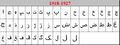 Adyghe Arabic alphabet letters
 -
 Adyghe Latin alphabet letters


.svg)
Grammar
Adyghe, like all Northwest Caucasian languages, has a basic subject–object–verb typology and is characterised by the ergative construction of sentences.
Vocabulary
Native vocabulary
| Cyrillic | Latin[52][53] | IPA | Translation |
|---|---|---|---|
| сэ | se | ady | I |
| пшъашъэ | ps̄as̄e | ady | girl |
| тӏыс | ţys | ady | to sit |
| тэдж | tedź | ady | to stand |
| Тэу ущыт? | Tew uśyt? | ady | How are you? |
| Сышӏу. | Syş̄w. | ady | I'm fine. |
| шы | šy | ady | horse |
| щы | śy | ady | three |
| жъуагъо | z̄waǧo | ady | star |
| тыгъэ | tyǧe | ady | sun |
| мазэ | maze | ady | moon |
| цуакъэ | cwaqe | ady | shoe |
| шъукъеблагъ | s̄wqéblaǧ | ady | welcome |
| лъэхъуамбэ | łeḩwambe | ady | toe |
| хьамлыу | hamlyw | ady | worm |
| кӏэнкӏэ | ḉenḉe | ady | egg |
| хьампӏырашъу | hamṗyras̄w | ady | butterfly |
| мэшӏоку | meş̄okw | ady | train |
| пхъэтӏэкӏу | pḩeţeķw | ady | chair |
| тхьалъыкӏо | thałyḉo | ady | prophet |
| къамзэгу | qamzegw | ady | ant |
| псычэт | psyćet | ady | duck |
Loanwords
| Cyrillic | Latin | IPA | Translation | Etymology |
|---|---|---|---|---|
| республикэ | réspublike | ady | republic | From Latin rēs pūblica ('public concern') via Russian республика. |
| компутер | komputér | ady | computer | From Latin computāre ('to settle together') via Russian компьютер. |
| математикэ | matématike | ady | mathematics | From Ancient Greek μάθημα máthēma ('study, knowledge') via Russian математика. |
| спорт | sport | ady | sports | From English sport via Russian спорт. |
| быракъ | byraq | ady | flag | Ultimately from Proto-Turkic *badrak ('spear; stick'). |
| къартӏоф | qārţof | ady | potato | From German Kartoffel ('potato') via Russian картофель. |
| томат | tomat | ady | tomato | From Spanish tomate, which in turn derives from Nahuan tomatl, via Russian томат. |
| орэндж | orendź | ady | orange | From Persian نارنگ nârang or نارنج nâranj. |
| нэмаз | nemaz | ady | salah (Islamic praying) | From Persian نماز namâz. |
| къалэ | qale | ady | city | Akkadian kalakku ('fort'). |
| дунай | dunaj | ady | earth | From Arabic دنيا dunyā ('world'). |
- There are thirteen labialised consonants; however, in some dialects, there are three additional ones: Кхъу [q͡χʷ], Ху [xʷ] and Чъу [t͡ɕʷ].
Sample texts
Al-Fatiha الفَاتِحَةِ
| Adyghe in Cyrillic script
(Mashbash & Koshbaev)[72] |
Adyghe in ABX Latin Script
(Used by Turkish Ministry of Education) |
Adyghe in Perso-Arabic Script
(Historical) |
English
(Dr. Mustafa Khattab)[73] |
|---|---|---|---|
1. Алахьэу гукӏэгъушӏэу, гукӏэгъу зыхэлъым ыцӏэкӏэ! |
1. Alahew gućeğuş'ew, gućeğu' zıxeĺım ıšeće! |
۱. اللهەو ݝوڃەغوضەو، ݝوڃەغو زہݗەݪہیم ئیڗەڃە! |
1. In the Name of God—the Most Compassionate, Most Merciful. |
John 1:1–5
| Adyghe in Cyrillic script | Adyghe in ABX Latin Script
(Used by Turkish Ministry of Education) |
Adyghe in Perso-Arabic Script
(Historical) |
English translation |
|---|---|---|---|
1. Ублапӏэм ыдэжь Гущыӏэр щыӏагъ. Ар Тхьэм ыдэжь щыӏагъ, а Гущыӏэри Тхьэу арыгъэ. |
1. Wıblaṕem ıdej Guşıer şıaáğ. Ar Them ıdej şıaáğ, a Guşıeri Thew arığe. |
۱. ئوبلاࢠەم ئہدەژ ݝوشہئەر شہئاغ. آر تحەم ئہدەژ شہئاغ، آ ݝوشہئەری تحەو آرہغە. |
1. In the beginning was the Word, and the Word was with God, and the Word was a god. |
Universal Declaration of Human Rights
| UDHR in Adyghe[74] | Adyghe in ABX Latin Script
(Used by Turkish Ministry of Education) |
Adyghe in Perso-Arabic Script
(Historical) |
IPA | English translation |
|---|---|---|---|---|
| Цӏыф пстэури шъхьэфитэу, ялъытэныгъэрэ яфэшъуашэхэмрэкӏэ зэфэдэу къалъфы. Акъылрэ зэхэшӏыкӏ гъуазэрэ яӏэшъы, зыр зым зэкъош зэхашӏэ азфагу дэлъэу зэфыщытынхэ фае. | Šıf pstewri şhefitew, yaĺıtenığere yafeşüaşexemreće zefedew kaĺfı. Akılre zexeş'ıć ğuazere yaeşı, zır zım zekoş zexaş'e azfagu deĺew zefışıtınxe faye. | ڗہف پستەوری صحەفیتەو، یاݪہتەنہغەرە یافەصواس̈ەݗەمرەڃەڗیف پستەوری صحەفیتەو، یاݪہتەنہغەرە یافەصواس̈ەݗەمرەڃە زەفەدەو قاݪفہ. آقہلرە زەݗەضہڃ غوازەرە یائەصہ، زہر زہم زەقۆس̈ زەڃاضە آزفاگو دەݪەو زەفہشہتہنڃە فایە. | [t͡sʼəf pstawərəj ʂ͡ħafəjtawə jaːɬətanəʁara jaːfaʂʷaːʃaxamrat͡ʃʼa zafadawə qaːɬfə aqəɮra zaxaʃʼət͡ʃʼ ʁʷaːzara jaːʔaʃə zər zəm zaqʷaʃ azfaːgʷ daɬawə zafəɕətənxa faːja] | All human beings are born free and equal in dignity and rights. They are endowed with reason and conscience and should act towards one another in a spirit of brotherhood. |
See also
- Adyghe Maq, the main Adyghe-language newspaper
- Anthem of the Republic of Adygea
Notes
References
- ↑ Hammarström, Harald; Forkel, Robert; Haspelmath, Martin, eds (2017). "Adyghe". Glottolog 3.0. Jena, Germany: Max Planck Institute for the Science of Human History. http://glottolog.org/resource/languoid/id/adyg1241.
- ↑ Adyghe (3rd ed.), Oxford University Press, September 2005, http://oed.com/search?searchType=dictionary&q=Adyghe (Subscription or UK public library membership required.)
- ↑ Aydın, Şamil Emre (2015) (in tr). Çerkes Diyalektleri: Çerkes Diyalektlerinin Karşılaştırmalı Analizi. Adana. ISBN 978-605-65691-1-1. https://www.academia.edu/27977779.
- ↑ 4.0 4.1 4.2 4.3 Colarusso, John (2014-01-21) (in en). The Northwest Caucasian Languages: A Phonological Survey. Routledge. ISBN 978-1-317-91816-5. https://books.google.com/books?id=3eKsAgAAQBAJ.
- ↑ Hammarström, Harald; Forkel, Robert; Haspelmath, Martin, eds (2017). "West Circassian". Glottolog 3.0. Jena, Germany: Max Planck Institute for the Science of Human History. http://glottolog.org/resource/languoid/id/adyg1241.
- ↑ 6.00 6.01 6.02 6.03 6.04 6.05 6.06 6.07 6.08 6.09 6.10 6.11 6.12 6.13 6.14 6.15 6.16 Абазов, Алексей Хасанович (2022) (in ru). Адыги: адыгейцы, кабардинцы, черкесы, шапсуги. Nauka. ISBN 978-5-02-040924-8. https://books.google.com/books?id=SGoL0AEACAAJ.
- ↑ Richmond, Walter (2013-04-09) (in en). The Circassian Genocide. Rutgers University Press. ISBN 978-0-8135-6069-4. https://books.google.com/books?id=LHlwZwpA70cC&q=walter+richmond+circassian+genocide.
- ↑ 8.0 8.1 8.2 8.3 8.4 8.5 8.6 8.7 Биданок, Марзият Мугдиновна (2015) (in ru). Адыгейский литературный язык (на материале диалектов адыгейского языка) (Monograph). Maykop: OOO "Elektronnye izdatelskie tekhnologii". https://catalog.inforeg.ru/Inet/GetEzineByID/306679.
- ↑ 9.0 9.1 9.2 9.3 9.4 9.5 9.6 9.7 Jaimoukha, Amjad M. (2001) (in en). The Circassians: A Handbook. Palgrave. ISBN 978-0-312-23994-7. https://books.google.com/books?id=5jVmQgAACAAJ.
- ↑ 10.0 10.1 10.2 Kāzemzāde, Hāmed (2018). The Circassian Question: The Formation of Linguistic and Cultural Identity in the Caucasus from the Mind-nineteenth Century to Modern Times (PhD Thesis thesis).
- ↑ 11.0 11.1 11.2 11.3 11.4 Кумахов, Мухадин Абубекирович (2006) (in ru). Адыгская (черкесская) энциклопедия. Фонд Им. Б.Х. Акбашева. ISBN 978-5-9900337-1-9. https://books.google.com/books?id=UIXbNAAACAAJ.
- ↑ 12.0 12.1 Хан-Гирей, Султан (1836) (in ru). Записки о Черкесии.
- ↑ Horak, William (2019). "Social Revolution in Circassia: The Interdependence of Religion and the World System". Journal of Caucasian Studies 4. https://dergipark.org.tr/tr/download/article-file/729687.
- ↑ Алексеевич, Мороз Георгий (2015). "Адыгские идиомы в Турции: от первых описаний до собственной письменности". Вестник РГГУ. Серия: Литературоведение. Языкознание. Культурология (8): 44–60. ISSN 2073-6355. https://cyberleninka.ru/article/n/adygskie-idiomy-v-turtsii-ot-pervyh-opisaniy-do-sobstvennoy-pismennosti.
- ↑ Арапов, Дмитрий Юрьевич; Bobrovnikov, V. O.; Бобровников, В. О.; Бабич, И. Л. (2007) (in ru). Северный Кавказ в составе Российской империи. Новое литературное обозрение. ISBN 978-5-86793-529-0. https://books.google.com.tr/books/about/%D0%A1%D0%B5%D0%B2%D0%B5%D1%80%D0%BD%D1%8B%D0%B9_%D0%9A%D0%B0%D0%B2%D0%BA%D0%B0%D0%B7_%D0%B2_%D1%81%D0%BE%D1%81.html?id=3rAdvgAACAAJ&redir_esc=y.
- ↑ Aydın, Şamil Emre (2015) (in tr). Çerkes Alfabeleri: Çerkeslerin Alfabe Girişimlerinin Kısa Tarihi ve Günümüz Çerkes Alfabeleri. Adana. ISBN 978-605-65691-0-4.
- ↑ Kotli︠a︡rov, V. N., ed (2014). Kavkaz: Cherkesii︠a︡. Kavkaz, proekt Marii i Viktora Kotli︠a︡rovykh. Nalʹchik: Izdatelʹstvo M. i V. Kotli︠a︡rovykh. ISBN 978-5-93680-746-6.
- ↑ 18.0 18.1 18.2 18.3 18.4 18.5 Akkieva, Svetlana I.; Dzamikhov, Kasbolat F. (2018). "ON THE CHARACTERIZATION OF THE CIRCASSIAN DIASPORA (ON MATERIALS OF THE RUSSIAN CAUCASIAN STUDIES)" (in en). Karadeniz Araştırmaları Dergisi 1 (57): 79–101. https://arastirmax.com/en/publication/karadeniz-arastirmalari-dergisi/1/57/79-101-characterization-circassian-diaspora-materials-russian-caucasian-studies/arid/e8a74279-7374-468a-92e2-b004e85ac102.
- ↑ Абазов, Алексей Хасанович (2022) (in ru). Адыги: адыгейцы, кабардинцы, черкесы, шапсуги. Nauka. ISBN 978-5-02-040924-8. https://books.google.com/books?id=SGoL0AEACAAJ.
- ↑ 20.0 20.1 Minakova, Valeriya (2023). “AND IF MY LANGUAGE DISAPPEARS TOMORROW...”: LANGUAGE IDEOLOGIES AND LANGUAGE MAINTENANCE PRACTICES OF THE CIRCASSIANS (ADYGHES) IN RUSSIA (Thesis). Pennsylvania State University.
- ↑ 21.0 21.1 21.2 Кумахов, Мухадин Абубекирович (2006) (in ru). Адыгская (черкесская) энциклопедия. Фонд Им. Б.Х. Акбашева. ISBN 978-5-9900337-1-9. https://books.google.com/books?id=UIXbNAAACAAJ.
- ↑ Ашуба, А. Е; Пазов, С. У; Биданок, М. М.; Магомедов, М. И. (2021). Хагба, Л. Р.. ed (in ru). Проблемы синтаксиса в кавказских языках. Sukhum.
- ↑ 23.0 23.1 23.2 Трахо, Рамазан (1956). Черкесы (Circassians - Northern Caucasians. Munich.
- ↑ Institute for the Humanities Research – Affi liated Federal State Budgetary Scientifi c Establishment «Federal Scientifi c Center «Kabardian-Balkarian Scientifi c Center of the RAS» (IHR KBSC RAS); Hakuasheva, Madina Andreevna (2019). "THE FORMATION OF KABARDIAN LITERARY CRITICISM IN THE 30S OF THE TWENTIETH CENTURY. THREE ARTICLES BY J. NALOEV". BULLETIN of the Kabardian-Balkarian Institute for the Humanities Research 4 (43): 78–86. doi:10.31007/2306-5826-2019-4-1-43-78-86. http://www.kbigi.ru/fmedia/10_%D1%85%D0%B0%D0%BA%D1%83%D0%B0%D1%88%D0%B5%D0%B2%D0%B0.pdf.
- ↑ Çelik, Mehmet, ed (2008–2016). "Kuzey Kafkasya" (in Turkish). Tarih Bilinci (Istanbul).
- ↑ "Protecting Cultural Heritage in the Caucasus". Papers from the RUCARR Conference, December 5-6, 2018 (Malmö University). 2020-12-21. doi:10.24834/isbn.9789178771608. ISBN 978-91-7877-160-8.
- ↑ 27.0 27.1 Topçu, Murat; Oral, Yasemin (2024-04-12). "Circassians and Abkhaz-Abazas in metropolitan areas: The case of Istanbul and Ankara" (in en). Minority Rights Group. https://minorityrights.org/resources/circassians-and-abkhaz-abazas-in-metropolitan-areas-the-case-of-istanbul-and-ankara/.
- ↑ Miyazawa, Eiji (2004). Memory Politics: Circassians of Uzunyayla, Turkey (Thesis).
- ↑ Abazova, Marita Muchamedovna (2014). Recʹ kabardino-čerkesskoj diaspory v Turcii. Nalʹcǐk: Izdat. Otdel KBIGI RAN. ISBN 978-5-91766-082-0.
- ↑ 30.0 30.1 30.2 30.3 Топчу (Папшу), Мурат. Состояние и перспективы изучения родного языкав черкесской диаспоре Турции
- ↑ 31.0 31.1 31.2 31.3 31.4 Battilani, Betül Seda; Topçu, Murat (2021-01-01). "The Circassian diaspora in Turkey: language education and how grassroots initiatives can help". Network of Laz and Circassian Civil Societies. https://www.academia.edu/87632456/The_Circassian_diaspora_in_Turkey_language_education_and_how_grassroots_initiatives_can_help.
- ↑ 32.0 32.1 "Turkey’s Circassians in uproar over alphabet - AL-Monitor: The Middle Eastʼs leading independent news source since 2012" (in en). https://www.al-monitor.com/originals/2015/04/turkey-circassians-in-uproar-over-latin-alphabet.html.
- ↑ 33.0 33.1 Надъярных Н.С., Бекизова Л.А. (отв. ред.). Культурная диаспора народов Кавказа: генезис, проблемы изучения (по материалам международной научной конференции. 14-19 октября 1991 г.)
- ↑ 34.0 34.1 34.2 Abazova, Marita Muchamedovna (2014). Recʹ kabardino-čerkesskoj diaspory v Turcii. Nalʹcǐk: Izdat. Otdel KBIGI RAN. ISBN 978-5-91766-082-0.
- ↑ Абрегов, А. Н.; Осипов, Г. А. (2021). "АДЫГЕЙСКИЙ ЯЗЫК, ЕГО ДИАЛЕКТЫ ЧЕРЕЗ ПРИЗМУ СОЦИО-И ЭТНОЛИНГВИСТИКИ". Литературная критика, литературоведение, фольклористика народов Карачаево-Черкесии: истоки, становление, развитие: 47–52. https://elibrary.ru/item.asp?id=48097883.
- ↑ Circassians bid to save ancient language. Al Jazeera. 14 May 2010. Archived from the original on 10 March 2016. Retrieved 29 December 2011.
- ↑ 37.0 37.1 Mackey, Bruce Douglas (1979) (in en). The Circassians in Jordan. Defense Technical Information Center. https://books.google.com.tr/books/about/The_Circassians_in_Jordan.html?id=HC2J0AEACAAJ&redir_esc=y.
- ↑ Брук, Джеймс. "Абхазия охотно принимает беженцев из Сирии" (in ru). ГОЛОС АМЕРИКИ. https://www.golos-ameriki.ru/a/syria-abkhazia/1642240.html.
- ↑ "Lidovky (Чехия): Абхазия ― одна из стран, которая радушно принимает беженцев. Им предлагают свободные дома и курсы русского языка" (in ru). ИноСМИ.Ru. 2018-09-05. https://inosmi.ru/politic/20180905/243170762.html.
- ↑ Naloev, Zaur Mukhamedovich (1985) (in ru). Этюды по истории культуры адыгов. Izd-vo "Ėlʹbrus". https://books.google.com.tr/books/about/%D0%AD%D1%82%D1%8E%D0%B4%D1%8B_%D0%BF%D0%BE_%D0%B8%D1%81%D1%82%D0%BE%D1%80%D0%B8%D0%B8_%D0%BA%D1%83%D0%BB%D1%8C.html?id=jahpzQEACAAJ&redir_esc=y.
- ↑ Кощбэе, Пщымаф; МэщбэшIэ, Исхьакъ; Аулъэ, Фаиз; ЛIыбзыу, Даут (in ady). КъурIан Iаятэхэм ямэхьанэхэр.
- ↑ "Adyghe | Institute for Bible Translation". https://ibtrussia.org/languages/adyghe.
- ↑ (in en) Great Soviet Encyclopedia. 1980. pp. 334. https://books.google.com/books?id=3mHSiteDJ20C&q=adyge+%22mak%22.
- ↑ "UNESCO Map of World's language in Danger". http://cms01.unesco.org/fileadmin/MULTIMEDIA/HQ/CLT/CLT/pdf/UNESCO-EndangeredLanguages-WorldMap-20090218.pdf.
- ↑ Arkadiev, Peter; Lander, Yury (2020). "The Northwest Caucasian Languages". in Polinsky, Maria (in en). The Oxford Handbook of the Languages of the Caucasus. Oxford: Oxford University Press. pp. 4.
- ↑ Kerasheva, Z. I. (1957) (in ru). Maykop: Adyghe Book Publishing House.
- ↑ Палатализация (смягчение) и аффрикатизация согласных (in Russian)
- ↑ Переднеязычные мягкие шипящие аффрикаты дж, ч, к1 (in Russian)
- ↑ Консонантная система уляпского говора в сопоставлении с аналогами других диалектов адыгских языков (in Russian)
- ↑ Studia Caucasologica I page 11 (in English)
- ↑ Applebaum, Ayla; Gordon, Matthew (2013). "A Comparative Phonetic Study of the Circassian Languages". University of California, Santa Barbara. https://journals.linguisticsociety.org/proceedings/index.php/BLS/article/download/809/592.
- ↑ 52.0 52.1 52.2 52.3 "ADYGHE (ADYGHIAN)". https://transliteration.eki.ee/pdf/Adyghe_3.0.pdf.
- ↑ 53.0 53.1 53.2 53.3 53.4 "Adõgee / Adyghian / Адыгабзэ Adygabze". KNAB: Kohanimeandmebaas / Place Names Database. 9 June 2003. https://arhiiv.eki.ee/knab/lat/kblady.pdf.
- ↑ "Languages of smaller Caucasian peoples". KNAB: Place Names Database. 9 June 2003. https://arhiiv.eki.ee/knab/lat/kblkauk2.pdf.
- ↑ 55.0 55.1 55.2 55.3 Kimmer, Dzepş (February–March 1991). "Niçin Yeni Bir Adiğe Alfabesi Oluşturulmalıdır?". Kafdağı (Ankara: Kuzey Kafkasya Kültür Derneği) 5 (47).
- ↑ Papşu, Murat (September–October 2006). "Çerkes-Adige yazısının tarihçesi". Nart (Ankara: Kafkas Dernekleri Federasyonu) (51). ISSN 1302-2539.
- ↑ Северный Кавказ в составе Российской империи. Москва: Новое литературное обозрение. 2007. pp. 460.
- ↑ 58.0 58.1 58.2 58.3 58.4 58.5 M. I. Isaev (1979) (in ru). Jazykovoe stroitel'stvo v SSSR. Мoscow: "Nauka" «Наука». pp. 180–191, 352.
- ↑ H. Sh. Urys (2000) (in ru). История кабардинского языка. Nalshyk: Elbrus. ISBN 978-5-7680-1439-1. http://lib.kbsu.ru/Elib/4/14/1/index.htm. Retrieved 5 March 2024.
- ↑ 60.0 60.1 "ADIGE DİL DERNEĞİ'NDEN ÇAĞRI!" (in tr). http://www.ozgurcerkes.com/?Syf=18&Hbr=355814&/D%C3%9CNYA%E2%80%99DA-YA%C5%9EAYAN-B%C3%9CT%C3%9CN-ADIGE-HALKININ-ORTAK-KULLANAB%C4%B0LECE%C4%9E%C4%B0-STANDART-B%C4%B0R-LAT%C4%B0N-ALFABES%C4%B0-OLU%C5%9ETURULMASI-%C4%B0%C3%87%C4%B0N-ADIGE-D%C4%B0L-DERNE%C4%9E%C4%B0N%C4%B0N-(ADDER)-ADIGE-HALKINA-%C3%87A%C4%9ERISID.
- ↑ Aydın, Şamil Emre (2015) (in tr). Çerkes Alfabeleri: Çerkeslerin Alfabe Girişimlerinin Kısa Tarihi ve Günümüz Çerkes Alfabeleri. Adana. ISBN 978-605-65691-0-4.
- ↑ "Экспериментальный проект учебника с упрощенным адыгским алфавитом выпущен в Адыгее - СА онлайн - Советская Адыгея" (in ru-RU). СА онлайн - Советская Адыгея. 2018-06-14. https://sovetskaya-adygeya.ru/2018/06/14/eksperimentalnyj-proekt-uchebnika-s-uproshchennym-adygskim-alfavitom-vypushchen-v-adygee/.
- ↑ Yevlampiev, Ilya; Pentzlin, Karl; Joomagueldinov, Nurlan (19 July 2011) (in en). Proposal to encode Arabic characters used for Adyghe and Chechen languages. pp. 4 and 10. https://www.unicode.org/L2/L2011/11277-adyghe-chechen.pdf.
- ↑ "Hapi Cevdet Yıldız | Anadili Eğitimi ve Alfabe Sorunu" (in TR). 18 June 2013. http://cherkessia.net/author_article_detail.php?article_id=3743.
- ↑ "kafkasya kuzey kafkasya cerkes cerkez çerkes çerkez kafkasya kuzey kafkasya cerkes cerkez çerkes çerkez kafkasya kuzey kafkasya cerkes cerkez çerkes çerkez". http://www.circassiancenter.com/cc-turkiye/yorum/nh/264-adder-2.htm.
- ↑ "Adıǵe Dili (Çerkes Dili) Latin alfabesine uyarlanıyor" (in tr). 2014-10-01. https://www.pusulahaber.com.tr/adige-dili-cerkes-dili-latin-alfabesine-uyarlaniyor-82281h.htm.
- ↑ "T.C. Millî Eğitim Bakanlığı Talim Terbiye Kurulu Başkanlığı". http://mufredat.meb.gov.tr/ProgramDetay.aspx?PID=1169.
- ↑ "Kaffed'den Kiril eylemi" (in tr). 2015-04-16. https://ajanskafkas.com/diaspora/kaffedden-kiril-eylemi/.
- ↑ "KAFFED'İN LATİN ALFABESİ İLE EĞİTİM KONUSUNDAKİ DAVASI RED EDİLDİ. – ÇERKES-FED" (in tr). August 2021. https://cerkesfed.org/yazarlar/yilmaz-donmez/kaffedin-latin-alfabesi-ile-egitim-konusundaki-davasi-red-edildi/.
- ↑ DANEF. "DANEF" (in tr-TR). https://www.danef.com/dosyalar.php?id=5.
- ↑ Choi, John D. (June 1991). "An acoustic study of Kabardian vowels" (in en). Journal of the International Phonetic Association 21 (1): 4–12. doi:10.1017/S0025100300005958. ISSN 1475-3502. https://www.cambridge.org/core/journals/journal-of-the-international-phonetic-association/article/abs/an-acoustic-study-of-kabardian-vowels/F303B442CE201E97D4F29D1A9567033F.
- ↑ Кощбэе, Пщымаф; МэщбэшIэ, Исхьакъ; Аулъэ, Фаиз; ЛIыбзыу, Даут (in ady). КъурIан Iаятэхэм ямэхьанэхэр.
- ↑ The Clear Quran: A Thematic English Translation. Lombard, IL: Siraj Publications. 2015. ISBN 978-0977300969.
- ↑ "OHCHR |". https://www.ohchr.org/EN/UDHR/Pages/Language.aspx?LangID=ady.
External links
 |
Adyghe edition of Wikipedia, the free encyclopedia |
- Grammar of the Circassian Language . Useful site to learn the Adyghe grammar.
- Louis Loewe (1854). A dictionary of the Circassian language, English-Circassian-Turkish. George Bell. https://archive.org/details/adictionarycirc01loewgoog.
- Sample Adyghe document in Arabic Script, 1924, تەزغەو نەخوشتەر-گوبغویش: تەزغەو نەشتەر-گوبغواب / Тэзгъэу нэхъущтэр-губгъуищ: тэзгъэу нэщтэр-губгъуаб. Zubrilin, Aleksey Arsenevich. Moscow and Krasny Vostok, USSR.
- "Adyghe transliteration schemes". http://transliteration.eki.ee/pdf/Adyghe_3.0.pdf..
- Adyghe sample, Language Museum.
- Learning Adyghe resource.
- Learn Circassian, International Centre for Circassian Studies (ICCS).
- Rferl North Caucasus Radio.
- Adyghe transliteration tool.
- Ancient Adyghe Abkhaz–Abaza Ubykh alphabet.
- How to count in Adyghe language.
- Adyghe language dictionary.
- Recordings of Adyghe language
Template:Northwest Caucasian languages
| Caucasian (areal) |
|  | ||||||||||||||||||
|---|---|---|---|---|---|---|---|---|---|---|---|---|---|---|---|---|---|---|---|---|
| Indo-European |
| |||||||||||||||||||
| Mongolic | ||||||||||||||||||||
| Turkic |
| |||||||||||||||||||
| Afroasiatic | ||||||||||||||||||||
| ||||||||||||||||||||
 |  |


