The Kandahar Greek Edicts of Ashoka are among the Major Rock Edicts of the Indian Emperor Ashoka (reigned 269-233 BCE), which were written in the Greek language and Prakrit language . They were found in the ancient area of Old Kandahar (known as Zor Shar in Pashto, or Shahr-i-Kona in Farsi) in Kandahar in 1963.[1] It is thought that Old Kandahar was founded in the 4th century BCE by Alexander the Great, who gave it the Ancient Greek name Αλεξάνδρεια Aραχωσίας (Alexandria of Arachosia).
The extant edicts are found in a plaque of limestone, which probably had belonged to a building, and its size is 45x69.5 cm and it is about 12 cm thick. These are the only Ashoka inscriptions thought to have belonged to a stone building.[1][2] The beginning and the end of the fragment are lacking, which suggests the inscription was original significantly longer, and may have included all 14 of Ashoka's Edicts in Greek, as in several other locations in India.[2] The plaque with the inscription was bought in the Kandahar market by the German doctor Seyring, and French archaeologists found that it had been excavated in Old Kandahar. The plaque was then offered to the Kabul Museum,[3] but its current location is unknown following the looting of the museum in 1992-1994.[4]
Greek communities lived in the northwest of the Mauryan empire, currently in Pakistan, notably ancient Gandhara near the current Pakistani capital of Islamabad and in the region of Gedrosia, and presently in Southern Afghanistan, following the conquest and the colonization efforts of Alexander the Great around 323 BCE. These communities therefore were significant in the area of Afghanistan during the reign of Ashoka.[5]
Content
An 1881 photo showing the ruined Old Kandahar citadel ("Zor Shar") where the Greek inscription was discovered[5]The Kandahar Greek Inscription was located at the edge of the Indian realm, near the border with the Greco-Bactrian kingdom and Ai-Khanoum.
The Edict is a Greek version of the end of the 12th Edicts (which describes moral precepts) and the beginning of the 13th Edict (which describes the King's remorse and conversion after the war in Kalinga), which makes it a portion of a Major Rock Edict.[6] This inscription does not use another language in parallel, contrary to the famous Kandahar Bilingual Rock Inscription in Greek language and Aramaic, discovered in the same general area.[7]
The Greek language used in the inscription is of a very high level and displays philosophical refinement. It also displays an in-depth understanding of the political language of the Hellenic world in the 3rd century BCE. This suggests the presence of a highly cultured Greek presence in Kandahar at that time.[2]
Implications
The proclamation of this edict in Kandahar is usually taken as proof that Ashoka had control over that part of Afghanistan, presumably after Seleucus I had ceded this territory to Chandragupta Maurya in their 305 BCE peace agreement.[1] The Edict also shows the presence of a sizable Greek population in the area[5][8] where great efforts were made to convert them to Buddhism.[9] At the same epoch, the Greeks were established in the Greco-Bactrian kingdom, and particularly in the border city of Ai-Khanoum, in the northern part of Afghanistan.
Translation
Kandahar Greek Edict of Ashoka
English translation
Original Greek text
(End of Edict Nb12)
"...piety and self-mastery in all the schools of thought; and he who is master of his tongue is most master of himself. And let them neither praise themselves or disparage their neighbors in any matter whatsoever, for that is vain. In acting in accordance with this principle, they exalt themselves and win their neighbors; in transgressing in these things they misdemean themselves and antagonize their neighbors. Those who praise themselves and denigrate their neighbors are self-seekers, wishing to shine in comparison with the others but in fact hurting themselves. It behoves to respect one another and to accept one another's lessons. In all actions it behoves to be understanding, sharing with one another all that which one comprehends. And to those who strive thus let there be no hesitation to say these things in order that they may persist in piety in everything.
(Beginning of Edict Nb13)
In the eighth of the reign of Piodasses, he conquered Kalinga. A hundred and fifty thousand persons were captured and deported, and a hundred thousand others were killed, and almost as many died otherwise. Thereafter, piety and compassion seized him and he suffered grieviously. In the same manner wherewith he ordered abstention from living thing, he has displayed zeal and effort to promote piety. And at the same time the king has viewed this with displeasure: of Brahmins and Sramins and others practicing piety who live there [in Kalinga]- and these must be mindful of the interests of the king and must revere and respect their teacher, their father and their mother, and love and faithfully cherish their friends and companions and must use their slaves and dependents as gently as possible - if, of those thus engaged there, any has died or been deported and the rest have regarded this lightly, the king has taken it with exceeding bad grace. And that amongst other people there are..."
Ancient city of Old Kandahar (red) and Chil Zena mountainous outcrop (blue) on the western side of Kandahar
The Kandahar Bilingual Rock Inscription, discovered in 1958, is the other well-known Greek inscription by Ashoka in the area of Kandahar. It was found on the mountainside of the Chil Zena outcrop on the western side of the city of Kandahar.
Two other inscriptions in Greek are known at Kandahar. One is a dedication by a Greek man who names himself "son of Aristonax" (3rd century BCE). The other is an elegiac composition by Sophytos son of Naratos (2nd century BCE).[12]
↑ 2.02.12.2Une nouvelle inscription grecque d'Açoka, Schlumberger, Daniel, Comptes rendus des séances de l'Académie des Inscriptions et Belles-Lettres Année 1964 Volume 108 Numéro 1 pp. 126-140 [1]
↑Rome, the Greek World, and the East: Volume 1: The Roman Republic and the Augustan Revolution, Fergus Millar, Univ of North Carolina Press, 2003, p.45 [2]


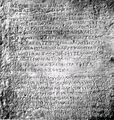 Kandahar Bilingual Rock Inscription in Greek and Aramaic, by Emperor Ashoka, 3rd century BCE, Kandahar
 Inscription in Greek by the "son of Aristonax", 3rd century BCE, Kandahar
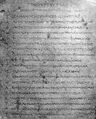 Kandahar Sophytos Inscription, 2nd century BCE, Kandahar
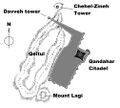 Plan of ancient fortifications of Kandahar.


.png)


