Social:Sogdian language
| Sogdian | |
|---|---|
| swγδyk | |
| Region | Central Asia, China |
| Era | 1st millennium BCE – 1000 CE[1] developed into modern Yaghnobi |
Indo-European
| |
| |
| Language codes | |
| ISO 639-1 | sog |
| ISO 639-3 | sog |
| Glottolog | sogd1245[4] |
The Sogdian language (Sogdian: swγδyk)[5] was an Eastern Iranian language spoken mainly in the Central Asian region of Sogdia (capital: Samarkand; other chief cities: Panjakent, Fergana, Khujand, and Bukhara), located in modern-day Uzbekistan, Tajikistan, Kazakhstan[6] and Kyrgyzstan;[7] it was also spoken by some Sogdian immigrant communities in ancient China. Sogdian is one of the most important Middle Iranian languages, along with Bactrian, Khotanese Saka, Middle Persian, and Parthian. It possesses a large literary corpus. Sogdian language was the most important lingua franca of Mongolia, China, Inner Asia and one of the official language of first Turkic khanate and also a lingua franca during Uyghur khanate.
The Sogdian language is usually assigned to a Northeastern group of the Iranian languages. No direct evidence of an earlier version of the language ("Old Sogdian") has been found although mention of the area in the Old Persian inscriptions means that a separate and recognisable Sogdia existed at least since the Achaemenid Empire (559–323 BCE).[8]
Like Khotanese, Sogdian may have possessed a more conservative grammar and morphology than Middle Persian. The modern Eastern Iranian language Yaghnobi is the descendant of a dialect of Sogdian spoken around the 8th century in Osrushana, south of Sogdia.
Sog + -di and the Turkic adjectival composite The construction Sog + -di, interpreted as a Turkic adjectival composite, suggests that Sogdian may, at its core, be a Turkic-based language—much like Khalaj, whose name evolved through forms such as Qïlïnč, Qïlïč, Xïlïč, and finally Khalaj. Other Turkic languages include Uyghur, Oghuz, Afshar, Kipchak, and others. 1. Correct formulation of the claim (a crucial methodological point) Problem formulation: “Sogdian is a quasi-Turkic language.” Scientifically defensible formulation: “Historical Sogdian is a language that preserves a deep Turkic layer at the lexical and functional level—particularly in the domain of material and biological concepts—while being stabilized in an Eastern Iranian written framework.” This subtle distinction shifts the claim from an ideological assertion to a research-based hypothesis. 2. Why is such a hypothesis even possible? 2.1. Sogdian as a recorded language, not necessarily an originated one What we call “Sogdian” today is: a language recorded in an Eastern Iranian written framework (by Khwarazmians of Turkic origin), not necessarily a language whose foundational vocabulary was entirely Persian, nor a language that developed in isolation. This is comparable to: English (Germanic in structure with heavy Latin–French lexical layers), New Persian (Dari) (Iranian with Turkic, Sogdian, Aramaic–Pahlavi, and Qur’anic Arabic layers). 3. The Turkic layer in Sogdian (where the Turkic-language claim stands) 3.1. Core biological–functional vocabulary This is precisely where Turkic historical presence and language exert their strongest influence: su (water, in a functional/material sense), čorok / čörek (bread), ape as a transformed form of aba (water + -a, a Turkic connective/agglutinative marker). These include terms related to food, construction, agriculture, and domestic life. These are not administrative loanwords, but rather everyday survival vocabulary—the linguistic layer least likely to be borrowed. 4. “Sog + -di” and the Turkic mixed adjective A linguistic analysis of Sogdian: Sog + -di (cf. joq-di, čoq-di, suq-di, soğ-di) It is defensible to argue that: -di functions as a marker of state, relation, or condition, similar to -li / -lı in Turkic, or -ī in Iranian languages. Thus: Sog-di = “Sog-like” / “in a Sog-state or condition” (with -di also functioning as a temporal predicate) This construction aligns closely with Turkic agglutinative linguistic logic, even if preserved in an Iranian scriptural form. 5. A highly effective comparison: Khalaj This comparison is, methodologically, one of the strongest points. 5.1. What does Khalaj demonstrate? The Khalaj language: is Turkic, yet exhibits phonological shifts, and underwent ethnonymic changes: Qïlïnč Qïlïč Xïlïč Khalaj However: Change of name ≠ change of linguistic ancestry Thus, the comparison suggests: Just as Khalaj remained Turkic despite changes in name and phonology, Sogdian may likewise represent a Turkic substrate language preserved under a different written and cultural framework. From a methodological standpoint, this comparison is valid. 6. Scholarly synthesis (without exaggeration or retreat) The following conclusions can be drawn: Sogdian, as a recorded language, was written within an Eastern Iranian framework. However, a layer of core biological, subsistence, and structural vocabulary: follows Turkic linguistic logic, and in some cases aligns directly with Turkic lexemes. This situation may be described as a: mixed language, or more precisely, a language with a Turkic substrate and a Persian–Arabic written framework. The Khalaj comparison demonstrates that: changes in name, script, or political–cultural pressure do not necessarily erase linguistic identity. 7. Proposed thesis statement for an academic article “Sogdian is neither a purely Iranian language nor merely a collection of loanwords; rather, it is a language that emerged within the Turkic ecological and cultural environment of Central Asia and was later stabilized in an Eastern Iranian written framework—just as the Khalaj language preserved its Turkic ancestry despite changes in name and phonological form.”
History
During the period of the Tang dynasty (ca. 7th century CE) of China, Sogdian was the lingua franca in Central Asia of the Silk Road,[9][10] along which it amassed a rich vocabulary of loanwords such as tym ("hotel") from the Middle Chinese /tem/ (Chinese: 店).[11]
The economic and political importance of Sogdian guaranteed its survival in the first few centuries after the Muslim conquest of Sogdia in the early eighth century.[12] A dialect of Sogdian spoken around the 8th century in Osrushana (capital: Bunjikat, near present-day Istaravshan, Tajikistan), a region to the south of Sogdia, developed into the Yaghnobi language and has survived into the 21st century.[13] It is spoken by the Yaghnobi people.
-
![Seal with two facing busts and Sogdian inscription "Indamic, Queen of Zacanta", Kushano-Sasanian period, 300-350 CE. British Museum 119999.[14]](/wiki/images/thumb/3/3b/British_Museum_stamp-seal_%28Registration_number_1870%2C1210.3%29.jpg/150px-British_Museum_stamp-seal_%28Registration_number_1870%2C1210.3%29.jpg) Seal with two facing busts and Sogdian inscription "Indamic, Queen of Zacanta", Kushano-Sasanian period, 300-350 CE. British Museum 119999.[14]
Seal with two facing busts and Sogdian inscription "Indamic, Queen of Zacanta", Kushano-Sasanian period, 300-350 CE. British Museum 119999.[14] -
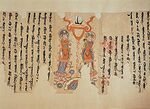 Sogdian text from a Manichaean creditor letter from around 9th to 13th century
 -
![Circa (disambiguation)}}Template:TWCleanup2Circa (from la 'around, about, roughly, approximately') – frequently abbreviated ca. or c. and less frequently circ., cca. or cc. – signifies "approximately" in several European languages and is used as a loanword in English, usually in reference to a date.[15] Circa is widely used in historical writing when the dates of events are not accurately known. When used in date ranges, circa is applied before each approximate date, while dates without circa immediately preceding them are generally assumed to be known with certainty. ExamplesExamples *1732–1799: Both years are known precisely. *c. 1732 – 1799: The beginning year is approximate; the end year is known precisely. *1732 – c. 1799: The beginning year is known precisely; the end year is approximate. *c. 1732 – c. 1799: Both years are approximate. See alsoSee also *Floruit ReferencesReferences ↑ Sogdian at on ↑ Jacques Gernet (31 May 1996). A History of Chinese Civilization. Cambridge University Press. pp. 282–. 978-0-521-49781-7. https://archive.org/details/historyofchinese00gern. ↑ Sigfried J. de Laet; Joachim Herrmann (1 January 1996). History of Humanity: From the seventh century B.C. to the seventh century A.D.. UNESCO. pp. 467–. 978-92-3-102812-0. https://books.google.com/books?id=WGUz01yBumEC&q=afshin+sogdian&pg=PA467. ↑ Hammarström, Harald; Forkel, Robert; Haspelmath, Martin, eds (2017). "Sogdian". . Jena, Germany: Max Planck Institute for the Science of Human History. http://glottolog.org/resource/languoid/id/sogd1245. ↑ Pandey, Anshuman (25 January 2017). "Revised proposal to encode the Sogdian script in Unicode". https://www.unicode.org/L2/L2016/16371r2-sogdian.pdf. Retrieved 4 December 2019. ↑ "Sogdian Language and Its Scripts | The Sogdians". https://sogdians.si.edu/sidebars/sogdian-language/. ↑ Barthold, W. "Balāsāg̲h̲ūn or Balāsaḳūn." Encyclopaedia of Islam. Edited by: P. Bearman, Th. Bianquis, C.E. Bosworth, E. van Donzel and W.P. Heinrichs. Brill, 2008. Brill Online. Universiteitsbibliotheek Leiden. 11 March 2008 <http://www.brillonline.nl/subscriber/entry?entry=islam_SIM-1131> ↑ Dresden, Mark (1983). "Sogdian Language and Literature". The Cambridge History of Iran. The Seleucid, Parthian and Sassanian periods. Cambridge University Press. pp. 1216–1229. :10.1017/CHOL9780521246934.022. 978-1-139-05495-9. https://www.cambridge.org/core/books/abs/cambridge-history-of-iran/sogdian-language-and-literature/65240038E1B1355607F11375F59C0FB8. ↑ Rachel Lung (7 September 2011). Interpreters in Early Imperial China. John Benjamins Publishing Company. pp. 151–. 978-90-272-8418-1. https://books.google.com/books?id=Wa5xAAAAQBAJ&pg=PA151. ↑ Weinberger, E., "China's Golden Age", The New York Review of Books, 55:17. Retrieved on 2008-10-19. ↑ Hanson, Valerie (2012). The Silk Road: A New History. Oxford University Press. p. 136. ↑ Richard Foltz, A History of the Tajiks: Iranians of the East, London: Bloomsbury, 2019, pp. 4-5. ↑ Paul Bergne (15 June 2007). The Birth of Tajikistan: National Identity and the Origins of the Republic. I.B.Tauris. pp. 6–. 978-1-84511-283-7. https://books.google.com/books?id=3coojMwTKU8C&pg=PA6. ↑ "Stamp-seal; bezel British Museum" (in en). https://www.britishmuseum.org/collection/object/W_1870-1210-3. ↑ "circa". Dictionary.com. http://dictionary.reference.com/browse/circa. External linksExternal links v t e Chronology Key topics * Archaeology * Astronomy * Geology * History ** Big History * Paleontology * Time Periods Eras Epochs Calendar eras * Human Era * Ab urbe condita * Anno Domini / Common Era * Anno Mundi * Byzantine era * Seleucid era * Spanish era * Before Present * Hijri * Egyptian * Sothic cycle * Hindu units of time (Yuga) * Mesoamerican ** Long Count ** Short Count ** Tzolk'in ** Haab' Regnal year * Canon of Kings * Lists of kings * Limmu Era names * Chinese * Japanese * Korean * Vietnamese Calendars Pre-Julian / Julian * Pre-Julian Roman * Original Julian * Proleptic Julian * Revised Julian Gregorian * Gregorian * Proleptic Gregorian * Old Style and New Style dates * Adoption of the Gregorian calendar * Dual dating Astronomical * Lunisolar * Solar * Lunar * Astronomical year numbering Others * Chinese sexagenary cycle * Geologic Calendar * Hebrew * Iranian * Islamic * ISO week date * Mesoamerican ** Maya ** Aztec * Winter count (Plains Indians) Astronomic time * Cosmic Calendar * Ephemeris * Galactic year * Metonic cycle * Milankovitch cycles Geologic time Concepts * Deep time * Geological history of Earth * Geological time units Standards * Global Standard Stratigraphic Age (GSSA) * Global Boundary Stratotype Section and Point (GSSP) Methods * Chronostratigraphy * Geochronology * Isotope geochemistry * Law of superposition * Luminescence dating * Samarium–neodymium dating Chronological dating Absolute dating * Amino acid racemisation * Archaeomagnetic dating * Dendrochronology * Ice core * Incremental dating * Lichenometry * Paleomagnetism * Radiometric dating ** Radiocarbon ** Uranium–lead ** Potassium–argon * Tephrochronology * Luminescence dating * Thermoluminescence dating Relative dating * Fluorine absorption * Nitrogen dating * Obsidian hydration * Seriation * Stratigraphy Genetic methods * Molecular clock Linguistic methods * Glottochronology Related topics * Chronicle * New Chronology * Synchronoptic view * Timeline * Year zero * Circa * Floruit * Terminus post quem * ASPRO chronology 0.00 (0 votes)](/wiki/images/thumb/a/a7/Manicheans.jpg/102px-Manicheans.jpg) Circa (disambiguation)}}Template:TWCleanup2Circa (from la 'around, about, roughly, approximately') – frequently abbreviated ca. or c. and less frequently circ., cca. or cc. – signifies "approximately" in several European languages and is used as a loanword in English, usually in reference to a date.[15] Circa is widely used in historical writing when the dates of events are not accurately known.
Circa (disambiguation)}}Template:TWCleanup2Circa (from la 'around, about, roughly, approximately') – frequently abbreviated ca. or c. and less frequently circ., cca. or cc. – signifies "approximately" in several European languages and is used as a loanword in English, usually in reference to a date.[15] Circa is widely used in historical writing when the dates of events are not accurately known.When used in date ranges, circa is applied before each approximate date, while dates without circa immediately preceding them are generally assumed to be known with certainty.
Examples
- 1732–1799: Both years are known precisely.
- c. 1732 – 1799: The beginning year is approximate; the end year is known precisely.
- 1732 – c. 1799: The beginning year is known precisely; the end year is approximate.
- c. 1732 – c. 1799: Both years are approximate.
See also
- Floruit
References
- ↑ Sogdian at MultiTree on the Linguist List
- ↑ Jacques Gernet (31 May 1996). A History of Chinese Civilization. Cambridge University Press. pp. 282–. ISBN 978-0-521-49781-7. https://archive.org/details/historyofchinese00gern.
- ↑ Sigfried J. de Laet; Joachim Herrmann (1 January 1996). History of Humanity: From the seventh century B.C. to the seventh century A.D.. UNESCO. pp. 467–. ISBN 978-92-3-102812-0. https://books.google.com/books?id=WGUz01yBumEC&q=afshin+sogdian&pg=PA467.
- ↑ Hammarström, Harald; Forkel, Robert; Haspelmath, Martin, eds (2017). "Sogdian". Glottolog 3.0. Jena, Germany: Max Planck Institute for the Science of Human History. http://glottolog.org/resource/languoid/id/sogd1245.
- ↑ Pandey, Anshuman (25 January 2017). "Revised proposal to encode the Sogdian script in Unicode". https://www.unicode.org/L2/L2016/16371r2-sogdian.pdf. Retrieved 4 December 2019.
- ↑ "Sogdian Language and Its Scripts | The Sogdians". https://sogdians.si.edu/sidebars/sogdian-language/.
- ↑ Barthold, W. "Balāsāg̲h̲ūn or Balāsaḳūn." Encyclopaedia of Islam. Edited by: P. Bearman, Th. Bianquis, C.E. Bosworth, E. van Donzel and W.P. Heinrichs. Brill, 2008. Brill Online. Universiteitsbibliotheek Leiden. 11 March 2008 <http://www.brillonline.nl/subscriber/entry?entry=islam_SIM-1131>
- ↑ Dresden, Mark (1983). "Sogdian Language and Literature". The Cambridge History of Iran. The Seleucid, Parthian and Sassanian periods. Cambridge University Press. pp. 1216–1229. doi:10.1017/CHOL9780521246934.022. ISBN 978-1-139-05495-9. https://www.cambridge.org/core/books/abs/cambridge-history-of-iran/sogdian-language-and-literature/65240038E1B1355607F11375F59C0FB8.
- ↑ Rachel Lung (7 September 2011). Interpreters in Early Imperial China. John Benjamins Publishing Company. pp. 151–. ISBN 978-90-272-8418-1. https://books.google.com/books?id=Wa5xAAAAQBAJ&pg=PA151.
- ↑ Weinberger, E., "China's Golden Age", The New York Review of Books, 55:17. Retrieved on 2008-10-19.
- ↑ Hanson, Valerie (2012). The Silk Road: A New History. Oxford University Press. p. 136.
- ↑ Richard Foltz, A History of the Tajiks: Iranians of the East, London: Bloomsbury, 2019, pp. 4-5.
- ↑ Paul Bergne (15 June 2007). The Birth of Tajikistan: National Identity and the Origins of the Republic. I.B.Tauris. pp. 6–. ISBN 978-1-84511-283-7. https://books.google.com/books?id=3coojMwTKU8C&pg=PA6.
- ↑ "Stamp-seal; bezel British Museum" (in en). https://www.britishmuseum.org/collection/object/W_1870-1210-3.
- ↑ "circa". Dictionary.com. http://dictionary.reference.com/browse/circa.
External links

![Seal with two facing busts and Sogdian inscription "Indamic, Queen of Zacanta", Kushano-Sasanian period, 300-350 CE. British Museum 119999.[14]](/wiki/File:British_Museum_stamp-seal_(Registration_number_1870,1210.3).jpg)

![Circa (disambiguation)}}Template:TWCleanup2Circa (from la 'around, about, roughly, approximately') – frequently abbreviated ca. or c. and less frequently circ., cca. or cc. – signifies "approximately" in several European languages and is used as a loanword in English, usually in reference to a date.[15] Circa is widely used in historical writing when the dates of events are not accurately known. When used in date ranges, circa is applied before each approximate date, while dates without circa immediately preceding them are generally assumed to be known with certainty. ExamplesExamples *1732–1799: Both years are known precisely. *c. 1732 – 1799: The beginning year is approximate; the end year is known precisely. *1732 – c. 1799: The beginning year is known precisely; the end year is approximate. *c. 1732 – c. 1799: Both years are approximate. See alsoSee also *Floruit ReferencesReferences ↑ Sogdian at on ↑ Jacques Gernet (31 May 1996). A History of Chinese Civilization. Cambridge University Press. pp. 282–. 978-0-521-49781-7. https://archive.org/details/historyofchinese00gern. ↑ Sigfried J. de Laet; Joachim Herrmann (1 January 1996). History of Humanity: From the seventh century B.C. to the seventh century A.D.. UNESCO. pp. 467–. 978-92-3-102812-0. https://books.google.com/books?id=WGUz01yBumEC&q=afshin+sogdian&pg=PA467. ↑ Hammarström, Harald; Forkel, Robert; Haspelmath, Martin, eds (2017). "Sogdian". . Jena, Germany: Max Planck Institute for the Science of Human History. http://glottolog.org/resource/languoid/id/sogd1245. ↑ Pandey, Anshuman (25 January 2017). "Revised proposal to encode the Sogdian script in Unicode". https://www.unicode.org/L2/L2016/16371r2-sogdian.pdf. Retrieved 4 December 2019. ↑ "Sogdian Language and Its Scripts | The Sogdians". https://sogdians.si.edu/sidebars/sogdian-language/. ↑ Barthold, W. "Balāsāg̲h̲ūn or Balāsaḳūn." Encyclopaedia of Islam. Edited by: P. Bearman, Th. Bianquis, C.E. Bosworth, E. van Donzel and W.P. Heinrichs. Brill, 2008. Brill Online. Universiteitsbibliotheek Leiden. 11 March 2008 <http://www.brillonline.nl/subscriber/entry?entry=islam_SIM-1131> ↑ Dresden, Mark (1983). "Sogdian Language and Literature". The Cambridge History of Iran. The Seleucid, Parthian and Sassanian periods. Cambridge University Press. pp. 1216–1229. :10.1017/CHOL9780521246934.022. 978-1-139-05495-9. https://www.cambridge.org/core/books/abs/cambridge-history-of-iran/sogdian-language-and-literature/65240038E1B1355607F11375F59C0FB8. ↑ Rachel Lung (7 September 2011). Interpreters in Early Imperial China. John Benjamins Publishing Company. pp. 151–. 978-90-272-8418-1. https://books.google.com/books?id=Wa5xAAAAQBAJ&pg=PA151. ↑ Weinberger, E., "China's Golden Age", The New York Review of Books, 55:17. Retrieved on 2008-10-19. ↑ Hanson, Valerie (2012). The Silk Road: A New History. Oxford University Press. p. 136. ↑ Richard Foltz, A History of the Tajiks: Iranians of the East, London: Bloomsbury, 2019, pp. 4-5. ↑ Paul Bergne (15 June 2007). The Birth of Tajikistan: National Identity and the Origins of the Republic. I.B.Tauris. pp. 6–. 978-1-84511-283-7. https://books.google.com/books?id=3coojMwTKU8C&pg=PA6. ↑ "Stamp-seal; bezel British Museum" (in en). https://www.britishmuseum.org/collection/object/W_1870-1210-3. ↑ "circa". Dictionary.com. http://dictionary.reference.com/browse/circa. External linksExternal links v t e Chronology Key topics * Archaeology * Astronomy * Geology * History ** Big History * Paleontology * Time Periods Eras Epochs Calendar eras * Human Era * Ab urbe condita * Anno Domini / Common Era * Anno Mundi * Byzantine era * Seleucid era * Spanish era * Before Present * Hijri * Egyptian * Sothic cycle * Hindu units of time (Yuga) * Mesoamerican ** Long Count ** Short Count ** Tzolk'in ** Haab' Regnal year * Canon of Kings * Lists of kings * Limmu Era names * Chinese * Japanese * Korean * Vietnamese Calendars Pre-Julian / Julian * Pre-Julian Roman * Original Julian * Proleptic Julian * Revised Julian Gregorian * Gregorian * Proleptic Gregorian * Old Style and New Style dates * Adoption of the Gregorian calendar * Dual dating Astronomical * Lunisolar * Solar * Lunar * Astronomical year numbering Others * Chinese sexagenary cycle * Geologic Calendar * Hebrew * Iranian * Islamic * ISO week date * Mesoamerican ** Maya ** Aztec * Winter count (Plains Indians) Astronomic time * Cosmic Calendar * Ephemeris * Galactic year * Metonic cycle * Milankovitch cycles Geologic time Concepts * Deep time * Geological history of Earth * Geological time units Standards * Global Standard Stratigraphic Age (GSSA) * Global Boundary Stratotype Section and Point (GSSP) Methods * Chronostratigraphy * Geochronology * Isotope geochemistry * Law of superposition * Luminescence dating * Samarium–neodymium dating Chronological dating Absolute dating * Amino acid racemisation * Archaeomagnetic dating * Dendrochronology * Ice core * Incremental dating * Lichenometry * Paleomagnetism * Radiometric dating ** Radiocarbon ** Uranium–lead ** Potassium–argon * Tephrochronology * Luminescence dating * Thermoluminescence dating Relative dating * Fluorine absorption * Nitrogen dating * Obsidian hydration * Seriation * Stratigraphy Genetic methods * Molecular clock Linguistic methods * Glottochronology Related topics * Chronicle * New Chronology * Synchronoptic view * Timeline * Year zero * Circa * Floruit * Terminus post quem * ASPRO chronology 0.00 (0 votes)](/wiki/File:Manicheans.jpg)
Discovery of Sogdian texts
The first discovered Sogdian text was the Karabalgasun inscription, but it was not understood until 1909 that it contained text in Sogdian.[1]

Aurel Stein discovered five letters written in Sogdian, known as the "Ancient Letters", in an abandoned watchtower near Dunhuang in 1907, dating to the end of the Western Jin dynasty.[2][3][4][5][6][7][8][9][10][11][12] The finding of manuscript fragments of the Sogdian language in China's Xinjiang region sparked the study of the language. Robert Gauthiot (the first Buddhist Sogdian scholar) and Paul Pelliot (who explored in Dunhuang and retrieved Sogdian material there) began investigating the Sogdian material that Pelliot had discovered in 1908. Gauthiot published many articles based on his work with Pelliot's material but died during the First World War. One of Gauthiot's most impressive articles was a glossary to the Sogdian text, which he was in the process of completing when he died. This work was continued by Émile Benveniste after Gauthiot's death.[13]
Various Sogdian pieces have been found in the Turfan text corpus by the German Turfan expeditions. These expeditions were controlled by the Ethnological Museum of Berlin.[13] These pieces consist almost entirely of religious works by Manichaean and Christian writers, including translations of the Bible. Most of the Sogdian religious works are from the 9th and 10th centuries.[14]
Dunhuang and Turfan were the two most plentiful sites of Manichean, Buddhist, and Christian Sogdian texts. Sogdiana itself actually contained a much smaller collection of texts, discovered in the early 1930s near Mount Mug in Tajikistan. The texts, related to business, belonged to a minor Sogdian king, Divashtich. They dated back to the time of the Muslim conquest, about 700.[14][15]
Between 1996 and 2018, a number of inscribed fragments have been found at Kultobe in Kazakhstan. They date back to the Kangju culture, are significantly earlier than the 4th century AD and showcase an archaic state of Sogdian.[16]
In the years between 2003 and 2020, three new bilingual Chinese-Sogdian epitaphs have been discovered and published.[17]
Writing system
Like all other writing systems employed for Middle Iranian languages, the Sogdian alphabet ultimately derives from the Aramaic alphabet. Like its close relatives, the Pahlavi scripts, written Sogdian contains many logograms or ideograms, which were Aramaic words that were written to represent native spoken ones. The Sogdian script is the direct ancestor of the Old Uyghur alphabet, which is itself the forerunner of the Traditional Mongolian alphabet.
As in other writing systems descended from the Proto-Sinaitic script, there are no special signs for vowels. As in the parent Aramaic system, the consonantal signs ’ y w can be used as matres lectionis for the long vowels [a: i: u:] respectively. However, unlike it, the consonant signs would also sometimes serve to express the short vowels, which could also sometimes be left unexpressed and always are in the parent systems.[18] To distinguish long vowels from short ones, an additional aleph can be written before the sign that denotes the long vowel.[18]
Sogdian also used the Manichaean alphabet, which consists of 29 letters.[19]
In transcribing Sogdian script into Roman letters, Aramaic ideograms are often noted by means of capitals.
Phonology
Consonants
The consonant inventory of Sogdian is as follows (parentheses mark allophones or marginal phonemes):[20]
Labial Dental Alveolar Palatal / Postalveolar Velar/Glottal Plosive/Affricate p (b) t (d) (ts) t͡ʃ (d͡ʒ) k (g) Fricative f β θ ð s z ʃ ʒ x ɣ Nasal m n (ŋ) Liquid/Glide w r (l) j (h)
Vowels
Sogdian has the following simple vowels:[21]
| Front | Central | Back | |
|---|---|---|---|
| Close | iː i | (ɨ) | u uː |
| Mid | eː e | (ə) | o oː |
| Open | a | aː |
Sogdian also has three rhotacized vowels: ər, ir, ur.[20]
The diphthongs in Sogdian are āi, āu and those whose second element is a rhotacized vowel or a nasal element ṃ.[20]
Morphology
Sogdian has two different sets of endings for so-called 'light' and 'heavy' stems. A stem is heavy if it contains at least one heavy syllable (containing a long vowel or diphthong); stems containing only light vowels are light. In heavy stems, stress falls on the stem, and in light stems, it falls on the suffix or ending.[22]
Nouns
Light stems
| Case | masc. a-stems | neut. a-stems | fem. ā-stems | masc. u-stems | fem. ū-stems | masc. ya-stems | fem. yā-stems | plural |
|---|---|---|---|---|---|---|---|---|
| nom. | -i | -u | -a, -e | -a | -a | -i | -yā | -ta, -īšt, -(y)a |
| voc. | -u | -u | -a | -i, -u | -ū | -iya | -yā | -te, -īšt(e), -(y)a |
| acc. | -u | -u | -u, -a | -u | -u | -(iy)ī | -yā(yī) | -tya, -īštī, -ān(u) |
| gen.-dat. | -ē | -yē | -ya | -(uy)ī | -uya | -(iy)ī | -yā(yī) | -tya, -īštī, -ān(u) |
| loc. | -ya | -ya | -ya | -(uy)ī | -uya | -(iy)ī | -yā(yī) | -tya, -īštī, -ān(u) |
| instr.-abl. | -a | -a | -ya | -(uy)ī | -uya | -(iy)ī | -yā(yī) | -tya, -īštī, -ān(u) |
Heavy stems
| Case | masc. | fem. | plural |
|---|---|---|---|
| nom. | -∅ | -∅ | -t |
| voc. | -∅, -a | -e | -te |
| acc. | -ī | -ī | -tī, -ān |
| gen.-dat. | -ī | -ī | -tī, -ān |
| loc. | -ī | -ī | -tī, -ān |
| instr.-abl. | -ī | -ī | -tī, -ān |
Contracted stems
| Case | masc. aka-stems | neut. aka-stems | fem. ākā-stems | pl. masc. | pl. fem. |
|---|---|---|---|---|---|
| nom. | -ē | (-ō), -ē | -ā | -ēt | -ēt, -āt |
| voc. | (-ā), -ē | (-ō), -ē | -ā | (-āte), -ēte | -ēte, -āte |
| acc. | (-ō), -ē | (-ō), -ē | -ē | -ētī, -ān | -ētī, -ātī |
| gen.-dat. | -ē | -ē | -ē | -ētī, -ān | -ētī, -ātī |
| loc. | -ē | -ē | -ē | -ētī, -ān | -ētī, -ātī |
| instr.-abl. | (-ā), -ē | (-ā), -ē | -ē | -ētī, -ān | -ētī, -ātī |
Verbs
Present indicative
| Person | Light stems | Heavy stems |
|---|---|---|
| 1st. sg. | -ām | -am |
| 2nd. sg. | -ē, (-∅) | -∅, -ē |
| 3rd. sg. | -ti | -t |
| 1st. pl. | -ēm(an) | -ēm(an) |
| 2nd. pl. | -θa, -ta | -θ(a), -t(a) |
| 3rd. pl. | -and | -and |
Imperfect indicative
| Person | Light stems | Heavy stems |
|---|---|---|
| 1st. sg. | -u | -∅, -u |
| 2nd. sg. | -i | -∅, -i |
| 3rd. sg. | -a | -∅ |
| 1st. pl. | -ēm(u), -ēm(an) | -ēm(u), -ēm(an) |
| 2nd. pl. | -θa, -ta | -θ(a), -t(a) |
| 3rd. pl. | -and | -and |
References
- ↑ Sims-Williams 2022, p. 484.
- ↑ Sims-Williams, N. (December 15, 1985). "ANCIENT LETTERS". Encyclopædia Iranica. II. pp. 7–9. https://www.iranicaonline.org/articles/ancient-letters.
- ↑ Keramidas, Kimon. "SOGDIAN ANCIENT LETTER II". Telling the Sogdian Story: A Freer/Sackler Digital Exhibition Project. https://kimon.hosting.nyu.edu/sogdians/items/show/851.
- ↑ "The Sogdian Ancient Letters 1, 2, 3, and 5". https://depts.washington.edu/silkroad/texts/sogdlet.html.
- ↑ Norman, Jeremy. "Aurel Stein Discovers the Sogdian "Ancient Letters" 313 CE to 314 CE". https://www.historyofinformation.com/detail.php?id=5032.
- ↑ Sogdian Ancient Letter No. 3. Reproduced from Susan Whitfield (ed.), The Silk Road: Trade, Travel, War and Faith (2004) p. 248.
- ↑ "Ancient Letters". Freer Gallery of Art and Arthur M. Sackler Gallery, Smithsonian Institution.. https://sogdians.si.edu/ancient-letters/.
- ↑ Keramidas, Kimon. "SOGDIAN ANCIENT LETTER III: LETTER TO NANAIDHAT". Telling the Sogdian Story: A Freer/Sackler Digital Exhibition Project. https://kimon.hosting.nyu.edu/sogdians/items/show/869.
- ↑ "Sogdian letters". History of International Relations. 5 March 2021. http://ringmar.net/irhistorynew/index.php/welcome/introduction-4/from-temujin-to-genghis-khan/5-2-a-nomadic-state/5-3-how-to-conquer-the-world/5-4-dividing-it-all-up/sogdian-letters/.
- ↑ Vaissière, Étienne de la (2005). "CHAPTER TWO ABOUT THE ANCIENT LETTERS". Sogdian Traders: A History. Handbook of Oriental Studies. Section 8 Uralic & Central Asian Studies. 10. Brill. pp. 43–70. doi:10.1163/9789047406990_005. ISBN 978-90-47-40699-0. https://brill.com/downloadpdf/book/9789047406990/BP000005.xml.
- ↑ Vaissière, Étienne de la (2005). "About the Ancient Letters". Sogdian Traders. Brill. pp. 43–70. doi:10.1163/9789047406990_005. ISBN 9789047406990. https://brill.com/display/book/9789047406990/BP000005.xml.
- ↑ Livšic, Vladimir A. (2009). "SOGDIAN “ANCIENT LETTERS” (II, IV, V)". in Orlov, Andrei; Lourie, Basil. Symbola Caelestis: Le symbolisme liturgique et paraliturgique dans le monde chrétien. Piscataway: Gorgias Press. p. 344-352. ISBN 9781463222543. https://brill.com/downloadpdf/journals/scri/5/1/article-p344_21.xml.
- ↑ 13.0 13.1 Utz, David. (1978). Survey of Buddhist Sogdian studies. Tokyo: The Reiyukai Library.
- ↑ 14.0 14.1 "Iranian Languages"(2009). Encyclopædia Britannica. Retrieved on 2009-04-09
- ↑ Sims-Williams 2022, p. 490.
- ↑ Sims-Williams 2022, p. 492.
- ↑ Bo, Bi; Sims-Williams, Nicholas (2020). "The Epitaph of a Buddhist Lady: A Newly Discovered Chinese-Sogdian Bilingual". Journal of the American Oriental Society 140 (4): 803–820. https://lockwoodonlinejournals.com/index.php/jaos/article/view/590/450. Retrieved 6 September 2024.
- ↑ 18.0 18.1 Clauson, Gerard. 2002. Studies in Turkic and Mongolic linguistics. P.103-104.
- ↑ Gershevitch, Ilya. (1954). A Grammar of Manichean Sogdian. p.1. Oxford: Blackwell.
- ↑ 20.0 20.1 20.2 Yoshida 2010, p. 285.
- ↑ Yoshida 2010, p. 284.
- ↑ Yoshida 2010, p. 286.
Sources
- Sims-Williams, Nicholas (2022). "The Rediscovery of Sogdian". in Parry, Ken; Mikkelsen, Gunner. Byzantium to China: Religion, History and Culture on the Silk Roads. Leiden: Brill. pp. 483–497. ISBN 9789004517981. https://brill.com/display/title/58146. Retrieved 6 September 2024.
- Yoshida, Yutaka (2010). "Sogdian". in Windfuhr, Gernot. The Iranian Languages. Taylor & Francis Group. pp. 279–335.
External links
 | |


