Totenkopf
Totenkopf (de, lit. dead person's head) is a German compound word for death's head. The word is often used to denote a figurative, graphic or sculptural symbol, common in Western culture, consisting of the representation of a human skull – usually frontal, more rarely in profile with or without the mandible. In some cases, other human skeletal parts may be added, often including two crossed long bones (femurs) depicted below or behind the skull (when it may be referred to in English as a "skull and crossbones"). The human skull is an internationally used symbol for death, the defiance of death, danger, or the dead, as well as piracy or toxicity.
In English, the term Totenkopf is commonly associated with 19th- and 20th-century German militarism, particularly in Nazi Germany.
The German word for skull, used in medical and other contexts, is Schädel; it lacks all military and other associations.
Etymology
Toten-Kopf translates literally to "Dead (one)'s Head", meaning exactly "dead person's head". Semantically, it refers to a skull, which in German is a Schädel. As a term, Totenkopf connotes the human skull as a symbol, typically one with crossed thigh bones as part of a grouping.
While earlier German may have used Totenkopf in its more literal sense (for example, the German poet Clemens Brentano (1778–1842) wrote in the story "Baron Hüpfenstich": "Lauter Totenbeine und Totenköpfe, die standen oben herum ..."[1] ("Nothing but the legs and heads of the dead, they stood around above ..."), it is unclear whether there are similar instances in contemporary German, given the more widespread word for 'skull' (Schädel) and the ineluctable connotations of Totenkopf.
Naval use
In early modern sea warfare to early modern sea piracy, buccaneers and pirates used the Totenkopf as a pirate flag: a skull or other skeletal parts as a death threat and as a demand to hand over a ship. The symbol continues to be used by modern navies.
-
![Emanuel Wynne's flag flown in 1700[2]](/wiki/images/thumb/5/5d/Pirate_Flag_of_Emanuel_Wynne.svg/120px-Pirate_Flag_of_Emanuel_Wynne.svg.png) Emanuel Wynne's flag flown in 1700[2]
Emanuel Wynne's flag flown in 1700[2] -
![Bartholomew Roberts' flag as described in a report from 1720[3]](/wiki/images/thumb/f/fe/Jolly_Roger_flag_of_pirate_Bartholomew_Roberts_%28early%29.svg/120px-Jolly_Roger_flag_of_pirate_Bartholomew_Roberts_%28early%29.svg.png) Bartholomew Roberts' flag as described in a report from 1720[3]
Bartholomew Roberts' flag as described in a report from 1720[3] -
![John Taylor, Edward England and Samuel Bellamy's flag as described by eyewitness Thomas Baker (Bellamy's crew)[4]](/wiki/images/thumb/f/ff/Flag_of_Edward_England.svg/120px-Flag_of_Edward_England.svg.png) John Taylor, Edward England and Samuel Bellamy's flag as described by eyewitness Thomas Baker (Bellamy's crew)[4]
John Taylor, Edward England and Samuel Bellamy's flag as described by eyewitness Thomas Baker (Bellamy's crew)[4] -
![Stede Bonnet's flag as described in a report from the 1718 Boston News-Letter[5]](/wiki/images/thumb/9/93/Pirate_Death%27s_Head_Flag.svg/120px-Pirate_Death%27s_Head_Flag.svg.png) Stede Bonnet's flag as described in a report from the 1718 Boston News-Letter[5]
Stede Bonnet's flag as described in a report from the 1718 Boston News-Letter[5] -
 19th century Jolly Roger used by Barbary corsairs
 -
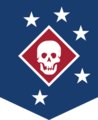 Insignia for the USMC Marine Raiders
![Emanuel Wynne's flag flown in 1700[2]](/wiki/File:Pirate_Flag_of_Emanuel_Wynne.svg)
![Bartholomew Roberts' flag as described in a report from 1720[3]](/wiki/File:Jolly_Roger_flag_of_pirate_Bartholomew_Roberts_(early).svg)
![John Taylor, Edward England and Samuel Bellamy's flag as described by eyewitness Thomas Baker (Bellamy's crew)[4]](/wiki/File:Flag_of_Edward_England.svg)
![Stede Bonnet's flag as described in a report from the 1718 Boston News-Letter[5]](/wiki/File:Pirate_Death%27s_Head_Flag.svg)


German military
Prussia

Use of the Totenkopf in Germany as a military emblem began under Frederick the Great, who formed a regiment of Hussar cavalry in the Prussian army commanded by Colonel von Ruesch, the Husaren-Regiment Nr. 5 (von Ruesch). It adopted a black uniform with a Totenkopf emblazoned on the front of its mirlitons and wore it on the field in the War of Austrian Succession and in the Seven Years' War.[6] The Totenkopf remained a part of the uniform when the regiment was reformed into Leib-Husaren Regiments Nr.1 and Nr.2 in 1808.[7] The symbol was then granted 3 years later to the Spanish Army’s 8th Light Cavalry Regiment “Lusitania”, who were nicknamed “Los Dragones de la Muerte” (the Dragons of Death) and were granted use of the skull after the infamous Battle of Madonna dell'Olmo in 1744, where they suffered great casualties.
Brunswick

In 1809, during the War of the Fifth Coalition, Frederick William, Duke of Brunswick-Wolfenbüttel raised a force of volunteers to fight Napoleon Bonaparte, who had conquered the Duke's lands. The Brunswick Corps was provided with black uniforms, giving rise to their nickname, the Black Brunswickers. Both hussar cavalry and infantry in the force wore a Totenkopf badge, either in mourning for the duke's father, Charles William Ferdinand, Duke of Brunswick-Wolfenbüttel, who had been killed at the Battle of Jena–Auerstedt in 1806, or according to some sources, as a sign of revenge against the French. After fighting their way through Germany, the Black Brunswickers entered British service and fought with them in the Peninsular War and at the Battle of Waterloo. The Brunswick corps was eventually incorporated into the Prussian Army in 1866.[8]
German Empire

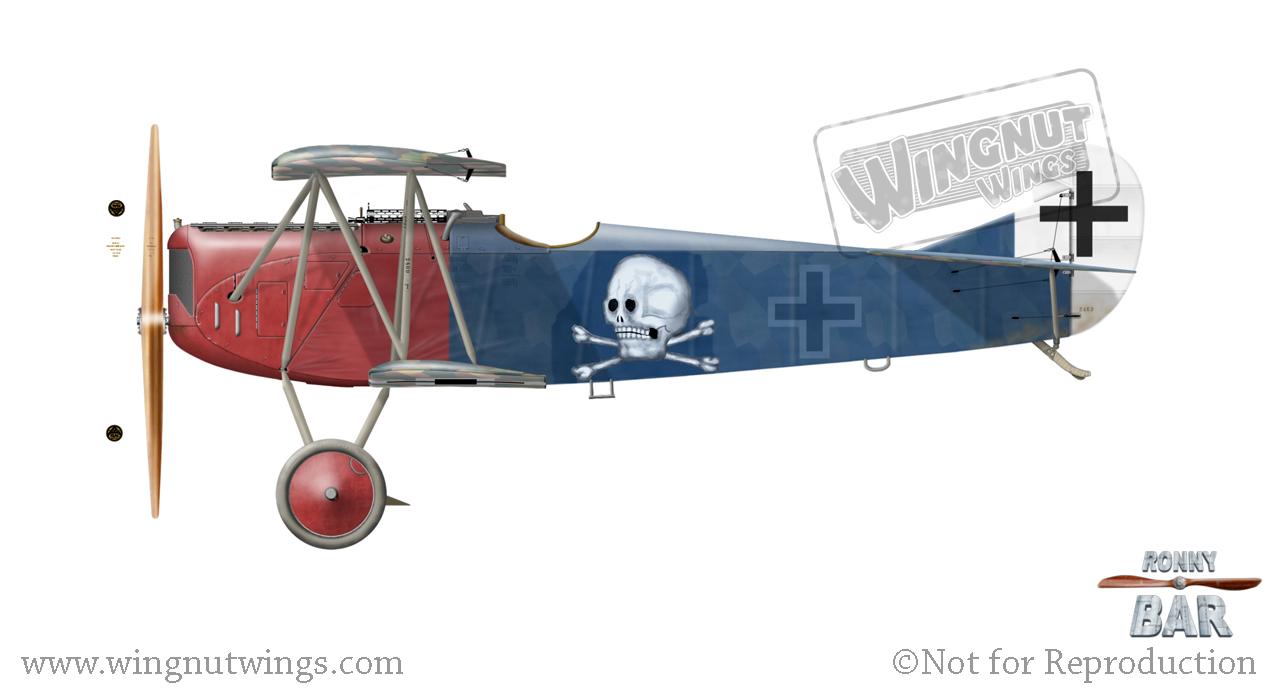
The skull continued to be used by the Prussian and Brunswick armed forces until 1918, and some of the stormtroopers that led the last German offensives on the Western Front in 1918 used skull badges.[9] Luftstreitkräfte fighter pilots Georg von Hantelmann[10] and Kurt Adolf Monnington[11] are just two of a number of Central Powers military pilots who used the Totenkopf as their personal aircraft insignia.
Weimar Republic
The Totenkopf was used in Germany throughout the interwar period, most prominently by the Freikorps. In 1933, it was in use by the regimental staff and the 1st, 5th, and 11th squadrons of the Reichswehr's 5th Cavalry Regiment as a continuation of a tradition from the Kaiserreich.[citation needed]
-
 Flag of the Iron Division Freikorps
 -
 Armed Freikorps troops in Berlin in 1919
 -
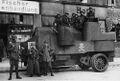 A Garford-Putilov Armoured Car used by the Freikorps in 1919
 -
 Flag at a meeting of former Brüssow Freikorps members in 1934


Nazi Germany
In the early days of the Nazi Party, Julius Schreck, the leader of the Stabswache (Adolf Hitler's bodyguard unit), resurrected the use of the Totenkopf as the unit's insignia. This unit grew into the Schutzstaffel (SS), which continued to use the Totenkopf as insignia throughout its history. According to a writing by Reichsführer-SS Heinrich Himmler, the Totenkopf had the following meaning:
The Skull is the reminder that you shall always be willing to put your self at stake for the life of the whole community.[12]
SS-Totenkopfverbände ('Death's Head Units') was the Schutzstaffel (SS) organization responsible for administering the Nazi concentration camps and extermination camps for Nazi Germany, among similar duties. While the Totenkopf was the universal cap badge of the SS, the SS-TV also wore this insignia on the right collar tab to distinguish itself from other SS formations.
The Totenkopf was also used as the unit insignia of the Panzer forces of the German Heer (Army), and also by the Panzer units of the Luftwaffe, including those of the elite Fallschirm-Panzer Division 1 Hermann Göring.[13]
Both the 3rd SS Panzer Division of the Waffen-SS, and the World War II era Luftwaffe's 54th Bomber Wing Kampfgeschwader 54 were given the unit name "Totenkopf", and used a strikingly similar-looking graphic skull-crossbones insignia as the SS units of the same name. The 3rd SS Panzer Division also had skull patches on their uniform collars instead of the SS sieg rune.[citation needed]
-
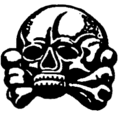 The first version of the SS-Totenkopf; used from 1923 to 1934
 -
 The second version of the SS-Totenkopf; used from 1934 to 1945
 -
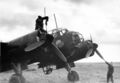 Junkers Ju 88 of Kampfgeschwader 54 (KG 54) in France, November 1940
 -
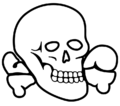 The "standalone" version of the WW II Luftwaffe KG 54 wing's dead's head unit insignia
 -
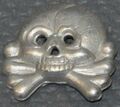 German Panzer totenkopf
 -
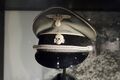 German SS uniform. Peaked visor cap with skull emblem (Totenkopf)
 -
 Members of SS Handschar; the SS-Totenkopf was printed on their fez cap.


._Norwegian_Armed_Forces_Museum_(Forsvarsmuseet)_Oslo,_Norway_2019-03-31_DSC01647.jpg)

Non-German military


- A skull and crossbones has often been a symbol of pirates, especially in the form of the Jolly Roger, but usually having the crossbones below the skull's lower mandibile (if present) rather than behind it, as used by pirate Samuel Bellamy in one example.
- The second oldest usage in a military uniform was that of the Spanish Army's Lusitania Dragoon Regiment, which adopted it in 1744. It included three skull and crossbones in the cuffs,[15] and in 1902 the skull and crossbones insignia was authorized again to replace the regiment number on the sides of the collar.[16]
- It was used as the emblem on the uniforms of Greek revolutionaries of Alexander Ypsilantis' Sacred Band (1821) during the Wallachian uprising of 1821
- Armenian fedayis, during the First World War against the Ottoman Empire, used a skull with two bolt rifles under the words "revenge revenge" in their flags.
- The British Army's Royal Lancers continue to use the skull and crossbones in their emblem, inherited from its use by the 17th Lancers, a unit raised in 1759 following General Wolfe's death in Quebec. The emblem contains an image of a death's head, and the words 'Or Glory', chosen in commemoration of Wolfe.[17]
- In 1792, a regiment of Hussards de la Mort (Death Hussars) was formed during the French Revolution by the French National Assembly and were organized and named by Kellerman. The group of 200 volunteers were from wealthy families and their horses were supplied from the King's Stables. They were formed to defend against various other European states in the wake of the revolution. They participated in the Battle of Valmy and its members also participated in the Battle of Fleurus (1794). They had the following mottos: Vaincre ou mourir, La liberté ou la mort and Vivre libre ou mourir – Victory or death; Freedom or death; and Live free or die.[18][19][20]
- Although not exactly a Totenkopf per se, the Chilean guerrilla leader Manuel Rodríguez used the symbol on his elite forces called Husares de la muerte ("Hussars of death"). It is still used by the Chilean Army's 3rd Cavalry Regiment.
- The primarily Prussian 41st Regiment New York Volunteer Infantry (mustered on 6 June 1861; mustered out 9 December 1865) wore a skull insignia.[21]
- The Vengeurs de la Mort ("death avengers"), an irregular unit of Commune de Paris, 1871.[22]
- The Portuguese Army Police 2nd Lancers Regiment use a skull-and-crossbones image in their emblem, similar to the one used by the Queen's Royal Lancers.
- The Kingdom of Sweden's Hussar Regiments wore a death's head emblem in the Prussian Style on the front of the mirleton.
- Ramón Cabrera's regiment adopted in 1838 a skull with crossbones flanked by an olive branch and a sword on a black flag during the Spanish Carlist Wars.
- Serbian Chetniks wore a death's head emblem in several conflicts: guerrilla in Old Serbia, First and Second Balkan Wars, World War I (both defense and resistance) and World War II.
- Some Macedonian-Bulgarian komitas that were members of the Internal Macedonian Revolutionary Organization wore a death's head emblem, usually with crossed revolver and qama below the skull and crossbones (similar to the Serbian ones) throughout the existence of the organization in several conflicts: Macedonian Struggle (Ilinden–Preobrazhenie Uprising, the Balkan Wars), World War I, during the interwar period in Macedonia, Kingdom of Serbs, Croats and Slovenes, and in World War II. The most prominent example being Pitu Guli who wears one in his only known photo, and his son Steryu Gulev.
- The Italian elite storm-troopers of the Arditi used a skull with a dagger between its teeth as a symbol during World War I. Various versions of skulls were also later used by the Italian Fascists.[citation needed]
- The Russian Kornilov's Shock Detachment (8th Army) adopted a death's head emblem in 1917. Then after World War I, the unit became Kornilov's Shock Regiment as a part of the White Russian Volunteer Army during the Russian Civil War. Also a death's head emblem was depicted on 17th Don Cossack regiment and Mariupol 4th Hussar regiment badges of Russian Imperial Army.
- The Estonian Kuperjanov's Partisan Battalion used the skull-and-crossbones as their insignia (since 1918); the Kuperjanov Infantry Battalion continues to use the skull and crossbones as their insignia today.
- Two Polish small cavalry units used death's head emblem during Polish–Ukrainian War and Polish–Soviet War – Dywizjon Jazdy Ochotniczej (pl) (also known as Huzarzy Śmierci i.e. Death Hussars) and Poznański Ochotniczy Batalion Śmierci (pl).
- During 1943–1945 the Italian Black Brigades and numerous other forces fighting for the Italian Social Republic wore various versions of skulls on their uniforms, berets, and caps.
- The United States Marine Corps Reconnaissance Battalions use the skull-and-crossbones symbol in their emblem.[23]
- The Batalhão de Operações Policiais Especiais, a special unit within the military police of Rio de Janeiro state, Brazil, uses the skull emblem to differentiate their team from the regular units.
- South Korea's 3rd Infantry Division (백골부대) have a skull-and-crossbones in their emblem.[23]
- Many United States Cavalry reconnaissance troops or squadrons utilize a skull insignia, often wearing the traditional Stetson hat, and backed by either crossed cavalry sabers, crossed rifles, or some other variation, as an unofficial unit logo. These logos are incorporated into troop T-shirts, challenge coins, or other items designed to enhance morale and esprit de corps.
- A version of the Punisher skull symbol has been used by U.S. military personnel since the Iraq War.
- Members of the Azov Regiment of the Ukrainian National Guard have used the totenkopf.[24]
- 72nd Mechanized Brigade of Ukrainian Ground Forces have a skull in their emblem.
- The skull and crosshair were the main symbol of the Wagner Group until it was merged with the Rosgvardiya.
Gallery
Flags
-
 Flag used from 1811 to 1812 by Regimiento de la muerte (Death Regiment) after Hidalgo's death in the Independence War
 -
One of the flags used by Argentine caudillo Facundo Quiroga, "Rn.o M." means "Religion or Death" (1825-1834)
-
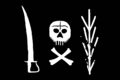 Spanish Carlist flag (1838)
 -
 Flag used by Filipino revolutionary general Mariano Llanera (1896–1899)
 -
 Banner of one of Russian "Death Units", formed in Eastern Front in 1917
 -
 Sailors of the Russian battleship Petropavlovsk after the 1917 February Revolution (flag calls for "death to the bourgeoisie").
 -
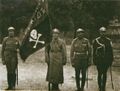 Kornilov's Shock Detachment flag bearer and honor guard (1917)
 -
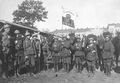 Polish Voluntary II Death Squad in Lviv, Ukraine (1920)
 -
![Flag used by Svyryd Kotsur's Dnipro Division, with the slogan "Death to all who stand in the way of freedom for the working people" (1920)[25]](/wiki/images/thumb/0/02/Anarchy_flag_in_Hulyaipole_Museum.jpg/95px-Anarchy_flag_in_Hulyaipole_Museum.jpg) Flag used by Svyryd Kotsur's Dnipro Division, with the slogan "Death to all who stand in the way of freedom for the working people" (1920)[25]
Flag used by Svyryd Kotsur's Dnipro Division, with the slogan "Death to all who stand in the way of freedom for the working people" (1920)[25] -
Reconstruction of the insignia used by the Arditi del Popolo (1921–1924)
-
 A flag captured by U.S. marines from Sandino's forces in 1932


![Flag used by Svyryd Kotsur's Dnipro Division, with the slogan "Death to all who stand in the way of freedom for the working people" (1920)[25]](/wiki/File:Anarchy_flag_in_Hulyaipole_Museum.jpg)

Other
-
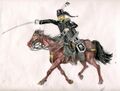 A French Hussard de la mort (1792)
 -
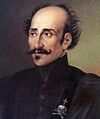 Alexander Ypsilantis, founder of the military force The Sacred Band, shown wearing the fighting force's uniform, complete with mandible-less totenkopf (1821)
 -
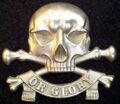 Cap badge of the British 17th Lancers
 -
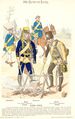 Swedish hussars in 1761
 -
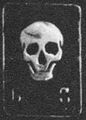 Pin worn by veterans of the Battle of Lwów. The G.S. stands for Góra Stracenia (Execution Mount) (1918).
 -
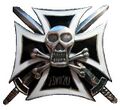 The "death's head" was the insignia of Polish Death Hussar Divisions, 1920 (Polish–Soviet War).
 -
 Early symbol of the Fire Cross League
 -
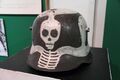 Helmet of a Finnish Light detachment 4 (World War II) in skeletal paint scheme
 -
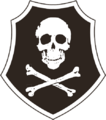 Insignia of the Estonian Kuperjanov Infantry Battalion
 -
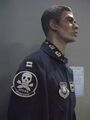 Stylized Totenkopf on shoulder sleeve insignia of the United States Air Force 400th Missile Squadron uniform sometime between 1995 and 2005
 -
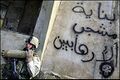 United States Army's 24th Infantry Regiment's "Deuce four skull" symbol used to mark buildings where enemy combatants had been killed in Iraq as part of Operation Iraqi Freedom (2004)
 -
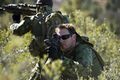 Totenkopf inspired patch depicting Punisher (Marvel character) skull symbol, without optional leg bones, worn by US Navy SEALs (2012)
 -
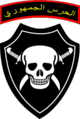 Insignia of the Syrian Republican Guard (2021)
 -
Emblem of the Polish Volunteer Corps


.jpg)


Police use
- The uniform of the Ordnungspolizei (Orpo) – Nazi Germany's uniformed police could feature the totenkopf. Peaked visor cap of the Sicherheitsdienst (SD) with skull emblem.
- "Punisher" variations of the totenkopf appear on police vehicles.[26]
- Challenge coins as used by the Firearms Training Team for the Calgary, Canada police force.[27]
-
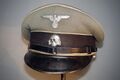 Peaked visor cap of the Sicherheitsdienst (SD) with skull emblem. Norwegian Armed Forces Museum, Oslo, Norway (1936).
 -
![Armored personnel carrier used by the Batalhão de Operações Policiais Especiais (BOPE). The BOPE website states the logo represents victory over death[28] (2018).](/wiki/images/thumb/8/86/CMF_Blindados_1.jpg/120px-CMF_Blindados_1.jpg) Armored personnel carrier used by the Batalhão de Operações Policiais Especiais (BOPE). The BOPE website states the logo represents victory over death[28] (2018).
Armored personnel carrier used by the Batalhão de Operações Policiais Especiais (BOPE). The BOPE website states the logo represents victory over death[28] (2018). -
![Challenge coin used by the Firearms Training branch of the Calgary Police Service (2020).[29]](/wiki/images/thumb/0/0a/Calgary_police_totenkopf_challenge_coin.jpg/120px-Calgary_police_totenkopf_challenge_coin.jpg) Challenge coin used by the Firearms Training branch of the Calgary Police Service (2020).[29]
Challenge coin used by the Firearms Training branch of the Calgary Police Service (2020).[29]
_with_skull_emblem_(Totenkopf)_Norwegian_Armed_Forces_Museum_(Forsvarsmuseet)_Oslo,_Norway_2020-02-24_2912.jpg)
![Armored personnel carrier used by the Batalhão de Operações Policiais Especiais (BOPE). The BOPE website states the logo represents victory over death[28] (2018).](/wiki/File:CMF_Blindados_1.jpg)
![Challenge coin used by the Firearms Training branch of the Calgary Police Service (2020).[29]](/wiki/File:Calgary_police_totenkopf_challenge_coin.jpg)
Other uses
- International hazard symbol to indicate poisonous substances
- Craft International logo, military training company founded by Chris Kyle
- Wilhelm "Deathshead" Strasse, a major antagonist in the Wolfenstein series, is named after the symbol
- Sometimes placed within a circle next to a 6 to represent Death in June
- The phrase "never lose your smile" is sometimes used in social media posts as a way of subtly expressing Nazi sympathies, particularly in countries where open promotion of Nazism is illegal. The phrase refers to the totenkopf skull, which, in some versions of the symbol, appears to be smiling. As the phrase also has innocuous meanings, its use by neo-Nazis is an example of a dogwhistle that relies on plausible deniability.[30]
Graham Platner tattoo controversy
In October 2025, Graham Platner, a Marine Corps veteran and oyster farmer running for the Democratic nomination in the 2026 United States Senate election in Maine, drew national attention after a chest tattoo of his was identified as resembling the Nazi Totenkopf.[31] The tattoo appeared in footage from his brother's wedding roughly a decade earlier, in which he was shown shirtless. Platner addressed the matter on the podcast Pod Save America, stating that he had received the tattoo with several other Marines while on shore leave in Croatia in 2007 and had been unaware of its association with the SS and SS-Totenkopfverbände until contacted by reporters and political operatives.[32][33]
A spokesperson for the Anti-Defamation League described the imagery as troubling for a candidate for high office, while noting that some individuals acquire such tattoos without understanding their associations and should be given an opportunity to repudiate them.[31] Platner stated that he had the tattoo covered up after the matter came to public attention.[33] Subsequent reporting by CNN and Jewish Insider cited an anonymous former acquaintance who said Platner had previously referred to the design as "my Totenkopf", calling into question his account that he was unaware of its meaning.[34][35] Maine Governor Janet Mills, a rival for the Democratic nomination, characterized the tattoo as "abhorrent" while saying voters should ultimately decide his place in the race.[36] The controversy, which coincided with reporting on a series of resurfaced Reddit posts, was followed by the resignations of several senior staff members from Platner's campaign over the following weeks.[37]
See also
- 3rd SS Division Totenkopf
- Black Brunswickers
- Fascist symbolism
- Human skull symbolism
- Jolly Roger – Pirate flag
- Kampfgeschwader 54
- Kuperjanov Battalion
- Memento mori
- Skull and Bones
- SS-Totenkopfverbände
- The Punisher
References
- ↑ Clemens Brentano: Baron Hüpfenstich - Chapter 2 (Projekt Gutenberg-DE)
- ↑ "Hoist the Colors: History of the Pirate Flag". Gold and Gunpowder. https://www.youtube.com/watch?v=auGOEwHOxu4.
- ↑ "The Pirate That Had WAY Too Many Flags...". Gold and Gunpowder. https://www.youtube.com/watch?v=8XO8tvGFS1A.
- ↑ "The Pirate Ship Whydah: Pirate strategy". "Real Pirates" museum exhibit website. Chicago, Illinois: The Field Museum. 2009. http://archive.fieldmuseum.org/pirates/pirateship_3.asp.
- ↑ Ed Foxe (2005-01-17). "Pirate Flags". http://www.bonaventure.org.uk/ed/flags.htm.
- ↑ Reid, Stuart (2010). Frederick the Great's Allies 1756–63. Osprey Publishing. ISBN 978-1849081771. https://books.google.com/books?id=m3uHCwAAQBAJ&q=Totenkopf+Frederick+the+Great&pg=PT28.
- ↑ Nash, David (1972). The Prussian Army, 1808-1815. Almark Publishing. p. 54. ISBN 978-0855240752. https://books.google.com/books?id=5pXfAAAAMAAJ&q=Leib-Husaren+Regiments+Nr.1+Totenkopf.
- ↑ Osprey Publishing – The Black Brunswickers
- ↑ First World War - Willmott, H. P.; Dorling Kindersley, 2003, Page 252
- ↑ "Georg von Hantelmann & Kurt Wüsthoff's Fokker D.VII, Jasta 15". http://www.wingnutwings.com/ww/vA565580A/www/products/decals/30006/colour_schemes/Fokker%20D.VII%20382~18,%20Georg%20von%20Hantelmann%20%2825%20victories%29%20&%20Kurt%20Wustoff%20%2827%20victories%29,%20Jasta%2015,%20June%201918.jpg.
- ↑ van Wyngarden, Greg (2011). Osprey Elite Aviation Units #40: Jasta 18 - The Red Noses. Oxford UK: Osprey Publishing. pp. 85–86, 97. ISBN 978-1-84908-335-5.
- ↑ Heinrich Himmler: "Der Totenkopf ist die Mahnung, jederzeit bereit zu sein, das Leben unseres Ichs einzusetzen für das Leben der Gesamtheit."
- ↑ Angolia, John R., and Adolf Schlicht, Uniforms and Traditions of the Luftwaffe Volume 2, R. James Bender Publishing, San Jose, CA, 1997. ISBN 0-912138-71-8.
- ↑ María de Sotto, Serafín (1856) (in es). Historia orgánica de las armas de Infantería y Caballería españolas. 16. p. 10. https://books.google.com/books?id=C2f7a3w0LFQC.
- ↑ María de Sotto, Serafín (1856) (in es). Historia orgánica de las armas de Infantería y Caballería españolas. 16. p. 10. https://books.google.com/books?id=C2f7a3w0LFQC.
- ↑ (in es) Colección legislativa del Ejército. 1902. pp. 390–391. http://bibliotecavirtualdefensa.es/BVMDefensa/i18n/catalogo_imagenes/grupo.cmd?path=98292.
- ↑ QRL Regimental Association
- ↑ Historique du 14e Chasseurs. Service Historique de la Défense.
- ↑ La Cavalerie pendant la Révolution. Desbrières et Sautai. 1907.
- ↑ Les Hussards français, Tome 1, De l'Ancien régime à l'Empire édition Histoire et collection.
- ↑ "New York State Military Museum and Veterans Research Center – Welcome". http://dmna.ny.gov/historic/mil-hist.htm.
- ↑ Draner. "1870–1871. Guerre et Commune. Gardes nationaux volontaires, gardes mobiles..." (in fr). p. 20. http://gallica.bnf.fr/ark:/12148/btv1b8426916f/f20.item.
- ↑ 23.0 23.1 Mark Felton Productions (10 March 2021). History of Nazi Symbols – Death's Head. youtube. Event occurs at 2:12.
- ↑ "Nationalists not extremists: Pravy Sektor deny radicalism claims and say they want to 'serve' Ukraine". The Independent. https://www.independent.co.uk/news/world/europe/ukraine-russia-pravy-sektor-extremism-b2011598.html.
- ↑ Patterson, Sean (30 June 2022). ""Death to All Who Stand in the Way of Freedom for the Working People": Anarchy's False Flag". Anarchist Studies. https://anarchiststudies.noblogs.org/death-to-all-who-stand-in-the-way-of-freedom-for-the-working-class-anarchys-false-flag/.
- ↑ Hannigan, Charley (13 April 2017). "Solvay police: Punisher decals stay; they show 'we will stand between good and evil'". https://www.syracuse.com/news/2017/04/central_new_york_police_punisher_decal_shows_we_will_stand_between_good_and_evil.html.
- ↑ "'Unbelievably inappropriate': Calgary police prohibit distribution of 'offensive' coin". https://calgaryherald.com/news/local-news/unbelievably-inappropriate-calgary-police-prohibit-distribution-of-offensive-coin.
- ↑ "BOPE - Batalhão de Operações Policiais Especiais". http://www.bopeoficial.com/.
- ↑ "'Unbelievably inappropriate': Calgary police prohibit distribution of 'offensive' coin". https://calgaryherald.com/news/local-news/unbelievably-inappropriate-calgary-police-prohibit-distribution-of-offensive-coin.
- ↑ "Is That A Hitler Salute In Your Feed? Decoding Neo-Nazi’s Secret Emoji Language". https://worldcrunch.com/in-the-news/secret-emoji-language-neo-nazis/.
- ↑ 31.0 31.1 Pendharkar, Eesha (21 October 2025). "Video shows Graham Platner with 'troubling' tattoo". The Maine Monitor. https://themainemonitor.org/platner-tattoo-nazi-totenkopf/.
- ↑ Gedeon, Joseph (21 October 2025). "'I'm not a secret Nazi': Maine Democratic Senate candidate addresses tattoo". The Guardian. https://www.theguardian.com/us-news/2025/oct/21/maine-graham-platner-tattoo-democrat-senate.
- ↑ 33.0 33.1 Kruesi, Kimberlee; Whittle, Patrick (22 October 2025). "Maine Senate candidate Platner says tattoo recognized as Nazi symbol has been covered". Associated Press. https://apnews.com/article/maine-platner-senate-trump-mills-tattoo-collins-fa8328a3c8aa5d5e0f34adb379e977b8.
- ↑ Kaczynski, Andrew (24 October 2025). "Graham Platner's claims that he didn't know tattoo was Nazi-linked undercut by new evidence". CNN. https://www.cnn.com/2025/10/24/politics/graham-platner-nazi-tattoo-evidence-kfile-invs.
- ↑ Kassel, Matthew (21 October 2025). "Graham Platner says 'I am not a secret Nazi' after photos of his tattoo emerge". Jewish Insider. https://jewishinsider.com/2025/10/graham-platner-ss-tattoo-maine-senate/.
- ↑ Pendharkar, Eesha (27 October 2025). "Criticizing Platner tattoo, Mills said it's 'up to the people' to decide". Maine Morning Star. https://mainemorningstar.com/2025/10/27/criticizing-platner-tattoo-mills-said-its-up-to-the-people-to-decide/.
- ↑ Wren, Adam; Piper, Jessica (23 October 2025). "Platner reshuffles campaign and sends out NDAs as he struggles to get ahead of controversies". Politico. https://www.politico.com/news/2025/10/23/graham-platner-maine-campaign-shakeup-ndas-controversies-00620849.
Bibliography
- Klaus D. Patzwall: Der SS-Totenkopfring. 5th edition: Patzwall, Melbeck 2010, ISBN 978-3-931533-07-6.
- Joost Hølscher (Author, Illustrator): Death's Head, The History of the Military Skull & Crossbones Badge (The History of Uniform). 1st edition: Éditions Chamerelle 2013, ISBN 978-90-820326-0-4
- Adrian Ruda: Der Totenkopf als Motiv. Eine historisch-kulturanthropologische Analyse zwischen Militär und Moden (The Skull as Motif: A Historical-Cultural Anthropological Analysis between Military and Fashion). Böhlau, Köln 2023, ISBN 978-3-412-52890-4.
 |  |