Unsolved:Lamassu
Lama, Lamma, or Lamassu (Cuneiform: 𒀭𒆗, an.kal; Sumerian: dlammař; later in Akkadian: lamassu; sometimes called a lamassuse)[1][2] is a Mesopotamian protective deity.[3]
Initially depicted as a goddess in Sumerian times, when it was called Lamma, it was later depicted from Assyrian times as a hybrid of a human, bird, and either a bull or lion—specifically having a human head, the body of a bull or a lion, and bird wings, under the name Lamassu.[3][4] In some writings, it is portrayed to represent a goddess.[5] A less frequently used name is shedu (Cuneiform: 𒀭𒆘, an.kal×bad; Sumerian: dalad; Akkadian, šēdu), which refers to the male counterpart of a lamassu.[6] Lamassu represent the zodiacs, parent-stars or constellations.[7][8]
Goddess Lama
The goddess Lama appears initially as a mediating goddess who precedes the orans and presents them to the deities.[3] The protective deity is clearly labelled as Lam(m)a in a Kassite stele unearthed at Uruk, in the temple of Ishtar, goddess to which she had been dedicated by king Nazi-Maruttash (1307–1282 BC).[9] It is a goddess wearing a ruffled dress and wearing a horned tiara symbolizing the deity, with two hands raised, in sign of prayer. Agnès Spycket proposed that similar female figures appearing in particular in glyptics and statuary from the Akkadian period, and in particular in the presentation scenes (common especially in the Paleo-Babylonian era) were to be considered as Lam(m)a.[10] This opinion is commonly followed and in artistic terminology these female figures are generally referred to as Lam(m)a.[3] From Assyrian times, Lamma becomes a hybrid deity, half-animal, half-human.[3]
-
 Lamma, protective winged deity, Sumerian Isin-Larsa period (2000–1800 BC)
 -
 Lamassu, Neo-Assyrian Empire, c. 721–705 BC. British Museum
 -
 Statuette of the goddess Lama, probably made in a workshop on the outskirts of Mesopotamia. Isin-Larsa period (2000–1800 BC). Royal Museums of Art and History
 -
 Cylinder seal showing the representation of a devotee (center) by goddess Lamma (left), to Ishtar (right). Babylonian, c. 18th–17th century BC, Metropolitan Museum of Art
 -
 Stele with inscription showing the protective deity Lam(m)a, dedicated by king Nazi-Maruttash to goddess Ishtar, from Uruk (1307–1282 BC). Metropolitan Museum of Art


Iconography

From Assyrian times, lamassu were depicted as hybrids, with bodies of either winged bulls or lions and heads of human males.[3] The motif of a winged animal with a human head is common to the Near East, first recorded in Ebla around 3000 BC. The first distinct lamassu motif appeared in Assyria during the reign of Tiglath-Pileser II as a symbol of power.[11][12]
Assyrian sculpture typically placed prominent pairs of lamassu at entrances in palaces, facing the street and also internal courtyards. They were represented as "double-aspect" figures on corners, in high relief. From the front, they appear to stand, and from the side, they walk. In earlier versions, they have five legs, as is apparent when viewed obliquely. Lamassu do not generally appear as large figures in the low-relief schemes running round palace rooms, where winged genie figures are common, but they sometimes appear within narrative reliefs, apparently protecting the Assyrians.[13]
The colossal entrance figures were often followed by a hero grasping a wriggling lion, also colossal in scale and in high relief. In the palace of Sargon II at Dur-Sharrukin, a group of at least seven lamassu and two such heroes with lions surrounded the entrance to the "throne room", "a concentration of figures which produced an overwhelming impression of power".[13] They also appear on cylinder seals. Notable examples include those at the Gate of All Nations at Persepolis in Iran, the British Museum in London, the Louvre in Paris, the National Museum of Iraq in Baghdad, the Metropolitan Museum of Art in New York, and the University of Chicago Oriental Institute. Several examples left in situ in northern Iraq were destroyed in the 2010s by the Islamic State of Iraq and the Levant when they occupied the area, as were those in the Mosul Museum.
Terminology
_from_Nimrud_2.jpg)
Lamassu represent the zodiacs, parent-stars, or constellations.[7][8] They are depicted as protective deities because they encompass all life within them. In the Sumerian Epic of Gilgamesh, they are depicted as physical deities as well, which is where the lamassu iconography originates, physical representations or embodiments of divine higher principles associated with specific celestial origins. Although lamassu had a different iconography and portrayal in the culture of Sumer, the terms "lamassu", "alad", and "shedu" evolved throughout the Assyro-Akkadian culture from the Sumerian culture to denote the Assyrian-winged-man-bull symbol and statues during the Neo-Assyrian Empire. Eventually, female lamassu were identified as "apsasû".[4]
The motif of the Assyrian-winged-man-bull called Aladlammu and Lamassu interchangeably is not the lamassu or alad of Sumerian origin, which were depicted with different iconography.[clarification needed] These monumental statues were called aladlammû or lamassu which meant "protective spirit".[4][clarification needed] In Hittite, the Sumerian form dlamma is used both as a name for the so-called "tutelary deity", identified in certain later texts with the goddess Inara, and a title given to similar protective deities.[14]
Mythology

The lamassu is a celestial being from ancient Mesopotamian religion bearing a human head, symbolising intelligence; a bull's body, symbolizing strength; and an eagle's wings, symbolizing freedom. Sometimes it had the horns and the ears of a bull. It appears frequently in Mesopotamian art. The lamassu and shedu were household protective spirits of the common Assyrian people, becoming associated later as royal protectors, and were placed as sentinels at entrances.[15] The Akkadians associated the god Papsukkal with a lamassu and the god Išum with shedu.
To protect houses, the lamassu were engraved in clay tablets, which were then buried under the door's threshold. They were often placed as a pair at the entrance of palaces. At the entrance of cities, they were sculpted in colossal size, and placed as a pair, one at each side of the door of the city, that generally had doors in the surrounding wall, each one looking toward one of the cardinal points.
In modern culture


Michael Rakowitz, a Northwestern University professor of Art Theory & Practice, won a Fourth Plinth commission to recreate the Lamassu that stood in Nineveh, Iraq, from 700 BC until it was destroyed by ISIS in 2015. Rakowitz's sculpture was displayed in London's Trafalgar Square from 2018 to 2020.[16]
The lamassu is also often used as a representation of Assyrian culture by the modern Assyrian people, and use it to pay homage to their ancient ancestry.[17]
Games
Lammasu [sic] and shedu are two distinct types of good-aligned creatures in the role-playing game Dungeons & Dragons, with lammasu having the bodies of winged lions and shedu depicted as human-headed winged bulls. Lammasu appear in the Magic: The Gathering trading card game as the white card Hunted Lammasu[18] in the Ravnica expansion, as well as the white card Venerable Lammasu found in the Khans of Tarkir expansion.[19]
In the video game Heroes of Might and Magic VI and its sequel, the lamasu [sic] is a recruitable elite creature of the necropolis faction (undead). Here, it is an artificial human/manticore hybrid with a short lifespan due to disease. Reborn as undead, lamasu are used as flying plague carriers.
Gallery
 Assyrian Human Headed Winged Lion and Bull (Lamassu), Smarthistory[20] Assyrian Human Headed Winged Lion and Bull (Lamassu), Smarthistory[20] |
-
 The British Museum – human-headed winged lions and reliefs from Nimrud with the Balawat Gates
 -
 The British Museum – human-headed winged bulls from Dur-Sharrukin
 -
 The British Museum – human-headed winged lion and bull from Nimrud, companion pieces in Metropolitan Museum of Art
 -
 Louvre – human-headed winged bulls from Dur-Sharrukin
 -
 Louvre – human-headed winged bulls, sculpture and reliefs from Dur-Sharrukin
 -
 Louvre – human-headed winged bulls and reliefs from Dur-Sharrukin, in their wider setting of reliefs
 -
 Louvre – human-headed winged bulls and reliefs from Dur-Sharrukin
 -
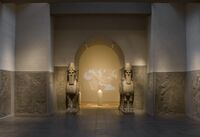 The Metropolitan Museum of Art – human-headed winged lion and bull from Nimrud, companion pieces to those in the British Museum, London
 -
 Detail, University of Chicago Oriental Institute. Possibly gypsum, Dur-Sharrukin, entrance to the throne room, c. 721–705 BC
 -
 Cuneiform script on the back of a lamassu in the University of Chicago Oriental Institute
 -
 Modern impression of Achaemenid cylinder seal, fifth century BC. A winged solar disc legitimises the Achaemenid emperor, who subdues two rampant Mesopotamian lamassu figures
 -
 The entrance of a fire temple in Fort Mumbai displaying a lamassu
 -
 Head of lamassu. Marble, eighth century BC, from Assur. Museum of the Ancient Orient, Istanbul
 -
 Head of a lamassu from the palace of Esarhaddon, from Nimrud, seventh century BC, the British Museum
 -
 Lamassu from the Throne Room (Room B) of the North-West Palace at Nimrud, ninth century BC, the British Museum
 -
 Lamassu on an Assyrian Genocide memorial in Yerevan


_~_Central_Palace_of_Tiglath-pileser_III_(744-727_B.C)_%2B_Full_Elevation_%26_Viewing_South.1.JPG)


_MET_DP252320.jpeg)


_of_the_North-West_Palace_at_Nimrud,_Iraq,_9th_century_BC._The_British_Museum,_London.jpg)

See also
- Mythological hybrid
- List of hybrid creatures in mythology
- Anzû (older reading: Zû), Mesopotamian monster
- Apis, Ancient Egyptian religion deity anthropomorphic bull
- Buraq, Islamic mythological human torso-equine body hybrid
- Centaur, Greek mythological human torso-equine body hybrid
- Cherubim, Abrahamic religious celestial human-winged hybrid
- Chimera, Greek mythological hybrid monster
- Enlil, ancient Mesopotamian deity: patriarch deity of supreme universal strength
- Griffin or griffon, lion-bird hybrid
- Harpy, Greek mythological hybrid human torso-bird body hybrid
- Jinn, pre-Islamic Arabian celestial beings, human-winged hybrid
- Kamadhenu, Hindu bovine goddess
- Lakhmu, Akkadian deity also known as Lammasu
- Lamashtu, ancient Mesopotamian female demons
- Manticore, Persian sphinx-like creature
- Mermaid, European, Asian, and African folklore, female human torso-fish tail hybrid
- Minotaur, Greek mythology: bull-man hybrid
- Pamola, the Abenaki-origin indigenous American "winged-moose" spirit protecting Mount Katahdin
- Pegasus, winged stallion in Greek mythology
- Sharabha, Hindu mythology: lion-bird hybrid
- Simurgh, Iranian mythical flying creature
- Sphinx, mythical creature with a lion's body and human head
- Thunderbird, mythological bird-like spirit in North American indigenous peoples' mythology
- Yali, Hindu mythological lion-elephant-horse hybrid
- Ziz, giant griffin-like bird in Jewish mythology
Citations
- ↑ Kriwaczek, Paul (2010). Babylon: Mesopotamia and the Birth of Civilization. St. Martin's Press. p. 37. ISBN 978-1-250-05416-6.
- ↑ "Kaskal: Rivista di storia, ambiente e culture del vicino oriente antico. Volume 6, 2009". LoGisma editore. http://www.torrossa.it/resources/an/2401509#page=241.
- ↑ 3.0 3.1 3.2 3.3 3.4 3.5 Leick, Gwendolyn (2002) (in en). A Dictionary of Ancient Near Eastern Mythology. Routledge. pp. 109–110. ISBN 978-1-134-64102-4. https://books.google.com/books?id=_pqEAgAAQBAJ&pg=PA109.
- ↑ 4.0 4.1 4.2 "Lamassu". https://www.livius.org/la-ld/lamassu/lamassu.html.
- ↑ Beaulieu, Paul-Alain (2003). The Pantheon of Uruk During the Neo-Babylonian Period. Brill. p. 137. ISBN 978-90-04-13024-1. https://books.google.com/books?id=v-WRJhvfudIC&pg=PA137.
- ↑ Black, Jeremy; Green, Anthony (2003). An Illustrated Dictionary: Gods, Demons and Symbols of Ancient Mesopotamia. The British Museum Press. ISBN 978-0-7141-1705-8.
- ↑ 7.0 7.1 Hewitt, J.F. (1901). History and Chronology of the Myth-Making Age. James Parker and Company. p. 85.
- ↑ 8.0 8.1 King, Leonard W. (1902). Enuma Elish Vol 1 & 2: The Seven Tablets of Creation; The Babylonian and Assyrian Legends Concerning the Creation of the World and of Mankind. Luzac and Co.. p. 78.
- ↑ Collon, Dominique (1975) (in en). The Seal Impressions from Tell Atchana/Alalakh. Butzon & Bercker. p. 181. ISBN 978-3-7887-0469-8. https://books.google.com/books?id=RZltAAAAMAAJ. "The deity which we have here called the Babylonian Goddess has been identified as the goddess Lama thanks to an inscription found at Uruk. Agnes Spycket has discussed the textual references to this interceding deity, and the way she is represented in art."
- ↑ Spycket, Agnès (1960). "La Déesse Lama". Revue d'Assyriologie et d'archéologie orientale 54 (2): 73–84. ISSN 0373-6032.
- ↑ "History – Mesopotamia". BBC. https://www.bbc.co.uk/history/ancient/cultures/mesopotamia_gallery_09.shtml.
- ↑ "Lamassu". ancientneareast.net. http://www.ancientneareast.net/religion_mesopotamian/lamassu.html.
- ↑ 13.0 13.1 Frankfort 1970, pp. 147–148.
- ↑ McMahon, John Gregory (1991). The Hittite State Cult of the Tutelary Deities. Oriental Institute of the University of Chicago. ISBN 978-0-918986-69-6. https://books.google.com/books?id=22sOAAAAYAAJ.
- ↑ Castor, Marie-José. "Winged Human-Headed Bull". Louvre.fr. http://www.louvre.fr/en/oeuvre-notices/winged-human-headed-bull.
- ↑ "The Lamassu, Resurrected". http://www.weinberg.northwestern.edu/about/news/2017/the-lamassu,-resurrected.html.
- ↑ "Lamassu Project" (in en-US). 26 February 2019. https://www.ramsenshamon.com/lamassu-project.
- ↑ "Hunted Lammasu". Wizards of the Coast. http://ww2.wizards.com/Gatherer/CardDetails.aspx?name=hunted_lammasu.
- ↑ "Venerable Lammasu". Wizards of the Coast. http://gatherer.wizards.com/Pages/Card/Details.aspx?multiverseid=386713.
- ↑ "Assyrian Human Headed Winged Lion and Bull (Lamassu)". Smarthistory at Khan Academy. http://smarthistory.khanacademy.org/neo-assyrian-lamassu.html.
General references
- Frankfort, Henri (1970). The Art and Architecture of the Ancient Orient. Pelican History of Art (4th ed.). Penguin. ISBN 978-0-14-056107-4.
External links
- Webpage about the Šêdu in the Louvre Museum Script error: The function "in_lang" does not exist.
 |  |


