Biology:Aethriamanta nymphaeae
| L-spot basker | |
|---|---|

| |
| L-Spot Basker in Cairns | |
Scientific classification 
| |
| Kingdom: | Animalia |
| Phylum: | Arthropoda |
| Class: | Insecta |
| Order: | Odonata |
| Infraorder: | Anisoptera |
| Family: | Libellulidae |
| Genus: | Aethriamanta |
| Species: | A. nymphaeae
|
| Binomial name | |
| Aethriamanta nymphaeae Lieftinck, 1949[2]
| |

| |

Aethriamanta nymphaeae is a species of dragonfly of the family Libellulidae,[3] commonly known as the L-spot basker.[4] It inhabits lagoons ponds and swamps across northern Australia.[5][6]
Identification

The L-spot basker Aethriamanta nymphaeae and Square-spot basker Aethriamanta circumsignata are very similar dragonflies and can be difficult to separate. The common name describes dark markings at the base of the hindwing of each species. The L-spot basker usually has one dark brown fleck radiating between the fourth and fifth vein (Cu and A) and a small dark patch at right angles which occupies a few cells parallel to the abdomen. These marks form the L shape. A lighter brown surrounds the dark marks and may extend to the arculus and hindwing margin. Light brown marks may also exist at the base of the forewing. In some examples of the L-spot basker, the dark markings may be absent altogether.[4]
Etymology
The genus name Aethriamanta combines the Greek αἴθρα (aithra, "bright sky") with the Latin amans ("loving"), possibly meaning "loving the bright sky".[7]
The species name nymphaeae is named for Nymphaea, the genus of waterlilies, derived from the Greek νυμφαία (nymphaia, "waterlily"), referring to the waterlily ponds of Lake Sentani, west of Hollandia, northern New Guinea, where the original specimens of this species were collected.[2][7]
Gallery
-
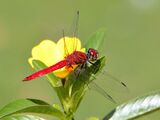 Male, Cairns, Australia
 -
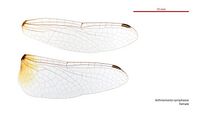 Female wings
 -
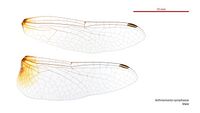 Male wings

.jpg)
.jpg)
See also
- List of Odonata species of Australia
References
- ↑ Dow, R.A. (2017). "Aethriamanta nymphaeae". IUCN Red List of Threatened Species 2017. doi:10.2305/IUCN.UK.2017-1.RLTS.T87534622A87539989.en. https://www.iucnredlist.org/species/87534622/87539989. Retrieved 20 November 2021.
- ↑ 2.0 2.1 Lieftinck, M.A. (1949). "The dragonflies (Odonata) of New Guinea and neighbouring islands Part VII. Results of the third Archbold Expedition 1938–1939 and of the Le Roux Expedition 1939 to Netherlands New Guinea (II. Zygoptera).". Nova Guinea. New series 5: 1–271 [233].
- ↑ "Species Aethriamanta nymphaeae Lieftinck, 1949". Australian Biological Resources Study. 2012. https://biodiversity.org.au/afd/taxa/Aethriamanta_nymphaeae.
- ↑ 4.0 4.1 Theischinger, Günther; Hawking, John (2006). The Complete Field Guide to Dragonflies of Australia. Collingwood, Victoria, Australia: CSIRO Publishing. p. 252. ISBN 978-0-64309-073-6.
- ↑ Theischinger, Gunther; Endersby, Ian (2009). Identification Guide to the Australian Odonata. Department of Environment, Climate Change and Water NSW. p. 188. ISBN 978-1-74232-475-3.
- ↑ Watson, J.A.L.; Theischinger, G.; Abbey, H.M. (1991). The Australian Dragonflies: A Guide to the Identification, Distributions and Habitats of Australian Odonata. Melbourne: CSIRO. pp. 278. ISBN 0-643-05136-8.
- ↑ 7.0 7.1 Endersby, Ian; Fliedner, Heinrich (2015). The Naming of Australia's Dragonflies. Eltham, Victoria, Australia: Busybird Publishing. ISBN 9781925260625. https://www.researchgate.net/publication/283318421_The_Naming_of_Australia's_Dragonflies.
 |
Wikimedia Commons has media related to Aethriamanta nymphaeae. |
Wikidata ☰ Q2993174 entry
 |  |


