Biology:Agkistrodon bilineatus
| Agkistrodon bilineatus | |
|---|---|

| |
Scientific classification 
| |
| Kingdom: | Animalia |
| Phylum: | Chordata |
| Class: | Reptilia |
| Order: | Squamata |
| Suborder: | Serpentes |
| Family: | Viperidae |
| Genus: | Agkistrodon |
| Species: | A. bilineatus
|
| Binomial name | |
| Agkistrodon bilineatus (Günther, 1863)
| |
| Synonyms | |
| |
Agkistrodon bilineatus (commonly called the cantil, Mexican cantil, Mexican ground pit viper,[3] cantil viper,[4] black moccasin,[5] or Mexican moccasin[4]) is a highly venomous pit viper species found in Mexico and Central America as far south as Honduras.[2]
Description

These are heavy-bodied snakes and share the same general body structure with copperheads. They average around 60 cm (24 in) in length and have a broad, triangular-shaped head with small eyes that have vertical pupils.
Coloration can vary, but most are brown or black, with darker brown or black banding, sometimes with white or cream-colored accents. A. taylori is known for being more elaborately patterned, often having distinct tan-colored banding, sometimes with orange or yellow accents that can almost appear gold in color. There are the following distinctive yellow and/or white lines on the head: a vertical line on the rostral and mental, a fine line on the canthus continuing above and beyond the eye to the neck, a broader line on the upper lip from the anterior nasal to the last labial.[6] Juveniles are almost always distinctly banded, with bright green or yellow tail tips, which they use to lure prey. As they age, their pattern and coloration fade and darken.
Common names
Mexican ground pit viper, cantil viper,[3][4] cantil,[5] Mexican moccasin,[4] neotropical moccasin,[7] Mexican yellow-lipped viper.[8]
The common name, "cantil", is based on the Tzeltal word kantiil "yellow lips."[3]
Geographic range
Mexico and Central America. On the Pacific side it is found from southern Sonora in Mexico south through Guatemala, El Salvador, and Honduras. The type locality given is "Pacific coast of Guatemala."[2]
Conservation status
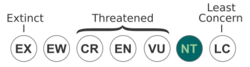
This species is classified as Near Threatened (NT) on the IUCN Red List of Threatened Species (v3.1, 2001).[1] A species is listed as such when it has been evaluated against the criteria but does not qualify for Critically Endangered, Endangered or Vulnerable now, but is close to qualifying for, or is likely to qualify for a threatened category in the near future. The population trend is down. Year assessed: 2007.[9][10] In 2012, it was again classified as Near Threatened.[1] In 2013, Louis W. Porras et al. wrote that the species was in rapid decline.[11]
The primary ecological concern is habitat loss.
Behavior
Diet
Juveniles eat frogs and lizards, while adults mainly eat small mammals and lizards in the genus Ctenosaura.[1]
Reproduction
Captivity
Venom
According to Gloyd and Conant (1990), "this species is greatly feared throughout its range," in some areas even more so than Bothrops asper. In Sonora, Mexico, it is feared more than any other reptile. In Nicaragua, it is considered the country's most dangerous snake.[12][13]
Bite symptoms, in general, may include nothing more than local pain, swelling and discoloration, but those from adult specimens can cause massive swelling and necrosis. Campbell and Lamar (1989) suggested that, due to the necrosis, amputation may be required in one out of every six cases. Some bites were fatal within only a few hours. Gaige (1936) cites one case in which a woman in Motul, Yucatán, Mexico was bitten by a 30 cm (11 3⁄4 in) specimen and died within a few hours. Alvarez del Toro (1983) reports gangrenous tissue falling away in fragments, eventually to expose the underlying bones, describing this is as "spontaneous amputation" of the necrotic wound.[12]
In Honduras, Cruz (1987) describes the bite symptoms as being similar to those of Bothrops species, although more severe considering the small size of these snakes. They include immediate and severe pain, oozing of blood from the fang punctures, considerable edema, nosebleed, bleeding of the gums, marked hematuria, general petechiae, shock, kidney failure and local necrosis.[12]
Polyvalent antivenom, produced by the Instituto Clodomiro Picado[14] in Costa Rica, is used to treat bites from this species.[15]
Taxonomy
References
- ↑ 1.0 1.1 1.2 1.3 Chaves, G.; Lamar, W.; Porras, L.W.; Solórzano, A.; Sunyer, J. (2021). "Agkistrodon bilineatus". IUCN Red List of Threatened Species 2021. doi:10.2305/IUCN.UK.2021-3.RLTS.T64296A3134536.en. https://www.iucnredlist.org/species/64296/3134536. Retrieved 26 December 2025.
- ↑ 2.0 2.1 2.2 McDiarmid, Roy W.; Campbell, Jonathan A.; Touré, T'Shaka A. (1999). Snake Species of the World: A Taxonomic and Geographic Reference. Herpetologists' League. ISBN 978-1-893777-01-9. https://books.google.com/books?id=PyWLQgAACAAJ.
- ↑ 3.0 3.1 3.2 Gloyd HK, Conant R. 1990. Snakes of the Agkistrodon Complex: A Monographic Review. Society for the Study of Amphibians and Reptiles. 614 pp. 52 plates. LCCN 89-50342. ISBN 0-916984-20-6.
- ↑ 4.0 4.1 4.2 4.3 Mehrtens JM. 1987. Living Snakes of the World in Color. New York: Sterling Publishers. 480 pp. ISBN 0-8069-6460-X.
- ↑ 5.0 5.1 Campbell JA, Lamar WW. 2004. The Venomous Reptiles of the Western Hemisphere. Comstock Publishing Associates, Ithaca and London. 870 pp. 1500 plates. ISBN 0-8014-4141-2.
- ↑ Boulenger, G.A. 1896. Catalogue of the Snakes in the British Museum (Natural History). Volume III., Containing the...Viperidæ. Trustees of the British Museum (Natural History). London. xiv + 727 pp. + Plates I.-XXV. (Ancistrodon bilineatus, pp. 521–522.)
- ↑ Gotch AF. 1986. Reptiles – Their Latin Names Explained. Poole, UK: Blandford Press. 176 pp. ISBN 0-7137-1704-1.
- ↑ Parker HW, Grandison AGC. 1977. Snakes – a natural history. Second Edition. British Museum (Natural History) and Cornell University Press. 108 pp. 16 plates. LCCCN 76-54625. ISBN 0-8014-1095-9 (cloth), ISBN 0-8014-9164-9 (paper).
- ↑ Lee, J.; Hammerson, G.A. (2007). "Agkistrodon bilineatus". IUCN Red List of Threatened Species 2007. doi:10.2305/IUCN.UK.2007.RLTS.T64296A12755881.en. https://www.iucnredlist.org/species/64296/12755881. Retrieved 26 December 2025.
- ↑ 2001 Categories & Criteria (version 3.1) at the IUCN Red List. Accessed 13 September 2007.
- ↑ Porras, Louis W.; Wilson, Larry David; Schuett, Gordon W.; Reisere, Randall S. (January 2013). "A taxonomic reevaluation and conservation assessment of the common cantil, Agkistrodon bilineatus (Squamata: Viperidae): a race against time". Amphibian and Reptile Conservation 7 (1): 48–73. https://www.researchgate.net/publication/260706472. Retrieved 2025-08-14.
- ↑ 12.0 12.1 12.2 Warrell DA. 2004. Snakebites in Central and South America: Epidemiology, Clinical Features, and Clinical Management. in Campbell, Jonathan A.; Lamar, William W.; Brodie, Edmund D. (2004). The venomous reptiles of the Western Hemisphere. Comstock Pub. Associates. ISBN 978-0-8014-4141-7. https://books.google.com/books?id=ZYQpAQAAMAAJ..
- ↑ Solorzano, Alejandro; Romero, Marjorie; Gutierrez, Jose Maria; Sasa, Mahmood (1999). "Venom Composition and Diet of the Cantil Agkistrodon bilineatus howardgloydi (Serpentes: Viperidae)". The Southwestern Naturalist 44 (4): 478–483. doi:10.2307/3672346. ISSN 0038-4909. Bibcode: 1999SWNat..44..478S.
- ↑ "Instituto Clodomiro Picado" (in es-es). 22 October 2006. http://www.icp.ucr.ac.cr/.
- ↑ Agkistrodon bilineatus at "MAVIN 2016-03-22, Index". http://www.toxinfo.org/antivenoms. Accessed 27 June 2008.
External links
 |
Wikimedia Commons has media related to Agkistrodon bilineatus. |
- Agkistrodon bilineatus at the Reptarium.cz Reptile Database. Accessed 7 December 2007.
- Agkistrodon taylori at the Reptarium.cz Reptile Database. Accessed 7 December 2007.
- Agkistrodon bilineatus at VN Illustrated Database of Mexican Biodiversity. Accessed 26 November 2006.
Wikidata ☰ Q1926277 entry
 |  |


