Biology:Akebia trifoliata
| Akebia trifoliata | |
|---|---|

| |
Scientific classification 
| |
| Kingdom: | Plantae |
| Clade: | Tracheophytes |
| Clade: | Angiosperms |
| Clade: | Eudicots |
| Order: | Ranunculales |
| Family: | Lardizabalaceae |
| Genus: | Akebia |
| Species: | A. trifoliata
|
| Binomial name | |
| Akebia trifoliata (Thunb.) Koidz
| |
Akebia trifoliata also known as chocolate vine, three leaf chocolate vine or three leaf akebia,[1] is a species of flowering plant. It is a close relative of the more commonly known Akebia quinata.
Description
Akebia trifoliata is a climbing vine with leaves composed of three ovate, slightly lobed leaflets, often bronze-tinted when young. It grows up to 9.1 m (30 ft) long.[2] It loses its leaves in cold climates, but the twining woody branches are handsome even when bare. Flowers are deep purple in short racemes and followed by light purple fruits.[3]
Like Akebia quinata, it grows in USDA hardiness zones from 5a to 9b: from −20 °F (−28.9 °C) to 30 °F (−1.1 °C).[4]


Uses
Culinary uses
The plant is grown for its ornamental appeal but also for the edible oblong purplish fruits.[5] The fruit itself has a mild flavor reminiscent of coconut or tapioca and is considered quite sweet.[6] It has a mild melon flavor when eaten ripe [7]
Medicinal uses
 | This section needs more medical references for verification or relies too heavily on primary sources. (February 2024) |  |
It is used in traditional Chinese medicine to help with urinary tract infections and "quickening blood flow."[8]
Extracts of the fruits have been shown to have diuretic properties (reduction of water-weight), hepato-regenerative, neuroprotective, analgesic, anti-inflammatory, and anti-obesity effects. It has been shown to help with weight loss in vitro[clarification needed] and reduction of fat deposition.[9]
The rind, though inedible, has been found to contain a high concentration of cancer fighting antioxidants which can be extracted by making a tea out of the rind.[10]
Akebia trifoliata also has been used to create an "antibacterial pectin" from its waste products which may increase the profitability of the plant when grown commercially.[11]
Gallery
-
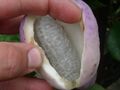 Fruit of Akebia trifoliata with hand for scale
 -
 Botanical illustration of Akebia trifoliata


References
- ↑ "Akebia trifoliata | three-leaf akebia Climber Wall Shrub/RHS Gardening" (in en-gb). http://www.rhs.org.uk/plants/748/akebia-trifoliata/details.
- ↑ WoFP (2018-05-11). "Akebia trifoliata (Three-leaf Akebia)" (in en-US). https://worldoffloweringplants.com/akebia-trifoliata-three-leaf-akebia/.
- ↑ WoFP (2018-05-11). "Akebia trifoliata (Three-leaf Akebia)" (in en-US). https://worldoffloweringplants.com/akebia-trifoliata-three-leaf-akebia/.
- ↑ WoFP (2018-05-11). "Akebia trifoliata (Three-leaf Akebia)" (in en-US). https://worldoffloweringplants.com/akebia-trifoliata-three-leaf-akebia/.
- ↑ "Akebia | plant genus | Britannica" (in en). https://www.britannica.com/plant/Akebia.
- ↑ "Akebia trifoliata | three-leaf akebia Climber Wall Shrub/RHS Gardening" (in en-gb). http://www.rhs.org.uk/plants/748/akebia-trifoliata/details.
- ↑ Christenhusz, Maarten J. M.; Rix, Martyn (September 2012). "739. Akebia Quinata". Curtis's Botanical Magazine 29 (3): 284–289. doi:10.1111/j.1467-8748.2012.01792.x. ISSN 1355-4905.
- ↑ Zhou, Jiaju; Xie, Guirong; Yan, Xinjian (2011-02-21) (in en). Encyclopedia of Traditional Chinese Medicines - Molecular Structures, Pharmacological Activities, Natural Sources and Applications: Vol. 5: Isolated Compounds T—Z, References, TCM Plants and Congeners. Springer Science & Business Media. ISBN 978-3-642-16741-6. https://books.google.com/books?id=ofONXILDKPsC&dq=%22Akebia+Trifoliata%22+-wikipedia&pg=PA357.
- ↑ Maciąg, Daria; Dobrowolska, Ewa; Sharafan, Marta; Ekiert, Halina; Tomczyk, Michał; Szopa, Agnieszka (2021-11-15). "Akebia quinata and Akebia trifoliata - a review of phytochemical composition, ethnopharmacological approaches and biological studies" (in en). Journal of Ethnopharmacology 280. doi:10.1016/j.jep.2021.114486. ISSN 0378-8741. PMID 34352331.
- ↑ Luo, Min; Zhou, Dan-Dan; Shang, Ao; Gan, Ren-You; Li, Hua-Bin (June 2021). "Influences of Microwave-Assisted Extraction Parameters on Antioxidant Activity of the Extract from Akebia trifoliata Peels" (in en). Foods 10 (6): 1432. doi:10.3390/foods10061432. ISSN 2304-8158. PMID 34205582.
- ↑ Yu, Ningxiang; Wang, Xiaoya; Ning, Fangjian; Jiang, Chengjia; Li, Yanbin; Peng, Hailong; Xiong, Hua (2019-08-01). "Development of antibacterial pectin from Akebia trifoliata var. australis waste for accelerated wound healing" (in en). Carbohydrate Polymers 217: 58–68. doi:10.1016/j.carbpol.2019.03.071. ISSN 0144-8617. PMID 31079685. https://www.sciencedirect.com/science/article/pii/S0144861719303431.
Wikidata ☰ Q1746131 entry
 |  |


