Biology:Aloidendron dichotomum
| Quiver tree | |
|---|---|

| |
Scientific classification 
| |
| Kingdom: | Plantae |
| Clade: | Tracheophytes |
| Clade: | Angiosperms |
| Clade: | Monocots |
| Order: | Asparagales |
| Family: | Asphodelaceae |
| Subfamily: | Asphodeloideae |
| Genus: | Aloidendron |
| Species: | A. dichotomum
|
| Binomial name | |
| Aloidendron dichotomum (Masson) Klopper & Gideon F.Sm.[2]
| |
| <mapframe height="200" frameless="1" width="300">{"properties":{"stroke-width":6,"stroke":"#ff0000","title":"Aloidendron dichotomum"},"type":"ExternalData","title":"Aloidendron dichotomum range.map","service":"page"}</mapframe> | |
| Aloidendron dichotomum range
Extant (resident)
| |

| |
| The distribution of Aloidendron dichotomum (light blue) in southern Africa | |
| Synonyms[2] | |
| |

Aloidendron dichotomum, formerly Aloe dichotoma, the quiver tree or kokerboom, is a tall, branching species of succulent plant, indigenous to Southern Africa, specifically in the Northern Cape province of South Africa, and parts of Southern Namibia.
Naming
Known as choje to the indigenous San people, the quiver tree gets its English common name from the San people practice of hollowing out the tubular branches of Aloidendron dichotomum to form quivers for their arrows. The specific epithet "dichotomum" refers to how the stems repeatedly branch into two ("dichotomous" branching) as the plant grows.[3] This species was moved to the genus Aloidendron as Aloidendron dichotomum in 2013.[4]
Related species
The three species can be distinguished as follows: In A. pillansii, the inflorescences hang from below the lowest leaves, rather than growing erect. A. ramosissimum is considerably smaller—rarely reaching more than 2 m in height—and assumes a more shrub-like shape. While there is a gradation between tree-like A. dichotomum and the shrubby A. ramosissimum, the relatively unique A. pillansii population is separated by a different flowering time and therefore does not interbreed with the other two species.[5]
Distribution and conservation
One of the few examples of spontaneous forests of A. dichotomum is the Quiver Tree Forest, about 14 km north of Keetmanshoop, in Namibia. Another is located in the Northern Cape of South Africa at Gannabos.[6][7]
Throughout much of its range this species is in decline. Modelling of Aloidendron dichotomum in South Africa and Namibia has contributed to understanding the needs of protected areas in response to climate change. Modelled range declines in this species due to climate change have recently been confirmed by field surveys.[8]
Cultivation
It can be propagated from seed and (with more difficulty) from cuttings or truncheons. Cuttings need to be thoroughly dried for several weeks in a shaded area before being planted.[3]
In popular culture
Michael Benson's book Space Odyssey: Stanley Kubrick, Arthur C. Clarke, and the Making of a Masterpiece (2018) briefly discusses how the kokerboom piqued the interest of film director, Stanley Kubrick. The book claims that several protected kokerboom trees were cut down so they could be used to film 2001: A Space Odyssey.[9]
Gallery
-
 Quiver tree in the Namib-Naukluft National Park, Namibia.
 -
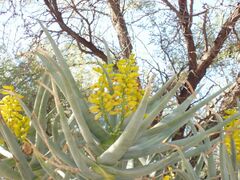 In bloom.
 -
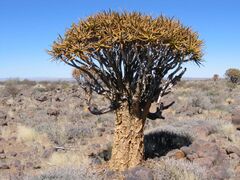 Quiver tree in southern Namibia.
 -
 Growth of a young plant from May to August.
 -
 Quiver tree at Fish River Canyon, Namibia.
 -
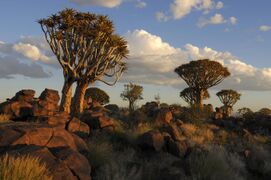 Quiver Tree Forest near Keetmanshoop, Namibia, in the evening.
 -
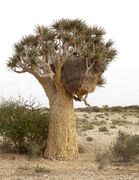 Sociable Weaver (Philetairus socius) nest in a Quiver tree. Northern Cape, South Africa.
 -
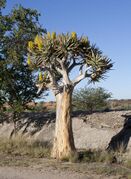 Quiver tree in flower in the Augrabies National Park, South Africa.
 -
 The flowers of the Quiver tree in May. Augrabies National Park, South Africa.
 -
 Quiver trees and Dolerite rocks near Keetmanshoop.
 -
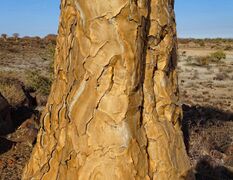 Close-up photo of bark on a quiver tree.
,_parque_nacional_de_Namib-Naukluft,_Namibia,_2018-08-05,_DD_39.jpg)


See also
References
- ↑ South African National Biodiversity Institute (2022). "Aloidendron dichotomum". IUCN Red List of Threatened Species 2022. doi:10.2305/IUCN.UK.2022-1.RLTS.T140661836A140666503.en. https://www.iucnredlist.org/species/140661836/140666503. Retrieved 23 March 2023.
- ↑ 2.0 2.1 "Aloidendron dichotomum". World Checklist of Selected Plant Families. Royal Botanic Gardens, Kew. http://wcsp.science.kew.org/namedetail.do?name_id=487777.
- ↑ 3.0 3.1 "Aloidendron dichotomum". South African National Biodiversity Institute. http://pza.sanbi.org/aloidendron-dichotomum.
- ↑ Grace, O.M.; Klopper, R.R.; Smith, G.F. (2013). "A revised generic classification for Aloe (Xanthorrhoeaceae subfam. Asphodeloideae)". Phytotaxa 76 (1): 7–14. doi:10.11646/phytotaxa.76.1.2. Bibcode: 2013Phytx..76....7G. https://www.biotaxa.org/Phytotaxa/article/view/phytotaxa.76.1.2/111. Retrieved 1 February 2023.
- ↑ Court, D. (2010). Succulent Flora of Southern Africa. Cape Town: Struik Nature. ISBN 978-1-77007-587-0.
- ↑ "Quiver Tree Forest". Gannabos Guest Farm. https://www.gannabos.co.za/quiver-tree-forest.php.
- ↑ "A world of ancient aloes – quiver tree forest, Northern Cape". southafrica.net. https://www.southafrica.net/gl/en/travel/article/a-world-of-ancient-aloes-quiver-tree-forest-northern-cape.
- ↑ Foden, Wendy; Midgley, Guy F.; Hughes, Greg; Bond, William J.; Thuiller, Wilfried; Hoffman, M. Timm; Kaleme, Prince; Underhill, Les G. et al. (2007). "A changing climate is eroding the geographical range of the Namib Desert tree Aloe through population declines and dispersal lags". Diversity and Distributions 13 (5): 645–653. doi:10.1111/j.1472-4642.2007.00391.x. Bibcode: 2007DivDi..13..645F. http://www4.nau.edu/direnet/publications/publications_f/files/Foden-2007.pdf. Retrieved 16 July 2011.
- ↑ Benson, Michael (2019-04-23) (in en). Space Odyssey: Stanley Kubrick, Arthur C. Clarke, and the Making of a Masterpiece. Simon & Schuster. p. 277. ISBN 978-1-5011-6394-4. https://www.simonandschuster.com/books/Space-Odyssey/Michael-Benson/9781501163944.
External links
- Desert-tropicals.com profile
- PlantZAfrica.com profile
- Dressler, S.; Schmidt, M.; Zizka, G. (2014). "Aloidendron dichotomum". African plants – a Photo Guide. Frankfurt/Main: Forschungsinstitut Senckenberg. https://www.africanplants.senckenberg.de/root/index.php?submitForm=true&page_id=77&searchTextMenue=Aloidendron+dichotomum&filterRegionIDs%5B%5D=6&filterRegionIDs%5B%5D=1&filterRegionIDs%5B%5D=2&filterRegionIDs%5B%5D=3&filterRegionIDs%5B%5D=5.
Wikidata ☰ {{{from}}} entry
 |  |


