Biology:Alosa macedonica
| Alosa macedonica | |
|---|---|

| |
Scientific classification 
| |
| Kingdom: | Animalia |
| Phylum: | Chordata |
| Class: | Actinopterygii |
| Order: | Clupeiformes |
| Family: | Alosidae |
| Genus: | Alosa |
| Species: | A. macedonica
|
| Binomial name | |
| Alosa macedonica (Vinciguerra, 1921)
| |
| Synonyms[2] | |
| |
Alosa macedonica, or the Macedonian shad or liparia, is a species of freshwater ray-finned fish belonging to the family Alosidae, the shads, pilchards and related fishes. Shads are typically anadromous but the Macedonian shad has become landlocked. This species is endemic to Greece.
Taxonomy
Alosa macedonica was first formally described as Clupea macedonica in 1921 by the Italian physician and ichthyologist Decio Vinciguerra with its type locality given as Lake Besikia in, Macedonia, Greece.[2] This species is now classified in the genus Alosa, which was proposed by Johann Heinrich Friedrich Link in 1797, within the family Alosidae in the order Clupeiformes, the herrings and related fishes.[3]
Etymology
Alaosa macedonica belongs to the genus Alosa, a derivatuion of alausa the Latin name for Clupea alosa which is the type species of the genus through absolute tautonymy. The specific name means "of Macedonia", the region of Greece to which this fish is endemic.[4]
Distribution and habitat
Alosa macedonica is endemic to Greece where it is restricted to Lake Volvi in the Mygdonia catchment in northern Greece. Its presence in neighbouring Lake Koroneia has been claimed, and that this species was extirpated from there when it dried up in the 1990s, however, its presence in that lake has never been confirmed. The liparia is pelagic living in the upper layers of the lake in the warmer months and retreating to deeper water in the cooler parts of the year.[1]
Biology
Alosa macedonica is a member of the genus Alosa, whose other species are often anadromous migrating between marine and freshwater. Research suggests that the ancestors of Alosa macedonica inhabited marine regions of the Aegean Sea.[5]
Alosa macedonica have teeth in the palatine and vomer. They have approximately 50 vertebrae and 106-128 gill rakers. They are about 181–230 mm (7.1–9.1 in) in length and spawn around the months of July and August.[5]
Reproduction
It reproduces once a year, and the breeding season lasts from mid-June to mid-August.[6]
Feeding habits
It feeds primarily on zooplankton, engaging in selective predation. However, larger individuals show a preference for a piscivorous diet, consuming fish such as Knipowitschia caucasica and Rhodeus amarus. [7]
Conservation
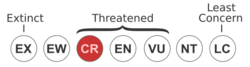
Alosa macedonica is classified as Critically endangered by the International Union for Conservation of Nature. Threats to this species include pollution, falling water levels in the lake due to abstraction and invasive species.[1]
References
- ↑ 1.0 1.1 1.2 Ford, M. (2024). "Alosa macedonica". IUCN Red List of Threatened Species 2024. doi:10.2305/IUCN.UK.2024-2.RLTS.T905A102878588.en. https://www.iucnredlist.org/species/905/102878588. Retrieved 25 January 2025.
- ↑ 2.0 2.1 Eschmeyer, William N.; Fricke, Ron; van der Laan, Richard, eds. "Species in the genus Alosa". California Academy of Sciences. http://researcharchive.calacademy.org/research/ichthyology/catalog/fishcatget.asp?tbl=species&genus=Alosa.
- ↑ Eschmeyer, William N.; Fricke, Ron; van der Laan, Richard, eds. "Genera in the family Alosidae". California Academy of Sciences. http://researcharchive.calacademy.org/research/ichthyology/catalog/fishcatget.asp?tbl=genus&family=Alosidae.
- ↑ Christopher Scharpf (7 January 2025). "Family ALOSIDAE Svetovidov 1952 (Shads and Sardines)". The ETYFish Project Fish Name Etymology Database. Christopher Scharpf. https://etyfish.org/alosidae/.
- ↑ 5.0 5.1 D. C. Bobori; E. T. Koutrakis; P. S. Economidis (2001). "Shad Species In Greek Waters – An Historical Overview And Present Status". Bulletin Français de la Pêche et de la Pisciculture 362-363 (362–363): 1101–1108. doi:10.1051/kmae:2001039.
- ↑ Kleanthidis Platon (2002). Biology of the reproduction, feeding habits and population dynamics of the endemic fish Alosa Macedonica (vinciguerra, 1921) of lake Volvi. PhD Thesis, Aristotle University of Thessaloniki (AUTh). Faculty of Science. Department of Biology.
- ↑ <Kleanthidis P. & Sinis A. 2001, Feeding habits of the Macedonian shad, Alosa macedonica (Vinciguerra, 1921) in Lake Volvi (Greece): seasonal and ontogenetic changes, Israel Journal of Ecology and Evolution.
External links
- "Photo of Alosa macedonica". http://www.ittiofauna.org/webmuseum/pesciossei/clupeiformes/clupeidae/alosa/alosa_macedonica/index_big.htm.
Wikidata ☰ Q304425 entry
 |  |


