Biology:Anacyclus pyrethrum
| Anacyclus pyrethrum | |
|---|---|

| |
| Mount Atlas daisy | |
Scientific classification 
| |
| Kingdom: | Plantae |
| Clade: | Tracheophytes |
| Clade: | Angiosperms |
| Clade: | Eudicots |
| Clade: | Asterids |
| Order: | Asterales |
| Family: | Asteraceae |
| Genus: | Anacyclus |
| Species: | A. pyrethrum
|
| Binomial name | |
| Anacyclus pyrethrum | |
| Synonyms | |
|
Anthemis pyrethrum L. | |
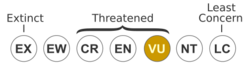
Anacyclus pyrethrum, the pellitory, Spanish chamomile, Mount Atlas daisy, bertram, or Akarkara, is a species of flowering plant in the daisy family Asteraceae.[4] It is native to Mediterranean Europe and parts of North Africa, but also naturalised in other parts of Europe, India and Pakistan.[5] This herbaceous perennial resembles chamomile species in habitat and appearance.
The plants known as pellitory-of-the-wall and spreading pellitory belong to a different family, the nettles (Urticaceae).
Names
Although one might assume from the specific epithet pyrethrum that this plant contains pyrethrins, it does not.[6] Both pyrethrum and "pellitory" derive ultimately from the ancient Greek for "fire" (πῦρ).[7]
Vernacular names
Anacyclus pyrethrum is known by various regional names in India and is commonly used in traditional systems like Ayurveda and Unani medicine.
| Language | Vernacular Name | Script |
|---|---|---|
| Hindi | Akarkara | अकरकरा |
| Sanskrit | Akalla | आकल्ल |
| Sanskrit | Ākārakarabha | आकारकरभ |
| Urdu | Aqarqarha | اقرقرحا |
| Tamil | Akkirakaram | அக்கிரகரம் |
| Telugu | Akarkara | అకర్కర |
| Kannada | Akarkara | ಅಕಾರ್ಕರ |
| Malayalam | Akarkaram | അകര്കാരം |
Cultivation
Anacyclus pyrethrum var. depressus (sometimes considered a separate species, Anacyclus depressus), called mat daisy or Mount Atlas daisy, is grown as a spring-blooming, low-water ornamental. It produces mats of grey-green, ferny foliage and single daisy-like white flowers. It is suitable for growing in an alpine or rock garden. It has gained the Royal Horticultural Society's Award of Garden Merit.[10]
-
 Var. depressus
 -
 same plant, flower detail
 -
 Var. depressus, flowers closed


Medicinal uses
Extracts of Anacyclus pyrethrum have anabolic activity in mice and also increase testosterone in the animal model.[11][12]
Ayurveda and Siddha medical traditions in India use it for diseases of the abdomen, sciatica, cough and others.[13] It is called Akkal-Kara in Hindi, Akkal Kadha in Marathi, Akkala-karra Malayalam, Akkarkkara (അകർക്കാര)(Telugu: అక్కలకఱ్ఱ)[14] and Akkarakaaram (Tamil: அக்கரகாரம்). A kind of oil is prepared by a method known as pit extraction (Tamil: குழி எண்ணெய்).
In The Perfumed Garden (from 15th century Tunisia), al-Nefzawi recommends pelleter taken externally as an ointment on the penis and scrotum or internally to enhance sexual pleasure and enhance erection (ch. 13, 15, 17).
References
- ↑ Rankou, H.; Ouhammou, A.; Taleb, M.; Manzanilla, V.; Martin, G. (2015). "Anacyclus pyrethrum". The IUCN Red List of Threatened Species (2015). doi:10.2305/IUCN.UK.2015-4.RLTS.T202924A53798702.en.
- ↑ "Details for: Anacyclus pyrethrum". Euro+Med PlantBase. Freie Universität Berlin. http://ww2.bgbm.org/EuroPlusMed/PTaxonDetail.asp?NameId=117602&PTRefFk=7000000. Retrieved 2008-06-16.
- ↑ "Anthemis pyrethrum record n° 135636". African Plants Database. South African National Biodiversity Institute, the Conservatoire et Jardin botaniques de la Ville de Genève and Tela Botanica. http://www.ville-ge.ch/cjb/bd/africa/details.php?langue=an&id=135636. Retrieved 2008-06-16.
- ↑ Brickell, Christopher, ed (2008). The Royal Horticultural Society A-Z Encyclopedia of Garden Plants. United Kingdom: Dorling Kindersley. ISBN 9781405332965.
- ↑ {{citation | mode = cs1 | title = Anacyclus pyrethrum | work = Germplasm Resources Information Network (GRIN) | url = | publisher = [[Organization:Agricultural Research ServAgricultural Research Service (ARS), United States Department of Agriculture (USDA) | access-date = }}
- ↑ "pyrethrum | Definition, Description, Insecticide, & Species" (in en). https://www.britannica.com/plant/pyrethrum.
- ↑ Shorter Oxford English Dictionary (6th ed.). United Kingdom: Oxford University Press. 2007. pp. 3804. ISBN 9780199206872.
- ↑ Nadkarni, K. M. (2002). Indian Materia Medica. 1. Popular Prakashan. pp. 60–61. ISBN 978-8171548194.
- ↑ Warrier, P. K. (1993). Indian Medicinal Plants: A Compendium of 500 Species. 1. Orient Longman. pp. 49–50. ISBN 978-0-86311-464-9.
- ↑ "RHS Plantfinder - Anacyclus pyrethrum var. depressus". Royal Horticultural Society. https://www.rhs.org.uk/Plants/89205/i-Anacyclus-pyrethrum-i-var-i-depressus-i/Details. Retrieved 12 January 2018.
- ↑ "Scientia Pharmaceutica". Archived from the original on 2011-10-03. https://web.archive.org/web/20111003111346/http://www.scipharm.at/download.asp?id=346. Retrieved 2011-07-31.
- ↑ Sharma, Vikas; Boonen, Jente; Spiegeleer, Bart De; Dixit, V. K. (January 2013). "Androgenic and Spermatogenic Activity of Alkylamide-Rich Ethanol Solution Extract of DC". Phytotherapy Research 27 (1): 99–106. doi:10.1002/ptr.4697. PMID 22473789.
- ↑ Khare, C.P. (2016). Ayurvedic Pharmacopoeial Plant Drugs. Boca Raton, FL: CRC Press. pp. 54-55. ISBN 978-1-4665-9000-7.
- ↑ "Akkala-karra; అక్కలకర, అక్కలకఱ్ఱ, అక్కలగర : శంకరనారాయణ తెలుగు-ఇంగ్లీష్ నిఘంటువు 1953". https://andhrabharati.com/dictionary/index.php?w=%E0%B0%85%E0%B0%95%E0%B1%8D%E0%B0%95%E0%B0%B2%E0%B0%95%E0%B0%B1%E0%B1%8D%E0%B0%B1.
External links
- UniProt. "Anacyclus pyrethrum". https://www.uniprot.org/taxonomy/159698.
- M. Grieve (1931). "Pellitory". A Modern Herbal. © Copyright Protected 1995-2008 Botanical.com. Archived from the original on 9 July 2008. https://web.archive.org/web/20080709010532/http://www.botanical.com/botanical/mgmh/p/pellit19.html. Retrieved 2008-06-16.
Wikidata ☰ Q1855185 entry
pl:Bertram lekarski
 |  |


