Biology:Aristolochia rotunda
| Smearwort | |
|---|---|

| |
Scientific classification 
| |
| Kingdom: | Plantae |
| Clade: | Tracheophytes |
| Clade: | Angiosperms |
| Clade: | Magnoliids |
| Order: | Piperales |
| Family: | Aristolochiaceae |
| Genus: | Aristolochia |
| Species: | A. rotunda
|
| Binomial name | |
| Aristolochia rotunda | |
Aristolochia rotunda, commonly known as smearwort or round-leaved birthwort, is a herbaceous perennial tuberous plant native to Southern Europe.
Etymology
Description

It grows to 20–60 centimetres (8–24 in) long, with slender, glabrescent, unbranched or branched stems. The root, a tuber, reaches 5–25 cm (2–10 in) in length and sometimes seems out of proportion to the slenderness of the plant. The stem has alternate, large, smooth-edged, heart-shaped, stalkless leaves 4–6 cm (1.6–2.4 in) long that clasp the stem with enlarged, basal lobes. The solitary flowers are tubular, about 2.5–5 centimetres (1–2 in) long, yellowish-green with a prominent, dark brown to dark purple flap, arising from the axils of the leaves; they have an unpleasant smell. The flowering period extends from April to June.[1]
Reproduction
This species is a host plant of the caterpillars of an uncommon butterfly, the southern festoon Zerynthia polyxena.[2] In eating the leaves of the plant, the larvae this insect ingest aristolochic acid that make them poisonous to birds.
Distribution
This plant is common in Mediterranean countries from Spain east to European Turkey.[3] It is naturalised very locally in southern England.[4]
Subspecies
Three subspecies are accepted:[3]
- Aristolochia rotunda subsp. rotunda (autonym)
- Aristolochia rotunda subsp. insularis (E.Nardi & Arrigoni) Gamisans
- Aristolochia rotunda subsp. reichsteinii E.Nardi
Habitat
This plant occurs along the banks of canals, edges of ditches and fields, sides of roads, meadows, slopes and forests. It prefers chalky soils and moist, shady areas, and grows at altitudes of 0–800 metres (0–2,625 ft) above sea level.
Chemical constituents
A. rotunda contains aristolochic acids which are carcinogenic, mutagenic, and nephrotoxic.[5]
Gallery
-
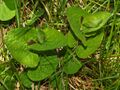 Plants of Aristolochia rotunda
 -
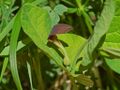 Flower of Aristolochia rotunda
 -
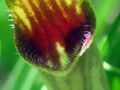 The small hairs inside the cup
 -
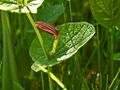 Flower and leaf of Aristolochia rotunda
 -
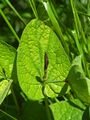 Leaf of Aristolochia rotunda


References
- ↑ "eFlore" (in fr). https://www.tela-botanica.org/eflore/?referentiel=bdtfx&module=fiche&action=fiche&num_nom=6466&onglet=synthese.
- ↑ Whalley, Paul Ernest Sutton (1981-01-01). The Mitchell Beazley Guide to Butterflies. p. 24. ISBN 0-85533-348-0.
- ↑ 3.0 3.1 "Aristolochia rotunda L." (in en). Royal Botanic Gardens, Kew. http://www.plantsoftheworldonline.org/taxon/93291-1.
- ↑ "Smearwort Aristolochia rotunda L.". https://plantatlas2020.org/atlas/2cd4p9h.kay.
- ↑ "Plants Containing Aristolochic Acid". International Agency for Research on Cancer. http://monographs.iarc.fr/ENG/Monographs/vol100A/mono100A-23.pdf.
Additional references
- Pignatti S. - Flora d'Italia - Edagricole – 1982, Vol. I, pag 135
- Tutin, T.G. et al. - Flora Europaea, second edition - 1993
- Björn Rulika, Stefan Wankeb, Matthias Nussa and Christoph Neinhuisb Pollination of Aristolochia pallida Willd. (Aristolochiaceae) in the Mediterranean - Flora - Morphology, Distribution, Functional Ecology of Plants - Volume 203, Pages 175-184
External links
 Data related to Aristolochia rotunda at Wikispecies

Wikidata ☰ Q2861412 entry
 |  |


