Biology:Aristolochia trilobata
| Aristolochia trilobata | |
|---|---|
| File:Flore des serres v14 021a.jpg | |
Scientific classification 
| |
| Kingdom: | Plantae |
| Clade: | Tracheophytes |
| Clade: | Angiosperms |
| Clade: | Magnoliids |
| Order: | Piperales |
| Family: | Aristolochiaceae |
| Genus: | Aristolochia |
| Species: | A. trilobata
|
| Binomial name | |
| Aristolochia trilobata | |
Aristolochia trilobata, commonly known as contribo[citation needed] or Bejuco de Santiago,[2] is a perennial herb in the Dutchman's pipe family Aristolochiaceae. A.trilobata is endemic to the Caribbean and is found in both Central America and South America.[1]
Description
Aristolochia trilobata is a climbing vine species that typically reaches a length of up to three meters. The leaves are characterized by dark green coloration and have three lobes. The bark is coarse, readily sheds, and emits a distinctive, potent odor.[citation needed]
In traditional folk medicine, the whole plant is used to create a tea or an extract. It is recommended to consume the tea in moderation (once a week) to prevent other health complications. Teas and extracts are known to increase immune health, increase appetite/energy, and fight fatigue.[citation needed] It has been commonly used to treat conditions such as flu, gastritis, parasites, fevers, constipation, stomach ache, and indigestion.[3]
Habitat
Aristolochia trilobata is a tropical plant native to the Caribbean. Its populations extend from Mexico to Brazil and grows best in a wet, tropical climate.[4]
Conservation
Some herbalists in Belize claim that it is harder to find an abundance of A. trilobata due to habitat destruction.[citation needed]
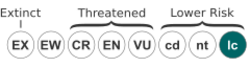
However, the International Union for Conservation of Nature (IUCN) most recently (December 2020) assessed the status of A. trilobata as "Least Concern (LC)".[1]
References
- ↑ 1.0 1.1 1.2 Bárrios, S.; Copeland, A. (2021). "Aristolochia trilobata". IUCN Red List of Threatened Species 2021. doi:10.2305/IUCN.UK.2021-3.RLTS.T170643357A192146840.en. https://www.iucnredlist.org/species/170643357/192146840. Retrieved 20 April 2024.
- ↑ "Aristolochia trilobata". ITIS. https://www.itis.gov/servlet/SingleRpt/SingleRpt?search_topic=TSN&search_value=18330#null.
- ↑ Balick, Michael J. (1996). "Transforming Ethnobotany for the New Millennium". Annals of the Missouri Botanical Garden 83 (1): 63. doi:10.2307/2399968.
- ↑ "Aristolochia trilobata L.". Royal Botanic Gardens, Kew. http://powo.science.kew.org/taxon/urn:lsid:ipni.org:names:319092-2.
Wikidata ☰ Q15290494 entry
 |  |


