Biology:Artocarpus nobilis
| Ceylon breadfruit | |
|---|---|

| |
Scientific classification 
| |
| Kingdom: | Plantae |
| Clade: | Tracheophytes |
| Clade: | Angiosperms |
| Clade: | Eudicots |
| Clade: | Rosids |
| Order: | Rosales |
| Family: | Moraceae |
| Genus: | Artocarpus |
| Species: | A. nobilis
|
| Binomial name | |
| Artocarpus nobilis Thwaites
| |
| Synonyms | |
| |
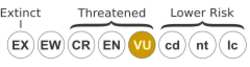
Artocarpus nobilis, the Ceylon breadfruit, is a tree species in the family Moraceae. It is endemic to south western regions of Sri Lanka. It is known as wal dhel (වල් දෙල්), baedi dhel (බැදි දෙල්) or hingala dhel (හිංගල දෙල්)[3] by local people.
The plant is known to be infected by Rigidoporus microporus to cause white root disease. This is the first time that the pathogen was found instead of Hevea brasiliensis.[4]
Description
Ceylon breadfruit is an evergreen plant with about 25m height. The seeds and fruits are used for medicinal purposes for the worm diseases caused by nematode Ascaris lumbricoides.[5]
Chemistry
Artocarpus nobilis contains prenylated flavonoids, xanthonoids in its root bark,[6] geranylated phenolic compounds in its fruits,[7] geranyl chalcones in its leaves[8] and pyranodihydrobenzoxanthones isolated from the bark.[9]
References
- ↑ World Conservation Monitoring Centre (1998). "Artocarpus nobilis". IUCN Red List of Threatened Species 1998. doi:10.2305/IUCN.UK.1998.RLTS.T30865A9578329.en. https://www.iucnredlist.org/species/30865/9578329. Retrieved 17 November 2021.
- ↑ "Artocarpus nobilis Thwaites — the Plant List". http://www.theplantlist.org/tpl/record/kew-2654041.
- ↑ "Biodiversity of Sri Lanka: වල් දෙල්/බැදි දෙල්/හිංගල දෙල්[Wal del/Bedi-del]/Hingala-del (Artocarpus nobilis)". 2012-06-17. http://biodiversityofsrilanka.blogspot.com/2012/06/wal-delbedi-delhingala-del-artocarpus.html.
- ↑ Madushani, HKI; Fernando, Thps; Wijesundara, RLC; Siriwardane, D. (2014). "First Report of white root disease of Artocarpus nobilis in Sri Lanka caused by Rigidoporus microporus". Journal of the National Science Foundation of Sri Lanka 42 (2): 197. doi:10.4038/jnsfsr.v42i2.6998.
- ↑ "Ayurvedic Plants of Sri Lanka: Plants Details". http://www.instituteofayurveda.org/plants/plants_detail.php?i=854&s=Family_name.
- ↑ Jayasinghe, U.L.B.; Samarakoon, T.B.; Kumarihamy, B.M.M.; Hara, N.; Fujimoto, Y. (2008). "Four new prenylated flavonoids and xanthones from the root bark of Artocarpus nobilis". Fitoterapia 79 (1): 37–41. doi:10.1016/j.fitote.2007.07.014. INIST:19972501. PMID 17855020.
- ↑ Jayasinghe, Lalith; Rupasinghe, G. Kalinga; Hara, Noriyuki; Fujimoto, Yoshinori (2006). "Geranylated phenolic constituents from the fruits of Artocarpus nobilis". Phytochemistry 67 (13): 1353–1358. doi:10.1016/j.phytochem.2006.04.011. INIST:18043180. PMID 16730759. Bibcode: 2006PChem..67.1353J.
- ↑ Jayasinghe, Lalith; Balasooriya, B. A.; Padmini, W. Chintha; Hara, Noriyuki; Fujimoto, Yoshinori (May 2004). "Geranyl chalcone derivatives with antifungal and radical scavenging properties from the leaves of Artocarpus nobilis". Phytochemistry 65 (9): 1287–1290. doi:10.1016/j.phytochem.2004.03.033. PMID 15184014. Bibcode: 2004PChem..65.1287J. https://www.sciencedirect.com/science/article/abs/pii/S0031942204001487.
- ↑ Uvais, M.; Sultanbawa, S.; Surendrakumar, Sivagnanasundram (1989). "Two pyranodihydrobenzoxanthones from Artocarpus nobilis". Phytochemistry 28 (2): 599–605. doi:10.1016/0031-9422(89)80059-7. Bibcode: 1989PChem..28..599U.
External links
Wikidata ☰ Q4801380 entry
 |  |


