Biology:Asplenium monanthes
| Asplenium monanthes | |
|---|---|
| File:Asplenium monanthes (1).jpg | |
| Asplenium monanthes pinnae with single sori | |
Scientific classification 
| |
| Kingdom: | Plantae |
| Clade: | Tracheophytes |
| Division: | Polypodiophyta |
| Class: | Polypodiopsida |
| Order: | Polypodiales |
| Suborder: | Aspleniineae |
| Family: | Aspleniaceae |
| Genus: | Asplenium |
| Species: | A. monanthes
|
| Binomial name | |
| Asplenium monanthes L.
| |
| Synonyms[2] | |
| |
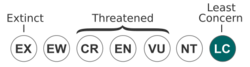
Asplenium monanthes, the single-sorus spleenwort, is a fern native to parts of Africa, islands in the Atlantic, the Americas and Hawaii. It belongs to the family Aspleniaceae.[2]
Description
Here are key features of Asplenium monanthes:[2][3]
- The erect-standing leaves' rachises are reddish dark-brown/blackish throughout, shiny and hairless.
- The once pinnately-divided leaves usually are up to 60 cm (24 in) long, but mostly about half that, and up to around 3 cm (1 in) wide. The leaves' 10-45 pairs of subdivisions, or pinnae, are strongly asymmetric, somewhat trapezoidal, the leaf's middle ones up to 17 mm (5⁄8 in) long and 8 mm (5⁄16 in) wide, though typically smaller, with bases rounded to diminishing gradually to the attachment point. Pinna margins facing the leaf tip are toothed, while margins on the pinnae's lower side are toothless.
- A single sorus (rarely up to 3) occurs on each fertile pinna, always near the lower, toothless margin. Sori are slender to oval in outline, with a narrow, silvery scale or film of tissue, the "indusium," running along the pinna's lower margin. When the spore-producing sporangia are mature, they may hide the indusium.
At some locations the above details still may not be enough to distinguish Asplenium monanthes from similar species in the area. An obscure feature possibly helping to confirm the identity is that sometimes along the length of the rachis, two very narrow, silvery, filmy "wings" can be observed, especially with magnification; these are barely visible in images on this page.[4] Also, these filmy wings' margins do not bear tiny, pimple-like bumps, but rather are entire or slightly notched.[5]
Distribution
Asplenium monanthes displays a scattered distribution. In the United States, it occurs in the southern states of Arizona, North and South Carolina, Alabama and Florida, plus Hawaii. In the Caribbean, it inhabits the islands of Jamaica and Hispaniola. In Mexico it occurs nearly throughout, though not in the Yucatan Peninsula. In Central America, it is found in Guatemala, El Salvador, Honduras, Nicaragua, Costa Rica and Panama. In South America, it inhabits Colombia, Venezuela, Ecuador, Peru, Bolivia, Brazil, Uruguay and Argentina. In Africa, it is found in Cameroon, Rwanda, Sudan, Ethiopia, Somalia, Uganda, Kenya, Tanzania, Malawi, Zimbabwe, South Africa, Lesotho and Madagascar. The spleenwort also appears in the Azores, Madeira, Canary Islands, Bioko, Gough Island and Tristan da Cunha.[6]
Habitat
In central Mexico at elevations of 1,400–2,300 m (4,600–7,500 ft) Asplenium monanthes inhabits forests with pine and oak, cloud forests, and secondary vegetation derived from those forests.[5] In Africa it is found on shaded floors in evergreen forests, often near streams, bamboo or podocarpus forest, and less often in forests along rivers or in heath zones near streams.[3] In North Carolina, it is described as a species of grottos and waterfalls requiring shade, high humidity or moist rock faces, and a cool microclimate. Though elsewhere usually it appears on limestone, here mainly it occurs in cracks and crevices of grantic rock.[7]
Uses by humans
In traditional medicine
In Mexico's Sonora state women of the Guarijio people take a "tea" of Asplenium monanthes to stop menstruation and as a contraceptive.[8]
As an ornamental
In Mexico's Michoacán state people in the high-elevation forest area of Nuevo San Juan Parangaricutiro use potted Asplenium monanthes as ornamental ferns during ceremonies.[9]
Taxonomy
In 1767, Carl Linnaeus described and named Asplenium monanthes using the name it still has, noting that his type specimen originated from Africa's Cape of Good Hope (written as "Cap. b. spei", shorthand for "Caput Bonae Spei").[10]
Varieties
In 2026 these two varieties were accepted:[2]
- Asplenium monanthes var monanthes
- Asplenium monanthes var wagneri (Kuhn) Stolze
The Asplenium monanthes fern complex
Asplenium monanthes is part of an "Asplenium monanthes complex" comprising 22 species occurring mainly in Mesoamerica, with its center of diversity in southern Mexico. The complex is part of the "black-stemmed" spleenwort group, which also includes the Asplenium normale and Asplenum trichomanes Complexes.[11]
Genetics and evolution
Asplenium monanthes is apomictic. This apogamy apparently has evolved independently multiple times, and has facilitated reticulate evolution. Moreover, the species is triploid and possibly sometimes tetraploid.[11]
Etymology
The genus name Asplenium is based on the Greek splen, meaning "spleen," because Dioscorides thought that a fern or ferns in the genus was useful for treating diseases of the spleen.[12] In the common name "spleenwort," the -wort is from Old English wyrt, meaning "plant, root,"[13] thus "a plant for the spleen."
The species name monanthes is based on the Greek monos, meaning "single, alone"[14] and the Greek anthos, meaning "flower".[15] In this case, an extended meaning of "flower" is conjured, that of "reproductive structure"—the fern's sorus. Thus, "a single sorus," aptly describing the single-sorus spleenwort.
References
- ↑ "Single-sorus fern". International Union for Conservation of Nature and Natural Resources. 2018. https://www.iucnredlist.org/species/83489970/83490214.
- ↑ 2.0 2.1 2.2 2.3 Wagner Jr., H.; Moran, Robbin C.; Werth, Charles R.. "Asplenium monanthes Linnaeus. In Flora of North America North of Mexico (FNA)". St. Louis, MO & Harvard University Herbaria, Cambridge, MA, USA: New York and Oxford: Oxford University Press via eFloras.org. http://www.efloras.org/florataxon.aspx?flora_id=1&taxon_id=200004143.
- ↑ 3.0 3.1 Ballings, Petra. "Asplenium monanthes L.". https://www.fernsofafrica.com/blank-species.php?species_id=102620.
- ↑ "Asplenium monanthes L." (in English and Spanish {descriptions}). published on the Internet from various floras. https://www.worldfloraonline.org/taxon/wfo-0001108056.
- ↑ 5.0 5.1 Madrigal González, Daniel; Bedolla García, Brenda Yudith (2022). "Familia Aspleniaceae" (in Spanish). Flora del Bajío y de Regiones Adyacentes (Pátzcuaro, Michoacán, México: Instituto de Ecología, A.C. (INECOL)) 229: 22–28. https://libros.inecol.mx/index.php/FB/catalog/view/2022.229/702/3643. Retrieved February 19, 2026.
- ↑ Hassler, Michael (August 2, 2026). "Search: Asplenium monanthes L (Loes.) Lundell". Germany: World Plants. https://www.worldplants.de/world-plants-complete-list/complete-plant-list/?name=Asplenium-monanthes#plantUid-14427.
- ↑ LeGrand, Harry; Sorrie, Bruce; Howard, Tom. "Search: Account for Single-sorus Spleenwort - Asplenium monanthes L.". Raleigh, NC, USA: North Carolina Biodiversity Project and North Carolina State Parks. https://auth1.dpr.ncparks.gov/flora/plant_list.php.
- ↑ "Flora Medicinal Guarijía de Sonora" (in Spanish). Mexico City, Mexico: Universidad Nacional Autónoma de México. 2009. http://www.medicinatradicionalmexicana.unam.mx/fmim/termino.php?l=4&p=guarijia&cr=6&t=flor-piedra&id=178.
- ↑ Bello-González, Miguel Ángel; Hernández-Moñpz, Selene; Lara-Chávez, María Blanca Nieves; Salgado-Garciglia, Rafael (2015). "Plantas Útiles de la Comunidad Indígena Nuevo San Juan Parangaricutiro, Michoacán, México" (in Spanish with English abstract). Polibotánica (Mexico City, Mexico: Instituto Politécnico Nacional) 39: 175–215. ISSN 1405-2768. https://www.scielo.org.mx/pdf/polib/n39/n39a10.pdf.
- ↑ Linnaeus, Carl (1767) (in Latin). Mantissa plantarum. pp. 130. https://bibdigital.rjb.csic.es/viewer/10315/?offset=#page=10&viewer=picture&o=bookmark&n=0&q=. Retrieved August 31, 2026.
- ↑ 11.0 11.1 Dyer, Robert J.; Savolainen, Vincent; Schneider, Harald (August 7, 2012). "Apomixis and reticulate evolution in the Asplenium monanthes fern complex". Annals of Botany. doi:10.1093/aob/mcs202. https://www.researchgate.net/profile/Harald-Schneider-2/publication/230864722_Apomixis_and_reticulate_evolution_in_the_Asplenium_monanthes_fern_complex/links/0c96051ba0150a8d15000000/Apomixis-and-reticulate-evolution-in-the-Asplenium-monanthes-fern-complex.pdf. Retrieved August 31, 2026.
- ↑ Wagner Jr., H.; Moran, Robbin C.; Werth, Charles R.. "Asplenium Linnaeus Boeckeler. In Flora of North America North of Mexico (FNA)". St. Louis, MO & Harvard University Herbaria, Cambridge, MA, USA: New York and Oxford: Oxford University Press via eFloras.org. http://www.efloras.org/florataxon.aspx?flora_id=1&taxon_id=102877.
- ↑ "wort". Dictionary Media Group, Inc. https://www.dictionary.com/browse/wort.
- ↑ "mon". Merriam-Webster, Incorporated. https://www.merriam-webster.com/dictionary/mon-.
- ↑ "-anthes noun combining form". Merriam-Webster, Incorporated. https://www.merriam-webster.com/dictionary/anthes.
Wikidata ☰ Q15597395 entry
 |  |


