Biology:Austroagrion cyane
| South-western billabongfly | |
|---|---|
Scientific classification 
| |
| Kingdom: | Animalia |
| Phylum: | Arthropoda |
| Class: | Insecta |
| Order: | Odonata |
| Suborder: | Zygoptera |
| Family: | Coenagrionidae |
| Genus: | Austroagrion |
| Species: | A. cyane
|
| Binomial name | |
| Austroagrion cyane (Selys, 1876)[2]
| |

| |
| Synonyms[3] | |
| |
Austroagrion cyane, the south-western billabongfly,[4] is a species of damselfly of the family Coenagrionidae.[5] Despite their common name, they have been found not only in south-western Australia,[4] but also in diverse locations across Australia.[6]
Habit & Habitat
Austroagrion cyane are permanent residents of aquatic habitats. They prefer slow-moving water. Adults grow to around 20-30 mm in length. Females are less common than males and are mostly attracted to ephemeral swamps.[7]
Etymology
The genus name Austroagrion combines the prefix austro- (from Latin auster, meaning "south wind", hence "southern") with Agrion, a genus name derived from Greek ἄγριος (agrios, "wild"). Austroagrion thus refers to a southern representative of that group.[8]
The species name cyane is derived from Greek κυανῆ (kyanē, "dark blue"), referring to its distinctive blue colouring.[9]
Gallery
-
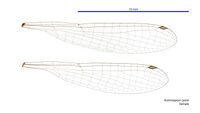 Female wings
 -
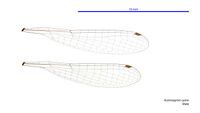 Male wings
.jpg)
.jpg)
References
- ↑ Dow, R.A. (2017). "Austroagrion cyane". IUCN Red List of Threatened Species 2017. doi:10.2305/IUCN.UK.2017-1.RLTS.T14263010A59256493.en. https://www.iucnredlist.org/species/14263010/59256493. Retrieved 20 November 2021.
- ↑ Selys-Longchamps, E. (1876). "Synopsis des Agrionines, 5me légion: Agrion (suite). Le grand genre Agrion" (in French). Bulletin de la Classe des Science, Académie Royale de Belgique 42: 490–531, 952–991 [508]. https://www.biodiversitylibrary.org/page/34716940.
- ↑ "World Odonata List". University of Puget Sound. https://www.pugetsound.edu/academics/academic-resources/slater-museum/biodiversity-resources/dragonflies/world-odonata-list2/.
- ↑ 4.0 4.1 Günther Theischinger & John Hawking (2006). The Complete Field Guide to Dragonflies of Australia. CSIRO Publishing. p. 92. ISBN 978-0-643-09073-6. https://books.google.com/books?id=_ega6FdnwZ0C&pg=PA92.
- ↑ "Species Austroagrion cyane (Selys, 1876)". Australian Biological Resources Study. 2012. https://biodiversity.org.au/afd/taxa/Austroagrion_cyane.
- ↑ "Austroagrion cyane (Selys, 1876)". 2017. http://bie.ala.org.au/species/urn:lsid:biodiversity.org.au:afd.taxon:0cb18aba-116d-465d-94e6-784ecd86f7e4.
- ↑ "South-western Billabongfly - Austroagrion cyane". 14 March 2010. http://esperancewildlife.blogspot.in/2010/03/south-western-billabongfly-austroagrion.html.
- ↑ Endersby, Ian (2012). "Etymology of the Dragonflies (Insecta: Odonata) named by R.J. Tillyard, F.R.S.". Proceedings of the Linnean Society of New South Wales 134: 1-16. https://openjournals.library.sydney.edu.au/LIN/article/view/5941.
- ↑ Endersby, Ian; Fliedner, Heinrich (2015). The Naming of Australia's Dragonflies. Eltham, Victoria, Australia: Busybird Publishing. ISBN 9781925260625. https://www.researchgate.net/publication/283318421_The_Naming_of_Australia's_Dragonflies.
 |
Wikimedia Commons has media related to Austroagrion cyane. |
Further reading
- "Austroagrion cyane (Selys, 1876)". Atlas of Living Australia. http://bie.ala.org.au/species/urn:lsid:biodiversity.org.au:afd.taxon:fea991c8-ec08-4b41-90d2-000dbf66e821.
- Herbert Campion (1915). "A new Agrionine dragonfly from Northern Australia". Annals and Magazine of Natural History. 8th ser. 16 (92): 105–108. doi:10.1080/00222931508693694. https://www.biodiversitylibrary.org/part/60708#/summary.
- D. F. Waterhouse (1954). "The rate of production of the peritrophic membrane in some insects". Australian Journal of Biological Sciences 7 (1): 59–72. doi:10.1071/BI9540059. PMID 13159751. http://www.publish.csiro.au/?act=view_file&file_id=BI9540059.pdf.
Wikidata ☰ Q2290252 entry
 |  |


