Biology:Blue-spotted hawker
| Blue-spotted hawker | |
|---|---|

| |
| Female | |
.jpg)
| |
| Male | |
Scientific classification 
| |
| Kingdom: | Animalia |
| Phylum: | Arthropoda |
| Class: | Insecta |
| Order: | Odonata |
| Infraorder: | Anisoptera |
| Family: | Aeshnidae |
| Genus: | Adversaeschna Watson, 1992[3] |
| Species: | A. brevistyla
|
| Binomial name | |
| Adversaeschna brevistyla (Rambur, 1842)[2]
| |

| |
| Synonyms[4] | |
| |

The blue-spotted hawker (Adversaeschna brevistyla) is the only known species of dragonfly of the genus Adversaeschna in the family Aeshnidae.[5][4][6] They are also known as the Lancer Dragonfly.[1] Their scientific name was formerly Aeschna brevistyla but was relatively recently changed to be Adversaeschna brevistyla [7]
Appearance
The blue-spotted hawker is a large dragonfly with a pair of pale stripes on either side of the thorax. At the base of the thorax, they have two symmetrical bright-blue stripes. The fore-edges of the wings are a pale orange with the color ending at the pterostigma, which is a reddish-brown. [7] Mature males have blue eyes whilst females have brown eyes.
Distribution and Habitat
The blue-spotted hawker is widespread across Australia, New Zealand and some Pacific Islands.[5]
It may be found near ponds and marshes as well as vegetation far from water.[5] It prefers still water but may also be found along calm streams.[7]
Conservation Status
As of 2019, they were marked as least concern in their risk of being threatened. [1]
Etymology
The genus name Adversaeschna combines the Latin adversus ("opposite" or "set apart") with -aeschna, a suffix commonly used for dragonflies associated with the Aeshna group. The name refers to the isolated taxonomic position of this genus.[3][8]
The species name brevistyla is derived from the Latin brevis ("short") and stylus ("stake" or "pointed instrument"), referring to the short appendages, historically referred to as styli.[2][8]
Gallery
-
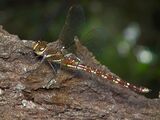 Female side view
 -
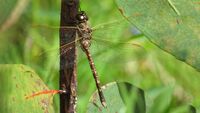 Female
 -
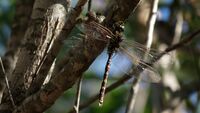 Male
Male -
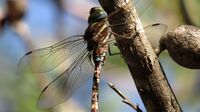 Male body detail
 -
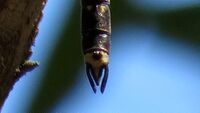 Male terminal abdominal appendages
 -
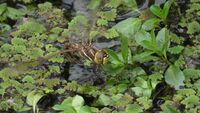 Female ovipositing, depositing her eggs in a dam
 -
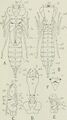 Larva
Larva -
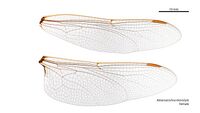 Female wings
 -
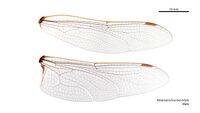 Male wings

.jpg)
.jpg)
.jpg)
.jpg)
.jpg)
_(1917)_(20194232190).jpg)
.jpg)
.jpg)
References
- ↑ 1.0 1.1 1.2 Rowe, R.; Marinov, M. (2020). "Adversaeschna brevistyla". IUCN Red List of Threatened Species 2020. doi:10.2305/IUCN.UK.2020-1.RLTS.T197095A83372228.en. https://www.iucnredlist.org/species/197095/83372228. Retrieved 19 November 2021.
- ↑ 2.0 2.1 Rambur, Jules (1842) (in fr). Histoire naturelle des insectes. Névroptères. Paris: Librairie Encyclopédique de Roret. pp. 534 [205]. http://gallica.bnf.fr/ark:/12148/bpt6k61025298/f227.image.
- ↑ 3.0 3.1 Watson, J.A.L. (1992). "The affinities of Aeshna brevistyla (Rambur) (Anisoptera: Aeshnidae)". Odonatologica 21 (4): 453–471 [470]. http://natuurtijdschriften.nl/record/592010.
- ↑ 4.0 4.1 "World Odonata List". University of Puget Sound. https://www.pugetsound.edu/academics/academic-resources/slater-museum/biodiversity-resources/dragonflies/world-odonata-list2/.
- ↑ 5.0 5.1 5.2 Daley, Elizabeth (2007). Wings: An introduction to Tasmania's winged insects. Riffles Pty Ltd..
- ↑ "Species Adversaeschna brevistyla (Rambur, 1842)". Australian Biological Resources Study. 2012. https://biodiversity.org.au/afd/taxa/Adversaeschna_brevistyla.
- ↑ 7.0 7.1 7.2 Chew, Peter (2009-01-21). "Blue-spotted Hawker - Adversaeschna brevistyla". Brisbane Insects and Spiders. http://www.brisbaneinsects.com/brisbane_dragons/BlueSpotted.htm.
- ↑ 8.0 8.1 Endersby, Ian; Fliedner, Heinrich (2015). The Naming of Australia's Dragonflies. Eltham, Victoria, Australia: Busybird Publishing. ISBN 9781925260625. https://www.researchgate.net/publication/283318421_The_Naming_of_Australia's_Dragonflies.
 |
Wikispecies has information related to Adversaeschna brevistyla |
Wikidata ☰ Q1375679 entry
 |  |


