Biology:Canavalia rosea
| Coastal jack-bean | |
|---|---|
| File:Canavalia rosea 01.jpg | |
Scientific classification 
| |
| Kingdom: | Plantae |
| Clade: | Tracheophytes |
| Clade: | Angiosperms |
| Clade: | Eudicots |
| Clade: | Rosids |
| Order: | Fabales |
| Family: | Fabaceae |
| Subfamily: | Faboideae |
| Genus: | Canavalia |
| Species: | C. rosea
|
| Binomial name | |
| Canavalia rosea | |
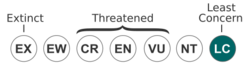

Canavalia rosea is a species of flowering plant of the genus Canavalia in the pea family of Fabaceae, it has a pantropical and subtropical distribution in upper beaches, cliffs, and dunes.[3][4] Common names include beach bean, bay bean, sea bean,[5] greater sea bean,[6] seaside jack-bean, coastal jack-bean,[2] and MacKenzie bean.[4]
Description
Vine
Coastal jack-bean is a trailing, herbaceous vine that forms mats of foliage. Stems reach a length of more than 6 m (20 ft) and 2.5 cm (0.98 in) in thickness. Each compound leaf is made up of three leaflets 3.0–15.0 cm (1.2–5.9 in) in diameter, which will fold themselves when exposed to hot sunlight.[5] It is highly salt-tolerant and prefers sandy soils.[4]
Flowers and pods
The flowers are purplish pink and 2.5–5.1 cm (0.98–2.01 in) long, they hang upside down from long stalks and produce a sweet smell.[5] The flat pods are straight or a little curved, 6.0–15.2 cm (2.4–6.0 in) long, their skin becoming prominently ridged as they mature. Each pod has between 2–10 brown seeds. The seeds are buoyant so they can be distributed by ocean currents.[4] The plant seems to contain L-Betonicine. The Canavalia rosea plant fruits and blooms all year long[1].
-
C. rosea pods and seeds
Uses
Young seeds and pods are edible, especially after boiling. The flowers can be made into a spice.[5]
References
- ↑ Bárrios, S.; Copeland, A. (2021). "Canavalia rosea". IUCN Red List of Threatened Species 2021. doi:10.2305/IUCN.UK.2021-3.RLTS.T65899681A192148107.en. https://www.iucnredlist.org/species/65899681/192148107. Retrieved 17 December 2022.
- ↑ 2.0 2.1 {{citation | mode = cs1 | title = Canavalia rosea | work = Germplasm Resources Information Network (GRIN) | url = | publisher = [[Organization:Agricultural Research ServAgricultural Research Service (ARS), United States Department of Agriculture (USDA) | access-date = 2010-12-04 }}
- ↑ Cite error: Invalid
<ref>tag; no text was provided for refs namedPOWO - ↑ 4.0 4.1 4.2 4.3 Christman, Steve (2004-01-14). "#857 Canavalia rosea". Floridata. http://www.floridata.com/ref/c/cana_ros.cfm.
- ↑ 5.0 5.1 5.2 5.3 Cite error: Invalid
<ref>tag; no text was provided for refs namedWS - ↑ Cite error: Invalid
<ref>tag; no text was provided for refs namedPaFoS
External links
 Data related to Canavalia rosea at Wikispecies
- Canavalia rosea at JSTOR Plant Science

Wikidata ☰ Q1317365 entry
 |  |


