Biology:Cedrela fissilis
| Cedrela fissilis | |
|---|---|
| File:Acaju-catinga (do tupi akaîukatinga), ou cedro-rosa, cedro, acaiacá. 03.jpg | |
| In Brazil | |
Scientific classification 
| |
| Kingdom: | Plantae |
| Clade: | Tracheophytes |
| Clade: | Angiosperms |
| Clade: | Eudicots |
| Clade: | Rosids |
| Order: | Sapindales |
| Family: | Meliaceae |
| Genus: | Cedrela |
| Species: | C. fissilis
|
| Binomial name | |
| Cedrela fissilis Vell.
| |
Cedrela fissilis is a species of tree in the family Meliaceae. It is native to Central and South America, where it is distributed from Costa Rica to Argentina.[2] Its common names include Argentine cedar,[2] cedro batata, cedro blanco, "Acaju-catinga" (its Global Trees entry) and cedro colorado.[1]
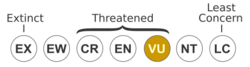
Once a common lowland forest tree, this species has been overexploited for timber and is now considered to be endangered. A few populations are stable, but many have been reduced, fragmented, and extirpated. The wood is often sold in batches with Cuban cedar (Cedrela odorata).[1]
Taxonomy
Original Description
Cedrela fissilis was first described by José Mariano da Conceição Vellozo in Florae Fluminensis (1829). The original protologue reads (translated):[3]
C. fissilis. Flowers in racemose, compound inflorescences; leaves hairy beneath. (Tab. 68.a T. 2) Observations. Both species yield timber of the highest quality for construction. It is said that on the Island of São Sebastião there stands a Cedrela of such enormous size that from it a boat (scapha) could be made measuring 11 palms in width. For this to be true, the trunk would necessarily have a circumference of 44 palms.
Taxonomic history
Cedrela brasiliensis was first described by Antoine Laurent de Jussieu in Flora Brasiliensis Meridionalis (1829), based on material collected in Minas Gerais, Brazil.[5] Jussieu distinguished a southern variant, var. australis, from specimens near Montevideo, noting denser pubescence on the branches, petioles, peduncles, and petals, and questioned whether this form might represent a distinct species. Both C. brasiliensis and its variety australis are now regarded as synonyms of C. fissilis.[6][7]
Gallery
-
 Stem
-
Leaves
-
Tree
-
Young tree
-
Leaflets

References
- ↑ 1.0 1.1 1.2 Barstow, M. (2018). "Cedrela fissilis". IUCN Red List of Threatened Species 2018. doi:10.2305/IUCN.UK.2018-1.RLTS.T33928A68080477.en. https://www.iucnredlist.org/species/33928/68080477. Retrieved 16 November 2021.
- ↑ 2.0 2.1 Cedrela fissilis. Germplasm Resources Information Network. USDA ARS.
- ↑ Vellozo, José Mariano da Conceição (1829) (in Latin). Florae Fluminensis. Rio de Janeiro: Typographia Nacional. p. 75. https://www.biodiversitylibrary.org/page/138228. "C. fissilis. C. floribus racemosis, compositis, foliis subtus pilosis. (Tab. 68.a T. 2)"
- ↑ Vellozo, José Mariano da Conceição (1829) (in Latin). Florae Fluminensis, Icones. 2. Rio de Janeiro: Typographia Nacional. p. 72. https://commons.wikimedia.org/w/index.php?title=File:Florae_Fluminensis_(Volume_02).pdf&page=72.
- ↑ Jussieu, Adrien-Henri (1829). Flora Brasiliensis Meridionalis. 2. Paris: A. St.-Hil.. pp. 86. https://www.biodiversitylibrary.org/page/31619740.
- ↑ "Cedrela brasiliensis var. australis A.Juss.". WCSP (in review). https://www.worldfloraonline.org/taxon/wfo-0000592392.
- ↑ "Cedrela fissilis Vell.". Royal Botanic Gardens, Kew. https://powo.science.kew.org/taxon/urn:lsid:ipni.org:names:577744-1.
https://globaltrees.org/threatened-trees/trees/acaju-catinga/
Wikidata ☰ Q936202 entry
 |  |


